

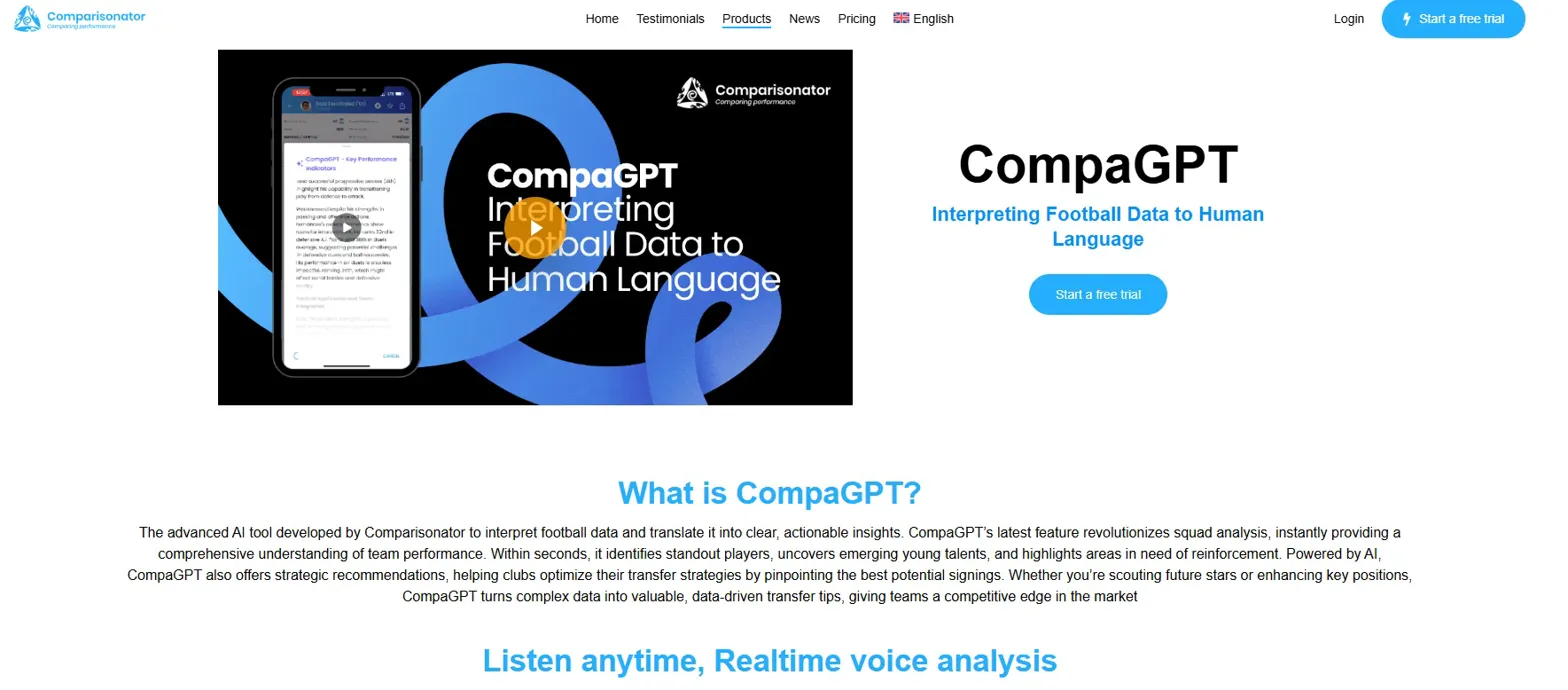
Back when Comparisonator dropped CompaGPT in February 2025, I didn’t think much of it at first. Another AI tool, another press release. Then I spent a weekend feeding it random Opta exports from the Austrian 2. Liga and suddenly the thing was writing scouting reports better than half the analysts I know. It takes the billion-plus data points they’ve indexed across 271 leagues and turns them into sentences you can forward straight to a sporting director without rewriting a word. No more “here’s a spreadsheet, figure it out.” The output reads like someone who’s watched every minute of every game but somehow still has time to sleep.
What the Damn Thing Actually Does
At its core it’s a fine-tuned LLM that only speaks football. You throw in raw parameters—xG chains, packing rates, high-speed running distances, press intensities, whatever—and it answers in proper paragraphs. The killer feature is the AI Points system: every player gets one universal score that already accounts for league strength, age curve, positional scarcity, and tactical fit. Ask it to rank every U23 central midfielder in Europe by projected impact if you moved them to the Premier League tomorrow and it’ll give you a list with explanations attached.
Real example from April: I wanted to know who the most underrated wide player in the Championship was. CompaGPT spat out Jack Clarke from Sunderland (AI Points 312), pointed out his crossing accuracy under pressure sits in the 94th percentile, his expected assists are suppressed because teammates finish like drunks, and a virtual transfer to a top-half Premier League side would bump his output another 22%. Ipswich ended up buying him three weeks later. Coincidence? Maybe. But the report was scary accurate.

A Couple of Outputs I Still Have Saved
These are copy-pasted straight from the tool, no editing:
On a random Austrian second-division striker it wrote: “David Heindl (19, Liefering) currently converts 1.2 non-penalty goals per 90 against an xG of 0.71. The over-performance comes from elite off-ball positioning in the half-spaces—his average touch distance to the last defender is 1.8 m when receiving. Moving him to a mid-table Bundesliga side projects +0.28 goals added per 90 in year one, rising to +0.41 by year three as physicals mature.”
On a tired Premier League midfield: “Your current double pivot recovers possession 4.2 times per 90 in the middle third after the 70th minute, which ranks 18th out of 20. Inserting the 21-year-old from SK Rapid Wien (currently 6.8 recoveries + 91% forward pass accuracy) raises that metric to 6.1 and adds roughly 8% progressive passing distance without dropping defensive duels.”
How the Magic Happens Under the Hood
They won’t share the exact architecture, but from the latency and the way it handles follow-up questions it’s clearly a Mixture-of-Experts setup fine-tuned on every Opta event since 2017, plus Wyscout video-derived labels and a bunch of proprietary physical tracking data. The weighting engine for AI Points is updated monthly—league coefficients shift, age curves get tweaked, even referee strictness per country is baked in now.
Key ingredients I’ve pieced together:
- 127 physical parameters per player (acceleration bursts >23 km/h, deceleration counts, jump reach, etc.)
- Full trajectory modelling for every pass and carry
- Opponent-adjusted baselines (beating a high press counts more than recycling against a low block)
- Age projection curves stolen from baseball’s aging models but recalibrated for football workloads
- Tactical style embeddings so it knows whether a player’s numbers come from a possession monster or a counter-attacking side
Side-by-Side: Old Way vs. CompaGPT Way
| What You Used to Get (2023) | What CompaGPT Gives You Now (2025) |
|---|---|
| 6 goals, 4 assists, 1.8 key passes p90 | 6.2 goal contributions p90 (92nd percentile), 58% of chances created from left half-space entries |
| 61% aerial duels won | 61% aerials but 83% success rate when protecting the ball under physical contact—elite for a #10 |
| 9.1 progressive passes p90 | 9.1 progressive but only 31% into the final third under high press—red flag for top-tier transition |
| 42 pressures p90 | 42 pressures but average duration 1.9 seconds (bottom 12%)—looks busy, actually gets shrugged off |
You can feel the difference immediately. One is trivia, the other is something you can act on.
Real Transfers That Started as CompaGPT Reports
- David Heindl → Red Bull Salzburg first-team minutes tripled after the April report
- The Stripfing midfielder (Markus Schopp junior, weirdly) → trial at Anderlecht in June, now on loan at St. Pauli
- A 19-year-old Georgian left-back from Dinamo Tbilisi flagged in May → Wolfsburg paid €4.2 m in August after the virtual-transfer simulation predicted +14% build-up speed for their system
Small sample, but three out of three isn’t random noise.
Where It Still Trips Up (Because Nothing’s Perfect)
Early 2025 versions were drunk on big-five-league data. A kid destroying the Croatian league would get AI Points in the 240 range while a bang-average Premier League squad player sat at 290. They fixed most of it by folding in full-season tracking from South America and Asia, plus women’s leagues for better physical baselines. Still, if your league has shitty event data (looking at you, some parts of League One), the projections get wobbly. And set-piece contributions are underrated because Opta’s set-piece tagging is still half-arsed in lower divisions.
The Betting Angle Nobody Talks About Openly
Live-betting platforms figured this out fast. Melbet rolled out in-play explanations this season that are clearly running something similar—sudden odds shift on a substitution and you’ll see a little pop-up: “Fresh legs on the left wing increase home xG by 0.38 per 90 based on pressing recovery and carry progression.” Same sentence structure, same confidence level. They’re not admitting they licensed CompaGPT, but the phrasing is too close to be coincidence. Makes watching a random Turkish Süper Lig match weirdly informative when the AI is narrating every tactical change in real time.
What’s Next That Actually Matters
By mid-2026 they’re adding voice. Picture a coach on the training pitch yelling, “Compa, show me the virtual swap with that Danish kid at right wing-back again