

You already know you’re spending too much time on your phone. That part isn’t news to anyone. The National Sleep Foundation’s 2022 Sleep in America Poll found that 58% of Americans are looking at screens within an hour of going to bed, and about 80% are staring at screens frequently throughout the day. The numbers aren’t surprising because you’re living them.
What actually helps is knowing which specific changes have real research behind them, not the vague “put your phone down more” advice that sounds reasonable but gives you nothing to work with. Five digital habits have been tested in actual clinical trials and measured with actual outcomes. Each one has a study attached to it, not a motivational quote.
Stop Using Your Phone 30 Minutes Before You Sleep
The short version: people who stopped using their phone 30 minutes before bed fell asleep 12 minutes faster and slept 18 minutes longer per night.
That comes from a randomized pilot trial published in PLOS ONE (He et al., 2020). The researchers took 38 adults and split them into two groups. One group was told to put the phone away 30 minutes before their usual bedtime for four weeks. The other group kept doing whatever they normally did. Sleep quality was measured using the Pittsburgh Sleep Quality Index, which is a standardized tool, not a self-reported “I feel like I slept better” type survey.
The phone-off group didn’t just sleep better, though. Their working memory scores improved too, which the researchers measured using n-back cognitive tasks. Mood scores went up on the Positive and Negative Affect Schedule. So you’re not just getting more sleep, you’re actually thinking more clearly the next day because your brain had a proper wind-down period the night before.
What does this look like in practice?
You probably already have the tools built into your phone and just haven’t used them for this purpose.
- On iPhone, go to Screen Time > Downtime and schedule it to start 30 minutes before your usual bedtime. Apps lock, the screen goes grey, and it becomes annoying enough to use that you stop reaching for it.
- On Android, Digital Wellbeing has a similar “Wind Down” mode that shifts the screen to grayscale and silences notifications.
- Replace the scroll with something boring. Not boring as in unpleasant, boring as in low-stimulation. A physical book, stretching, sitting there doing nothing. Your brain needs the signal that the active part of the day is over.

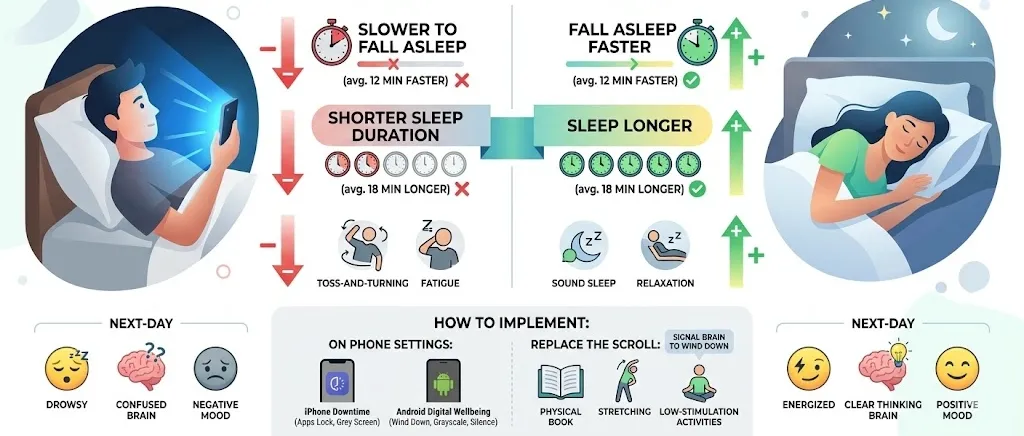
The study participants who put their phones down weren’t doing anything special during those 30 minutes. They just weren’t on their phones. That alone was enough to change their sleep quality scores significantly over four weeks.
You Can Cap Your Screen Time, But It Will Creep Back Up
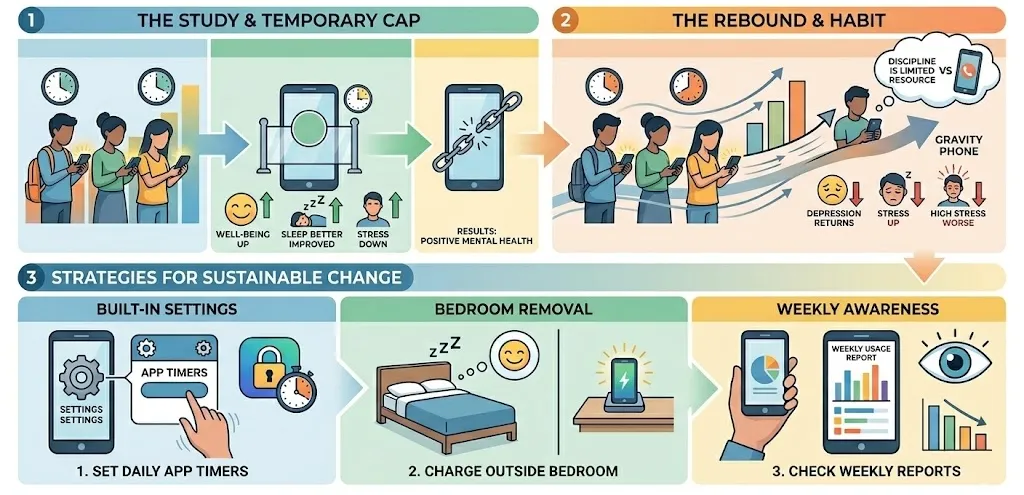
A randomized controlled trial published in BMC Medicine (Pieh et al., 2025) tested what happens when you actually limit smartphone use to two hours a day for three weeks. The trial included 111 university students whose average daily screen time was around 276 minutes, roughly four and a half hours a day.
The results were clear. Depressive symptoms dropped by 27%. Well-being improved. Stress went down. Sleep quality got better. The effect sizes were small to medium, which in research terms means real and consistent, not just a statistical blip.
Here is the frustrating part though. Once the three week intervention ended and the students went back to normal life, screen time climbed right back to where it was before. The mental health improvements started reversing too. The study’s own conclusion called this a causal relationship, meaning the screen time reduction directly caused the improvements, but maintaining the change requires something structural because your phone is literally designed to pull you back in.
So how do you make it stick?
This is where most advice articles just say “be more disciplined” and leave it there. That doesn’t work because discipline is a limited resource and your phone never runs out of ways to grab your attention.
What works better is building the limits into your phone’s settings so the default is restricted, not open.
- Set daily app timers for social media and entertainment apps. When the timer runs out, the app locks. You can override it, but the friction of having to deliberately unlock it is often enough to break the autopilot scroll.
- Charge your phone in another room at night. This removes the temptation entirely for those late night hours that tend to be the least intentional and most mindless.
- Check your weekly screen time report every Sunday. The awareness alone tends to reduce usage even without hard limits, because seeing the number confronts you with how much time is actually going where.
The two-hour daily target from the Pieh study is a solid benchmark, but even cutting an hour off your current average moves things in the right direction based on what the data showed.

What a Digital Detox Actually Does to Your Body
Quick answer: it measurably lowers your stress hormones and inflammation markers.
The word “detox” sounds dramatic, and most people picture someone locking their phone in a drawer for a week. The research is more practical than that.
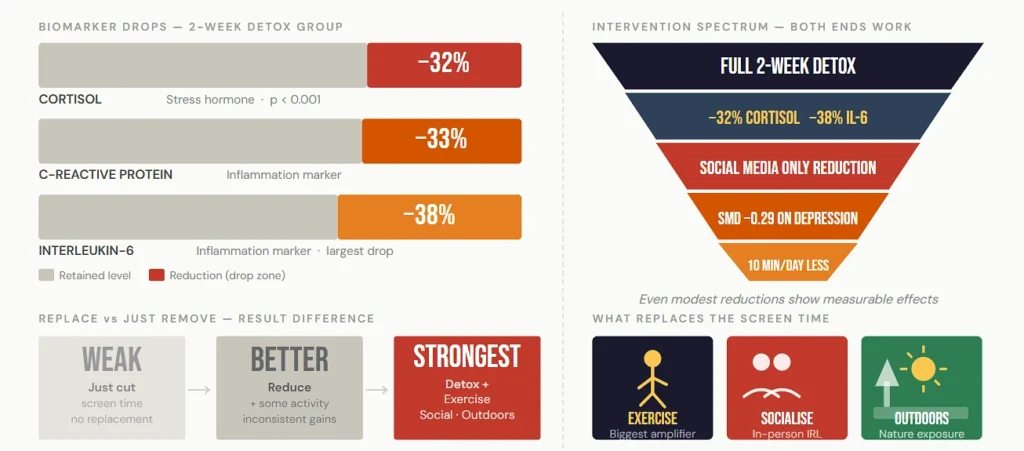
A 2025 study published in BMC Medical Education randomized 240 medical students into three groups. One group did a two-week digital detox combined with alternative activities like exercise and socializing. Another group just reduced their screen time. A control group changed nothing.
The biological results from the detox group were striking:
- Cortisol levels dropped by 32% (p<0.001)
- C-reactive protein, an inflammation marker, decreased by 33%
- Interleukin-6, another inflammation marker, fell by 38%
- Perceived stress and anxiety scores both declined significantly
A separate meta-analysis published in Narra J (Ramadhan et al., 2024) reviewed 10 studies on social media detox and found a statistically significant effect on reducing depression (standardized mean difference of -0.29, p=0.01). The effect on broader things like life satisfaction and general well-being was less consistent, which honestly makes the findings more believable. A study claiming everything gets better across the board would feel suspicious. Real interventions tend to work strongly on specific things and less on others.
You don’t need to go cold turkey for this to work
The studies used intervention periods ranging from a full week of social media abstinence down to reducing daily usage by just 10 minutes over three weeks. Both ends showed measurable effects. A realistic version might look like:
- One notification-free evening per week. Phone goes into do-not-disturb from 6pm until morning. You pick the day.
- Phone stays out of the bedroom entirely. Buy a cheap alarm clock if that’s the excuse keeping it on your nightstand.
- Leave it behind for walks, meals, and conversations. Not as some big commitment, just as a default setting you build into your week.
One thing the BMC Medical Education study made especially clear: the group that replaced screen time with actual activities (exercise, going outside, socializing) showed dramatically better results than the group that just reduced screen time without filling the gap. Cutting something out works better when something else takes its place.

Track What You’re Doing Because 66 Days Is the Real Number
You’ve probably heard that it takes 21 days to form a habit. That number is essentially made up. Research from Phillippa Lally and colleagues at University College London, published in the European Journal of Social Psychology (2010), tracked how long it actually takes for a behavior to become automatic. The average was 66 days, and the range was massive, anywhere from 18 days to 254 days depending on the person and the complexity of the habit.
This matters for digital habits specifically because most people try something for two or three weeks, don’t see dramatic results, and quit right at the point where the habit hasn’t actually formed yet. The initial motivation that carried you through the first week is gone by week three, and without some external system keeping you accountable, the old patterns slide right back in.
The American Society of Training and Development found that people with structured accountability systems achieved their goals at a 95% success rate compared to 65% for those who simply committed to making a change. Habit tracking apps create a lightweight version of that accountability. You open the app, you mark whether you did the thing or didn’t, and the visual record of your consistency (or lack of it) keeps you honest.
For digital wellness specifically, tracking your screen time IS the habit. You’re already generating the data. Your phone records exactly how many minutes you spent on each app, how many times you picked up the device, what hours were heaviest. Checking that report once a week and actually looking at the trends is a five-minute task that changes how you think about your usage, because the numbers are harder to ignore than the vague feeling that you’re on your phone too much.
Build a Wind-Down Routine That Stacks Multiple Habits Together
This is where the individual habits start working together. You’re putting the phone away 30 minutes before bed (habit one), your daily screen time is already lower because of the limits you set (habit two), and you’ve cleared some mental space by taking notification breaks during the week (habit three). Now the question is what you do with that pre-sleep window to actually support better rest.
Sleep tracking through a wearable or a phone app gives you data to work with. You track for a couple of weeks and start noticing patterns. Maybe you’re consistently waking up at 2am. Maybe your deep sleep percentage is lower on nights when you ate late or skipped your wind-down routine. The tracking by itself doesn’t fix anything, but it turns “I’m not sleeping well” into “I’m not sleeping well on these specific nights and here’s what was different about them.”
The routine itself becomes the sleep cue
The reason a structured pre-bed routine works isn’t because any single component is some kind of miracle fix. It’s because the consistency of doing the same sequence of things at the same time each night trains your body to expect sleep at a predictable point. Basic circadian science. Your body responds to cues, and a repeatable routine is one of the strongest cues you can give it.
What that routine looks like varies from person to person. Some people stretch. Some read. Some use breathing exercises. Some add sleep gummies as part of a structured bedtime sequence that helps signal the transition from awake mode to sleep mode. The combination matters more than any single element because sleep quality is affected by several things at once, temperature, light exposure, mental stimulation, physical tension, and a good wind-down routine addresses multiple factors in one consistent block of time.
The sleep tracker’s job is giving you feedback on whether what you’re doing is actually working. If you add something to your routine and your deep sleep percentage stays flat for two weeks, that element probably isn’t doing much for you specifically. If you add something and your wake-ups decrease, keep doing it. The data removes the guesswork and lets you build a routine that fits your actual sleep patterns, not generic advice that may or may not apply to you.
One Final Thought
None of this requires quitting technology or making your life harder. It’s about picking a few specific changes that have tested results behind them and building them into your daily routine with enough structure that they stick past the first few weeks. The research is pretty consistent on one thing: small changes work, but only for as long as you maintain them. Set the systems up, let the phone do the enforcing, and stop relying on motivation to carry you through.
References
- He, J.W., Tu, Z.H., Xiao, L., Su, T., & Tang, Y.X. (2020). Effect of restricting bedtime mobile phone use on sleep, arousal, mood, and working memory: A randomized pilot trial. PLOS ONE, 15(2), e0228756 – https://doi.org/10.1371/journal.pone.0228756
- Pieh, C., Humer, E., Hoenigl, A., Schwab, J., Mayerhofer, D., Dale, R., & Haider, K. (2025). Smartphone screen time reduction improves mental health: a randomized controlled trial. BMC Medicine, 23, 107 – https://doi.org/10.1186/s12916-025-03944-z
- Ramadhan, R.N., Rampengan, D.D., Yumnanisha, D.A., et al. (2024). Impacts of digital social media detox for mental health: A systematic review and meta-analysis. Narra J, 4(2), e786 – https://doi.org/10.52225/narra.v4i2.786
- From screens to serenity: evaluating the effect of digital detox on mental and physiological health (2025). BMC Medical Education – https://doi.org/10.1186/s12909-025-08267-4
- Lally, P., van Jaarsveld, C.H.M., Potts, H.W.W., & Wardle, J. (2010). How are habits formed: Modelling habit formation in the real world. European Journal of Social Psychology, 40(6), 998-1009 – https://doi.org/10.1002/ejsp.674
- National Sleep Foundation (2022). 2022 Sleep in America Poll – https://www.thensf.org/sleep-in-america-polls/