
Nepal’s cricket team walked out at the Wankhede Stadium in Mumbai on February 8, 2026 to face England in their opening match of the ICC Men’s T20 World Cup. Twelve years had passed since their last win at a World Cup. Two years since their previous appearance in the tournament. And for the first time in the country’s cricketing history, they’d qualified for consecutive editions 2024 in the West Indies and now 2026 in India and Sri Lanka.
They didn’t make the Super Eights. They were actually the first team officially eliminated from the 2026 tournament after losing their opening three group matches. But the results on the field are only half of what happened. The other half is in the broadcasting deals, the digital numbers, the sponsorship money flowing into Nepali cricket, and the fact that the ICC specifically carved out a separate media rights package for Nepal ahead of this tournament. That doesn’t happen for countries where nobody is watching.
How Nepal Got Here 2014, Then a Decade of Nothing, Then Back-to-Back
Nepal’s World Cup timeline is patchy in the best possible way. They first qualified for the T20 World Cup back in 2014 after finishing third in the 2013 ICC Qualifier. Won two matches in that tournament. Then disappeared from the World Cup stage for an entire decade.
The return came in 2024 when they qualified through the Asia regional pathway. Group stage exit — didn’t win a single match. But qualification alone was the headline. For a country classified as an ICC Associate Member, getting to the main tournament twice in three years represents a step change. Nepal qualified for 2026 with an unbeaten run at the Asia-Pacific Regional Final in Oman in October 2025, topping the qualification group without dropping a match.
They were drawn into Group C alongside England, West Indies, Scotland, and tournament debutants Italy. The group was always going to be brutal.
Nepal’s 2026 World Cup Results Eliminated First, But the Scotland Win Mattered
Melbet information invites you to get acquainted with their campaign:
- vs England (Feb 8, Chennai): Chasing 184, Nepal reached 180/6 in 20 overs. Lost by 3 runs. Dipendra Singh Airee smashed 44 off 29 balls. Sher Malla took a wicket with his first ball in T20Is.
- vs Italy (Feb 12, Chennai): Lost by 10 wickets. Italy’s maiden World Cup victory came at Nepal’s expense.
- vs West Indies (Feb 15, Mumbai): Lost by 9 wickets. West Indies qualified for Super Eights; Nepal became the first team eliminated from the 2026 tournament.
- vs Scotland (Feb 20, Mumbai): Won by 7 wickets. Airee’s unbeaten 50 off 23 balls sealed Nepal’s first T20 World Cup win in 12 years. Sompal Kami took 3/25.
One win in four matches. Bottom of Group C. No Super Eights. On paper, a poor tournament. But Airee finished with 169 runs in four innings at an average of 56.33 and a strike rate of 144.44 — good enough to make Sportskeeda’s Best Eliminated XI of the tournament. The Scotland match, with the Wankhede crowd behind them, was the kind of moment that sticks in a country’s cricketing memory longer than a group stage exit.
The Broadcasting Infrastructure Nepal Has Built Around Cricket in Two Years
This is where the numbers get properly interesting, because something shifted between 2024 and 2026 that goes well beyond squad selection.
Kantipur TV Got Dedicated Nepal Commentary for the 2026 World Cup
The ICC confirmed Kantipur TV as the local broadcaster for the 2026 T20 World Cup in Nepal, with selected matches produced locally featuring Nepali-language commentary. That Nepali commentary feed was also made available on ICC.tv for Nepali-speaking audiences globally. On top of that, Star Sports — the primary ICC broadcast partner for the subcontinent — is available in Nepal through its distribution partners, covering India, Sri Lanka, Bangladesh, Bhutan, Maldives, and Nepal.
What made this cycle different was the ICC specifically releasing an Expression of Interest for media rights in Nepal in December 2025. The package included non-exclusive broadcast and digital rights. The ICC doesn’t typically issue country-specific EOIs for Associate Member nations. They did for Nepal because the viewership data justified it.
Star Sports Broadcasting Nepal’s Domestic League — That’s New
Star Sports Network secured broadcasting rights for the Nepal Premier League starting with the inaugural season in late 2024. This was the first time Star Sports — the network that carries IPL, ICC events, and major international cricket — broadcast a domestic cricket tournament from Nepal. The Cricket Association of Nepal (CAN) Secretary Paras Khadka acknowledged the financial investment required but emphasised its importance for the league’s growth and global visibility.
Star Sports returned for the second season of the NPL in 2025, with CAN confirming the partnership would continue. DishHome, one of Nepal’s largest digital TV and streaming providers, picked up the OTT rights for NPL Season 2, adding another distribution layer for digital audiences.
The NPL also secured Siddhartha Bank as title sponsor on a five-year deal running from 2024 to 2029 — described by CAN as the highest-ever sponsorship amount in the history of Nepali sports. International players like Shikhar Dhawan (India), Martin Guptill (New Zealand), and James Neesham (New Zealand) signed for NPL franchises, which isn’t something that happens for leagues nobody watches.
Nepal Won the ICC Digital Fan Engagement Award — Twice in a Row
The ICC hands out Development Awards annually to Associate Member nations doing exceptional work in growing the sport. Nepal’s Cricket Association won the ICC Digital Fan Engagement of the Year award in both 2023 and 2024. Two consecutive years. The 2024 numbers that earned the award tell the story of a fanbase that’s growing at an unusual pace for a non-Test nation.
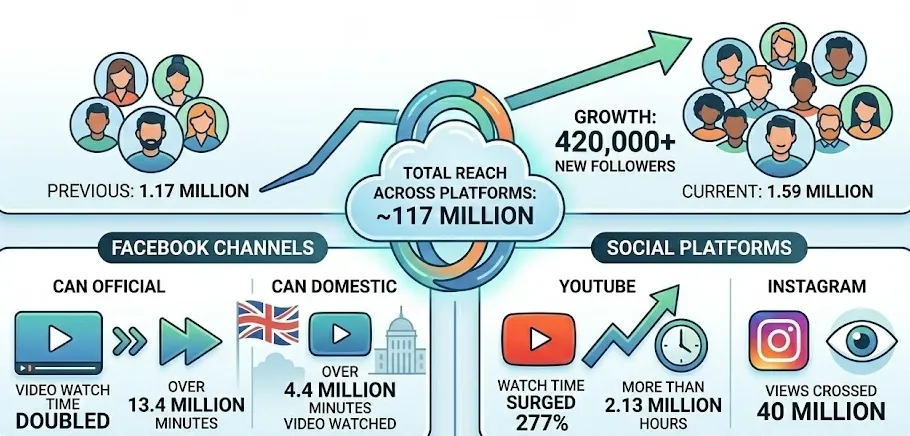
CAN’s Digital Growth Numbers (2024 Award Period)
- Total reach across platforms: approximately 117 million
- Overall follower count: grew from 1.17 million to 1.59 million — that’s 420,000+ new followers
- Facebook (CAN Official): video watch time doubled to over 13.4 million minutes
- CAN Domestic Facebook account: over 4.4 million minutes of video watched
- YouTube: watch time surged 277% to more than 2.13 million hours
- Instagram: views crossed 40 million
Source: ICC Development Awards 2024 global winners announcement, July 2025.
CAN’s Cricket Operations Manager Binod Das attributed the growth to behind-the-scenes content, player stories, and match updates — essentially treating the national team’s social media like a media operation rather than an afterthought. The digital strategy was executed in partnership with Makura Creations, a Nepali digital agency.

For context, Nepal’s total population is roughly 29.6 million. Having 1.59 million followers across cricket platforms for a country that size — and reaching 117 million total impressions — means the content is travelling well beyond Nepal’s borders. Das confirmed that fans from Afghanistan, Bangladesh, and other cricket nations regularly engage with CAN’s content.
16.5 Million Internet Users and 89% Mobile Broadband — Nepal’s Digital Base Keeps Growing
The fan engagement numbers don’t exist in a vacuum. Nepal’s digital infrastructure has expanded significantly over the past few years, and cricket content consumption sits directly on top of that growth.
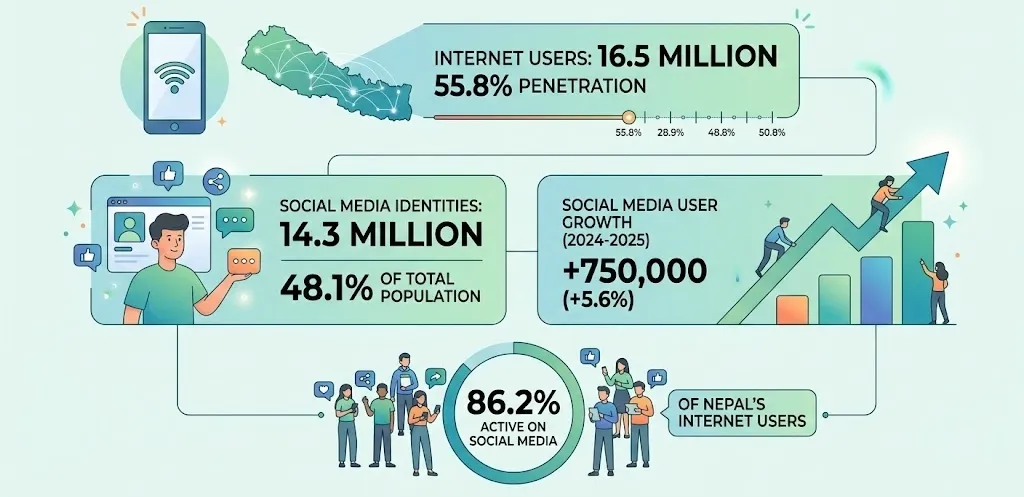
According to DataReportal’s Digital 2025 report for Nepal:
- 16.5 million internet users as of January 2025, representing 55.8% penetration
- 14.3 million social media user identities — equivalent to 48.1% of the total population
- Social media users grew by 750,000 (+5.6%) between early 2024 and early 2025
- 86.2% of Nepal’s internet users are active on at least one social media platform
The Nepal Telecommunications Authority reports mobile broadband penetration at 89%, with 4G subscribers reaching 2.59 crore (25.9 million) as of late 2025. Around 96% of Nepali internet users access the web through mobile devices. Nepal Telecom and Ncell — the two dominant operators — have been aggressively expanding 4G coverage, with 98% of local levels now connected.

This mobile-first internet population is exactly the audience that consumes cricket through apps, social media highlights, and streaming platforms rather than traditional television. It also explains why platforms like MelBet have found traction during major cricket tournaments — the infrastructure for mobile sports engagement in Nepal now actually supports it at scale.
The Economics of Cricket Growing in a $1.3 Billion Telecom Market
Nepal’s telecom market is valued at approximately $1.3 billion according to Ken Research, and the overlap between telecom growth and cricket consumption is hard to separate. Affordable smartphones with penetration projected to reach 70%, up from 60% in 2022 — drive both data usage and sports app downloads.
The Nepal Premier League has created a new economic layer around cricket domestically. Packed stadiums during NPL matches. Merchandise. Ticket sales. Tourism spikes when fans from across Nepal travel to Kathmandu for matches. Infrastructure upgrades at the Tribhuvan University International Cricket Ground. And the digital economy layer — streaming platforms, fantasy cricket apps, and cricket betting apps that plug into the tournament cycle — adds revenue dimensions that didn’t exist even three years ago.
The NPL’s five-year title sponsorship with Siddhartha Bank, the Star Sports broadcasting deal, and the DishHome OTT partnership collectively represent a level of commercial investment in Nepali cricket that was unthinkable before 2024. These aren’t charity arrangements. Sponsors and broadcasters commit money because they see viewership data that justifies the spend.
What the 2026 World Cup Actually Did for Nepal’s Cricket Profile
Nepal finished bottom of Group C. That’s the scoreline. But the tournament delivered several things that don’t show up in the points table.
Dipendra Singh Airee became the first Nepali cricketer to score 2,000 runs in T20Is during the tournament. His 169 runs across four innings at a strike rate of 144.44 earned him recognition in the best eliminated XI alongside players from Australia, Afghanistan, and the Netherlands. He’s 28. Nepal will likely have him for at least two more World Cup cycles.
The England match — where Nepal came within 3 runs of pulling off what would have been one of the biggest upsets in T20 World Cup history — generated significant global attention. Nepal posted 180/6, their highest-ever innings total in a T20 World Cup. That near-miss created more international media coverage than a comfortable loss ever would.
The Scotland victory at Wankhede gave Nepal their first T20 World Cup win since 2014. Sompal Kami’s caught-and-bowled dismissal of Brandon McMullen and the subsequent Scottish collapse from 131/1 to 170 all out will be replayed on Nepali cricket channels for years.
And the fact that Nepal’s brothers — Aarif and Aasif Sheikh — both featured in the squad added to a narrative that transcends cricket stats. The 2026 World Cup was one of five tournaments across all editions to feature sibling pairs, and Nepal was one of those stories.
Consecutive World Cups Changed the Conversation About Nepali Cricket
Going to a World Cup once is an achievement for an Associate Member. Going twice in a row shifts the conversation from “can Nepal qualify?” to “what does Nepal need to become genuinely competitive?” The answer to the second question involves broadcasting revenue, sponsorship money, infrastructure investment, digital fan engagement, and grassroots development — all of which are now measurably in motion.
Nepal’s men’s team is ranked in the top 15 of the ICC T20I rankings. The Nepal Premier League has international players and Star Sports coverage. The CAN has won back-to-back ICC Digital Fan Engagement awards. Kantipur TV is broadcasting World Cup cricket with dedicated Nepali commentary. The country’s mobile broadband penetration sits at 89% with 25.9 million 4G subscribers.
None of that guarantees a Super Eights appearance next time around. But the gap between where Nepal was in 2015 — out of the World Cup picture entirely, minimal broadcasting infrastructure, no domestic franchise league — and where they are now is significant enough that the ICC carved out dedicated media rights for them. Broadcasters and sponsors are investing. The digital numbers keep climbing. The trajectory, regardless of what happens in any single group stage match, is pointed firmly upward.