


Counterpoint Research’s Memory Price Tracker is showing some ugly numbers. Mobile RAM costs jumped 50% quarter-on-quarter. NAND storage went up over 90% QoQ. Those aren’t gentle increases that’s the kind of spike that rewrites how much it costs to build a phone.
And the analysts aren’t sugarcoating where this leads. “Higher retail prices are unavoidable in 2026 as rising costs will be passed to consumers.”

Budget Phones Are Getting Hit the Hardest
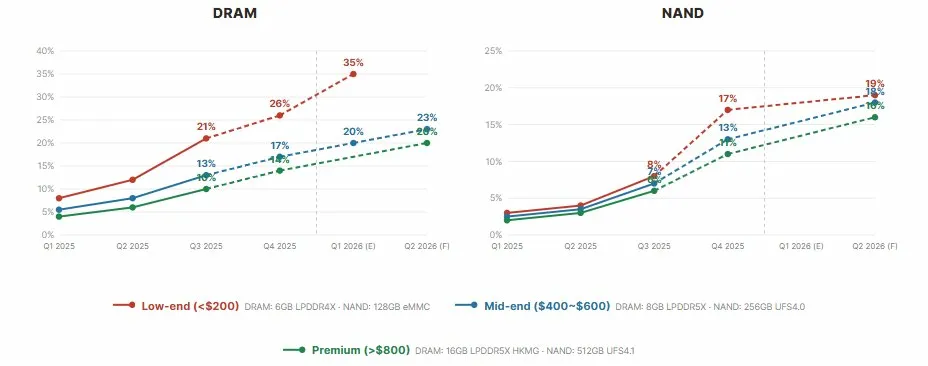
Memory costs are eating into the Bill of Materials across every price tier, but sub-$200 phones are taking the worst of it. A typical budget device running 6GB of LPDDR4X RAM and 128GB of eMMC storage now sees memory chewing up 43% of the total BoM. That’s a 25% increase from last quarter alone.
When nearly half the cost of building a phone goes toward memory, manufacturers don’t have many places to hide. Margins on cheap phones were already razor-thin.
Mid-Range and Flagship Aren’t Spared Either
A mid-ranger in the $400–$600 bracket something with 8GB of LPDDR5X RAM and 256GB of UFS 4.0 storage is seeing RAM costs up 15% and storage up 11% if built in Q1. By Q2, those numbers climb to 20% and 16%.
Premium and flagship phones ($800+) have bigger margins to absorb some of this, but they’ve got their own problem on top of the memory crunch 2nm chipsets are expensive. Counterpoint estimates BoM costs for a phone packing 16GB of LPDDR5X HKMG RAM and 512GB of UFS 4.1 storage will rise by $100 to $150 in Q2. At that point, RAM accounts for 23% of the BoM and storage takes up another 18%.
Smartphone Memory Cost Share Estimation in Different Price Segments
What This Means at the Register
Counterpoint expects retail prices to follow the component costs up. Budget phones could climb around $30. Premium devices are looking at $150 to $200 in price hikes.
Senior Analyst Shenghao Bai put it bluntly: “The memory price surge is delivering a structural impact to smartphone BoM costs. In 2026, OEMs will struggle to balance component costs, gross margins and shipment targets. Those who rely heavily on entry-level models to drive market share will face a significant risk of short-term losses.”