

You probably have more ways to reach people right now than your grandparents had in their entire lives combined. WhatsApp, Instagram DMs, Snapchat, Discord, Telegram, Facebook Messenger, whatever else launched last Tuesday. And yet — and this is the part that should bother everyone more than it does — Cigna ran this big national survey and found that nearly 3 in 5 Americans feel like nobody truly knows them.
Not “I need more friends.” Not even “I am lonely.” Something worse. The feeling of being invisible while technically surrounded by people who supposedly care about you. Eight hundred Facebook friends and still that quiet “does anyone actually see me” thing happening in the background.
In 2023 the US Surgeon General looked at all of this and said yeah, this is an epidemic. Compared the health damage to smoking fifteen cigarettes a day which honestly sounds dramatic until you read the WHO numbers from their June 2025 Commission on Social Connection report. 1 in 6 people worldwide persistently lonely. Roughly 100 deaths every hour globally linked to social isolation. 871,000 people a year. The World Health Organization published those figures, not some sad Instagram infographic.
So we built the most connected civilization in human history and somehow ended up lonelier than the people who had to wait three weeks for a letter to arrive. Cool. Great job everyone.
It Is Not Old People Who Are Loneliest. That Surprised Basically Everyone

You would assume this is mainly an elderly problem right?
Spouse dies, kids move across the country, person sits alone in a house watching daytime television. And that is real, it happens, it is awful. But when Gallup actually measured it across all age groups in 2024, adults aged 18 to 34 came out as the loneliest demographic. Not close either. The youngest adult group, the one with the most communication technology available to them, reported feeling the most disconnected.
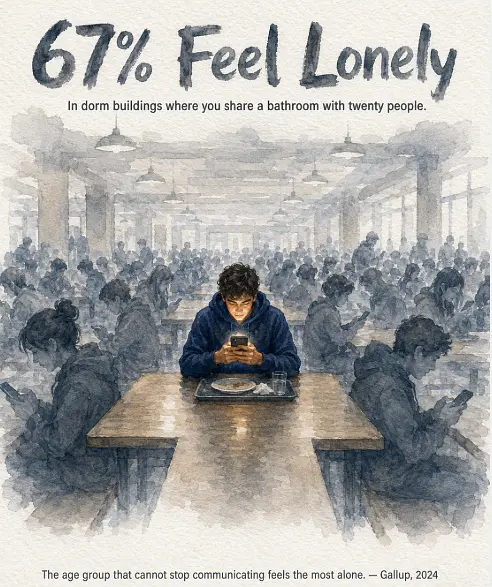
Active Minds and TimelyCare did a campus-specific survey of 1,100 students that same year — 67% said they felt lonely. Sixty-seven percent. In dorm buildings where you share a bathroom with twenty people and eat in a dining hall with three hundred. How do you feel alone in that environment? That is genuinely hard to understand until you think about what “being around people” actually means now versus what it meant before everyone had a phone in their hand during every meal.
EdWeek came in with a 2025 report saying teens are among the loneliest demographics on the planet. Teens. The age group that literally cannot stop communicating with each other through screens is simultaneously the age group that feels most alone. If that does not make you pause and go “wait, what?” then I do not know what would.
Scrolling Through Someone’s Life Is Not the Same as Being in It

OK so this is the part where the research gets uncomfortable for anyone who spends a lot of time on social media, which is basically all of us, myself included.
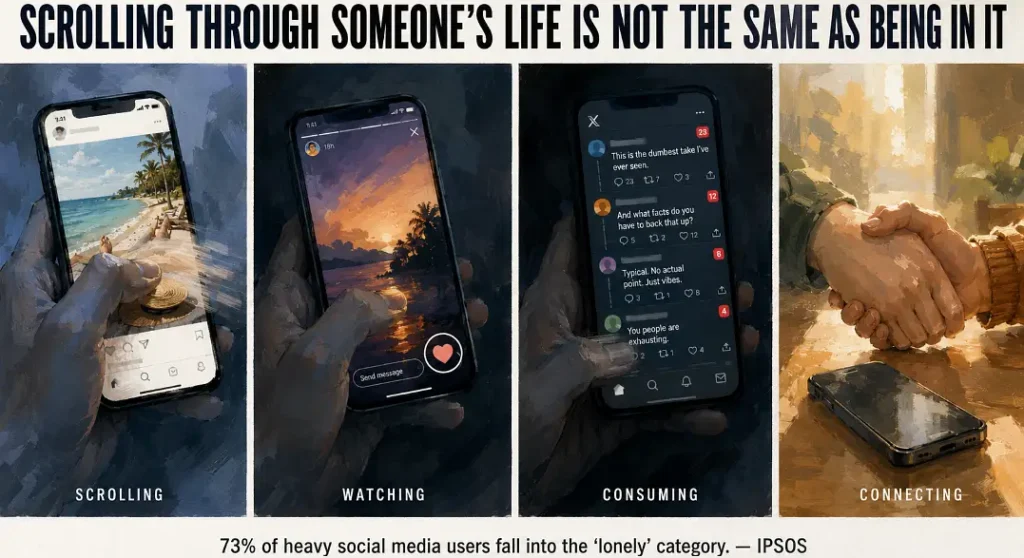
IPSOS data: heavy social media use correlates directly with higher loneliness scores. Not a little bit either. Frequent users face a 3x higher risk of perceived social isolation. Separately, 73% of heavy social media users fall into the “lonely” category.
And look, correlation is not causation, sure, every stats professor is already typing that reply. But at some point when every major study — Gallup, IPSOS, Cigna, WHO, the Surgeon General — keeps pointing in the same direction, you have to at least consider that maybe the direction is correct.
Here is what seems to be happening. There is a difference between passive consumption and active interaction and it is a bigger deal than most people realize. Scrolling through someone’s vacation photos is passive. Watching stories is passive. Reading tweets and not responding is passive. And that is what people do on social media roughly 80% of the time. The platforms are literally designed for it — the infinite scroll, the autoplay, the algorithmic feed that keeps serving content so you never run out of reasons to keep your thumb moving.
A November 2025 APA poll found 6 in 10 US adults saying societal division is a major stress source. Where does that division play out loudest? In the feeds. Rage gets engagement. Engagement gets reach. Reach gets ad revenue. Nobody optimized these platforms for “did this interaction make the user feel less alone.” They optimized for “did the user stay on the app for another eleven minutes.”
Why a Video Call Feels Different From a Text Thread (and the Science Behind It)
UCLA research that has been cited for years now puts this number out there — about 93% of emotional communication is non-verbal. Tone of voice, facial expression, the way someone pauses before answering, posture, eye contact, even breathing patterns. All of that carries meaning. Text gives you roughly 7% of that bandwidth. A smiley emoji is not the same as watching someone’s face actually light up. We all know this intuitively but it is easy to forget when texting feels so convenient.
The WHO’s 2025 report specifically looked at tech-based interventions for loneliness and made a distinction worth paying attention to. Hybrid approaches — video calls, voice chat, live conversation platforms with some human element — showed real reductions in loneliness. Text-only digital tools? They lagged behind. Not useless, just less effective at the thing that actually matters.
Video preserves the non-verbal stuff that text kills. You can hear when someone is genuinely laughing versus doing the polite thing. You can see if the person you are talking to is actually interested or just waiting for their turn to speak. You catch the micro-expressions that give conversations their real texture — the slight surprise, the confusion, the moment someone connects with what you said. All of that disappears the second communication becomes words on a screen.
This is part of why platforms built around live face-to-face conversation, things like Chat with CallMeChat where you video chat with someone one-on-one, tend to produce a different experience than scrolling through posts about strangers’ lives. One is watching from outside. The other is actually being in a conversation where another person can see your face and hear your voice and respond to you in real time. The difference sounds obvious when you say it out loud but somehow we collectively decided that typing at each other was an acceptable substitute. The loneliness numbers suggest it was not.
There is also an app out of Brandeis University called “Strangers” that launched specifically for college campuses, and their whole model is the opposite of social media — they want to get users OFF the app and into real friendships. That is an interesting business model when every other platform is engineered to keep you on as long as possible.
The Money Problem Nobody Connects to Loneliness
This is a tangent but it is an important one because it keeps getting left out of the conversation.
University of Southern California, 2025 study: financial strain is directly linked to higher loneliness rates and the effects get worse over time. And it is not just “I have less money so I go out less.” It is the shame component.
People turning down a wedding invitation because the gift plus travel would wreck them financially. Skipping a friend’s birthday dinner because they cannot afford to split the bill without stress. Saying no to a weekend trip and then not knowing how to explain why without admitting they are broke. Then just… stopping. Not showing up. And once you stop showing up, people stop asking, and now you have lost the connection without either side ever having the actual conversation about what went wrong.
Financial stress isolates people through embarrassment before it isolates them through logistics. That is a sentence I wish someone had said to me years ago because it explains a pattern I have watched happen to people around me without fully understanding the mechanism.
The loneliness epidemic is not just a “too much screen time” story even though screens are a big part of it. It arrived alongside rising cost of living, declining community participation, people moving cities for work every few years and starting their social circles from zero each time, remote work removing the accidental daily human contact that offices used to provide whether you wanted it or not. Social media did not cause all of that. But it created a very convincing illusion that connection was still happening while all those other forces were quietly pulling the real thing apart.
What Actually Seems to Work Based on the Research
I considered not including this section because “what helps” lists always feel a bit patronizing, like yes thank you I will simply fix loneliness by Joining A Club. But the research does consistently point to specific things and some of them are less obvious than you would expect so here goes.
The Surgeon General’s advisory, the WHO report, and multiple systematic reviews converge on the same core finding — face-to-face interaction is still the strongest buffer against loneliness. Revolutionary stuff obviously. But the nuance matters:
- Video and voice platforms outperform text-only tools for reducing isolation. The non-verbal bandwidth makes a measurable difference. Even a clunky Zoom call with bad lighting does more for loneliness than a perfectly crafted text exchange.
- Intentional use beats passive use every time. People who pick up the phone and call someone report better outcomes than people who spend the same amount of time scrolling. Same screen, same hours, completely different result.
- Structured stranger-conversation platforms — group meetups, video chat with new people, interest-based live sessions — show loneliness reductions in systematic reviews. The “structured” part matters. Random comment threads do not have the same effect.
- Cutting passive scroll time specifically — not all screen time, just the mindless feed consumption — correlates with improved wellbeing across multiple studies. Nobody is saying throw your phone in a lake. Just maybe stop opening Instagram every time you have nine seconds of boredom.
The Surgeon General compared loneliness to fifteen cigarettes a day. The WHO is counting 100 deaths an hour. And the fix, according to basically every researcher who has studied this, is not some complicated intervention or expensive therapy program. It is embarrassingly simple — talk to people. Actually talk to them. See their face, hear their voice, let the 93% of communication that text strips away do the work it was designed to do.
We have the technology for that. We have had it for years. We just somehow decided that typing “lol” at each other was close enough. The loneliness numbers say otherwise.