
In the world of business technology, the smartphone is no longer just a communication tool; it’s a portable office, a high-end camera, and a secure vault for company data. But as flagship prices climb towards the £1,200 mark, businesses face a critical financial fork in the road: Do you purchase your fleet outright, or do you opt for a business lease?
While “owning” your tech feels like the traditional path, the rapid pace of innovation is making ownership a risky investment. Here is the breakdown of the Total Cost of Ownership (TCO) to help you decide.
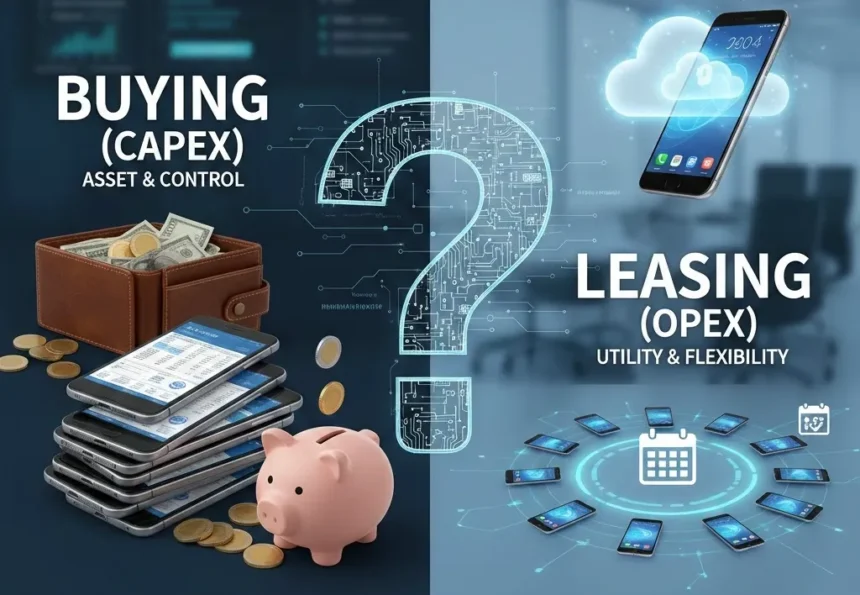
The Case for Buying (CAPEX)
Buying hardware outright is a Capital Expenditure (CAPEX). This is often the preferred route for freelancers or small companies with healthy cash reserves who want total control over their assets from day one.
Pros:
- No Monthly Interest: You pay once and avoid the “death by a thousand cuts” of monthly interest or financing fees.
- Asset Flexibility: You can sell the device whenever you wish, swap to any network tariff, or pass the handset down to a junior staff member without contractual hurdles.
- Long-term Savings: If your organisation plans to sweat its assets and keep a phone for four years or more, buying is almost always cheaper than a continuous lease.
Cons:
- Lump Sum Strain: Dropping £10,000 on a dozen iPhones can significantly impact a small company’s monthly cash flow.
- Depreciation: Smartphones are “depreciating assets”. Much like a new car, a handset loses roughly 20–30% of its value the moment the seal is broken.
- The “Obsolete” Trap: When you own the phone, you are responsible for it when the battery begins to degrade or the manufacturer stops providing security updates.
The Case for Leasing (OPEX)
Leasing treats mobile hardware as an Operating Expense (OPEX). Much like a SaaS subscription or a company car, you pay for the utility of the device rather than the hardware itself.
Pros:
- Cash Flow Preservation: You get the latest tech for a predictable monthly fee, leaving your capital free for hiring, marketing, or stock.
- Tax Efficiency: In the UK, lease payments can often be offset against Corporation Tax as a business expense, and VAT-registered businesses can reclaim the VAT on monthly payments. This also extends to smaller plans like business SIM only contracts.
- The Upgrade Cycle: Leasing ensures your team always has the latest security features. When the lease ends, you simply swap for the new model, avoiding the hassle of selling old kit.
Cons:
- Contractual Commitment: You are tied to a payment plan, usually for 24 or 36 months.
- Damage Liability: While many leases include “fair wear and tear” clauses, significant damage can result in end-of-term charges if you haven’t taken out comprehensive business insurance.
The “Total Cost” Comparison
Feature
Buying Outright
Monthly Leasing
Upfront Cost
- High (£800–£1,400)
- Low (£0–£50)
Accounting
- CAPEX (Depreciation)
- OPEX (Direct Expense)
Security
- Manual Upgrades
- Automatic Refresh Cycle
Disposal
- You must sell/recycle
- Returned to Provider
The Verdict: Which is right for you?
Choose Buying if: You have the capital available, you intend to keep your handsets for 3+ years, and you have a small team where “hand-me-down” hardware works for interns or part-time staff.
Choose Leasing if: You are scaling a team, you need to preserve cash for growth, and your industry requires the highest level of mobile security and 24/7 reliability.
Remember, the right business mobile deals will save your company thousands!