
Most people shop for a watch band the way they shop for a phone case. Scroll, like the color, buy. Three weeks later it’s in a drawer because it snags on every sweater sleeve or leaves a red line after a long run.
The band market has matured fast. What used to be a choice between Apple’s own lineup and a pile of anonymous silicone knockoffs is now a genuine category, with small brands doing real material engineering, which is good news and bad news. More options, more ways to pick wrong.
So here’s a buying framework that has held up for me across a couple of years of rotating straps, plus what each material actually does after six months on a wrist.
Why Band Choice Matters More Than It Used To
Your watch isn’t a watch anymore. It’s a sensor package. It tracks sleep, flags irregular heart rhythms, logs workouts, and increasingly acts as a passive health monitor rather than something you check.
That shift changes the hardware requirements. As one look at the current wearables landscape puts it, these devices have moved past being simple accessories and into the category of daily infrastructure. A band that’s uncomfortable at 2 a.m. isn’t just annoying. It means you take the watch off, and the sleep data stops.
Researchers at Florida Atlantic University swabbed wristbands across a range of materials and found that 95 percent carried some level of bacterial contamination, with porous rubber and plastic straps holding the most and metal bands holding almost none. Material isn’t just aesthetics. It’s a maintenance decision.
The Three Tests That Predict Comfort
Specs won’t tell you whether you’ll actually wear something. These three questions will.
The Sleeve Test
Put the band on and pull a long-sleeve shirt over it. Then push the sleeve up. Then pull it back down.
If the buckle catches, the hardware sits too proud. If the strap bunches your cuff, the profile is too thick. This single motion eliminates maybe a third of the bands on the market, and nobody thinks to try it before buying.
Low profile isn’t a style preference. It’s the difference between a band you wear in November and one you wear only in July.
The Sleep Test
Wear it overnight. Not one night, four.
Bands that feel fine at a desk can feel like a cuff at 3 a.m. The failure points are usually the same: a rigid clasp under the wrist bone, or a material that doesn’t give when your hand is tucked under a pillow. Stretch-woven and soft-loop styles win here. Link bracelets rarely do.
The Sweat Test
Do a hard workout, then leave the band on for two more hours without rinsing it.
You’re testing for two things. Does it hold odor, and does it hold moisture against your skin? Nylon that wicks properly will be dry within twenty minutes. Nylon that doesn’t will smell faintly of a gym bag by Thursday, permanently.
Materials, Ranked by How They Age
New bands all look good. Six-month bands don’t.
Woven Nylon
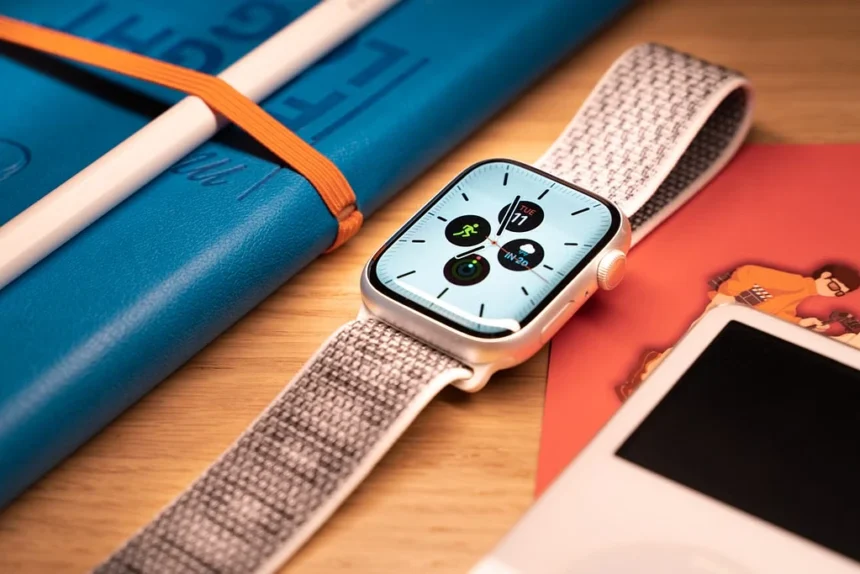
The most versatile option, and the one I’d tell a first-time buyer to start with. It’s light, it doesn’t warm up in the sun, and it survives a washing machine. Solace Bands built much of its catalog around this material, and browsing their range is a reasonable way to see how much variation exists inside a category most people assume is one texture.
If you want a quick sense of the spread, their collection of best Apple Watch bands covers woven, leather, and metal in one place, which makes comparing profiles easier than jumping between sites.
The caveat: lighter woven colors pick up denim transfer. A pale sand nylon worn with raw indigo jeans will pick up a blue cast along the edge within a month, and it doesn’t fully wash out. Buy darker if that bothers you.
Leather
Best for looking like you’re wearing a watch rather than a fitness tracker. Full-grain develops a patina. Bonded leather peels, usually starting at the tang holes around month four.
Leather’s real weakness is water. Not one splash, but the cumulative effect of showers you forgot to take it off for. It stiffens, then cracks. If you’re the type who never removes the watch, skip leather entirely and don’t feel bad about it.
Metal
Milanese loops and link bracelets look sharp and, per the FAU findings, stay the cleanest. They’re also the heaviest, and weight is the thing people underestimate. An extra 40 grams on your non-dominant wrist is noticeable during a bench press and during a night’s sleep.
Metal also has a fit problem. Link bracelets need sizing. Milanese magnets slip on some wrists during pull-ups. Try before you commit if you can.
Silicone and Fluoroelastomer
Cheap, waterproof, and honestly fine. Good fluoroelastomer is more comfortable than bad nylon. But it’s the material most prone to trapping moisture, which loops back to the hygiene research above. Rinse it. Regularly.
What “Low Profile” Actually Means
The phrase gets used loosely, so here’s a concrete definition. A low-profile band has:
- A clasp under roughly 4 mm at its thickest
- No hardware on the underside of the wrist
- Tapering from lug to buckle rather than uniform width
- Connectors that sit flush with the case, not proud of it
Very few makers publish those numbers, which is frustrating. Solace Bands lists dimensions on most product pages, and Nomad does as well, but you’ll often be reduced to squinting at side-angle photos and reading reviews for the phrase “sits flat.”
A connector that’s a fraction of a millimeter off leaves a visible gap and a rough edge you’ll feel every time you rest your wrist on a desk. It’s the fastest way to tell a well-made third-party band from a bad one, and you can check it in about two seconds after unboxing.
Building a Rotation Instead of Finding “The One”
Nobody has one pair of shoes. The same logic applies here, and it costs less than you’d think.
A rotation that covers almost everything:
- A woven or sport loop for daily wear and workouts. This is your workhorse, on maybe 70 percent of days.
- A leather or dressier strap for meetings and evenings. Swaps take ten seconds.
- A backup in whatever material you liked most. Because the workhorse will eventually be in the wash.
Buying three mid-range bands beats buying one expensive one, in the same way three decent shirts beat one designer shirt you’re afraid to sweat in. Brands like Solace Bands sit in a useful price bracket for this approach, though plenty of alternatives work equally well depending on your taste.
One maintenance note regardless of what you buy. Apple’s own band care guidance is worth two minutes of reading, particularly the part about never soaking leather and drying stainless steel thoroughly. Most band deaths are avoidable.
The Bottom Line
Stop shopping by photograph. Shop by the three tests: sleeve, sleep, sweat.
Get those right, and the material question mostly answers itself. Woven nylon if you want one band to do everything. Leather if the watch is also an accessory. Metal if you value looks and cleanliness over weight. Silicone if you’re in and out of water and don’t want to think about it.
The best band isn’t the most expensive one in your cart. It’s the one still on your wrist in six months, which is a much harder standard than it sounds.