
I was going through my feed last week and saw Ross Scott post that the Stop Killing Games campaign is shifting to policy work now, less public noise more behind-closed-doors regulator meetings. And I realised most people probably missed what actually happened with the EU response back in June because it got buried under E3 coverage and summer game announcements.
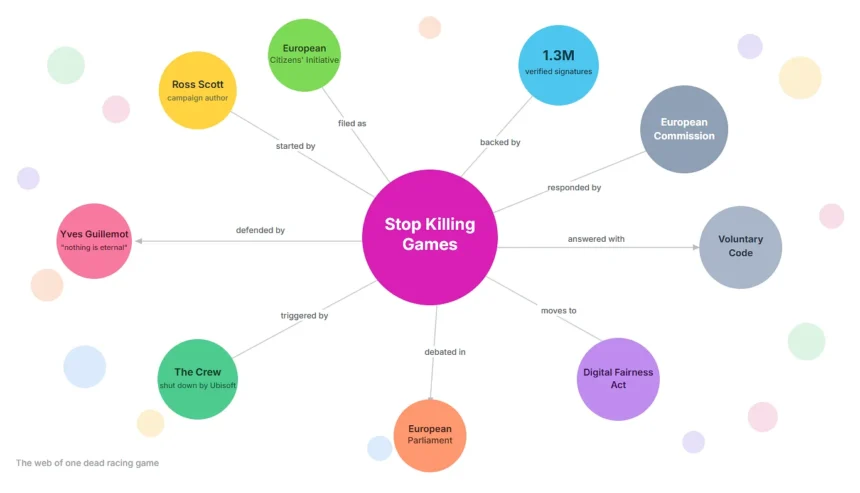
For anyone who was not following this. Ubisoft shut down The Crew back in 2024, servers off, game dead, even if you had the disc in your console it stopped working. EA did the same to Anthem around the same period. No refunds. A YouTuber called Ross Scott started a European Citizens’ Initiative called Stop Killing Games, it collected 1,294,188 verified signatures across 24 EU member states, and the European Commission was legally required to respond.
The Commission Responded on June 16 – The Answer Was Basically No.
The Commission said it cannot propose a legal obligation forcing publishers to keep games playable after they stop selling them. Cited intellectual property rights and copyright constraints as the main reasons.
They committed to three things by end of this year, and all three of them are soft.
- A voluntary code of conduct developed with the games industry about how to handle end-of-life games
- Consumer awareness work about existing rights under current EU law
- A report on the Digital Content Directive covering what happens when digital content gets discontinued
A voluntary code of conduct is not a regulation. Publishers can look at it and shrug if they want to, and based on how voluntary codes have worked in other parts of the tech industry, shrugging is the most likely outcome until an actual law shows up with actual consequences attached to it.
Ross Scott’s response was essentially that they will move on without the Commission and pursue the Digital Fairness Act instead, which is a separate upcoming EU legislative process that might offer a better path for stronger consumer protections around digital goods.
Ubisoft’s CEO Said “Nothing Is Eternal” and That Was His Actual Response
I keep going back to this quote because it tells you everything about where the industry stands on this.
Yves Guillemot, CEO of Ubisoft, was asked about all of this when Stop Killing Games was gaining traction. His response to people who paid money for The Crew and then had it taken away was that nothing is eternal and players should get comfortable with not owning their games.
“consumers just don’t understand the value proposition we’re offering them”
Yves Guillemot
That is a real quote from the head of a company that took money from customers for a product and then remotely disabled it. Buy a book and the publisher cannot come to your house and set it on fire two years later. Buy a record and the label cannot remotely snap it. Buy a game from Ubisoft and apparently the arrangement is different. The whole game ownership conversation has been sitting on forums for years but it took The Crew dying and a million signatures for it to reach the level of an actual EU legal process.
What Actually Changes From Here
Nothing changes right now. Publishers can still kill games. The Commission’s voluntary code of conduct does not exist yet and when it does exist it will not be binding.
But the Stop Killing Games team pointed to the Digital Fairness Act as the next legislative window. That act is still in development and could potentially include provisions around digital goods that the current ECI could not achieve on its own.
Nicolae Ștefănuță, Vice President of the European Parliament, said during the parliamentary debate in May that a game, once sold, belongs to the customer and not the company. That is an MEP going on record with a position that directly contradicts how every major publisher currently operates. It does not change the law today but it does signal where the political pressure is heading.
The European Parliament held a plenary debate on this initiative on May 21, 2026. Three separate committees were involved in the public hearing back in April. IMCO (Internal Market and Consumer Protection), JURI (Legal Affairs), and PETI (Petitions). That level of committee involvement for a gaming issue would have been unthinkable five years ago.
What This Means Beyond Just One Dead Racing Game
Microtransactions came up during the parliamentary discussion even though the original petition was strictly about server shutdowns. MEPs started connecting the dots between publishers killing games and publishers selling items inside games that also disappear when the servers go dark. You pay for a skin. The game dies. The skin is gone. Where did that money go?
The Commission’s decision to explore a voluntary code of conduct rather than legislation means the industry gets to self-regulate for now. History suggests self-regulation in the tech and gaming space results in whatever is cheapest for the companies involved, which is usually nothing meaningful until an actual law forces the issue.
1,294,188 people signed something. That is not a Reddit complaint thread. That is a verified, cross-border, multi-language political action that cleared every institutional threshold the EU requires. The Commission said no to legislation. The fight moves to the Digital Fairness Act. The publishers continue operating exactly as before in the meantime.
Ross Scott said the campaign is shifting from public updates to policy work and regulator meetings now. Less tweets, more corridors in Brussels. Whether the Digital Fairness Act drafters care more about consumer rights than publisher lobbying budgets is the open question, and honestly nobody can predict that until the draft text shows up.
1,294,188 verified signatures and the Commission went with a voluntary code of conduct. The publishers are still operating exactly as they were before the petition existed. The only thing that actually changed is that the conversation moved from Reddit threads into European Parliament committee rooms, and for a gaming issue to get that far is genuinely unprecedented even if the result so far has been disappointing for everyone who signed.