
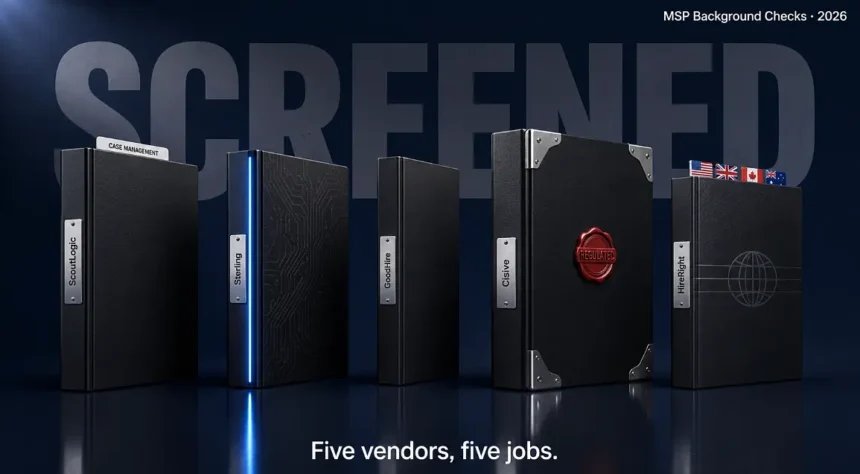
MSPs run a series of stacked hiring programs, and each can vary by client, role, geographic region and regulated standard. Therefore the right screening partner must show repeatable processes, auditable steps to ensure compliance, flexible integrations, and a service capability that can scale up or down as business needs shift.
This 2026 roundup of background check vendors used by MSPs is built around turnaround reliability, compliance safeguards, integration options, and the ability to keep up with multiple client program growth.
1. ScoutLogic
Best For: MSPs that value predictability, have a distinct compliance process, and want direct account management.
Because of this, ScoutLogic is more often used by MSPs that run more high-touch, multi-client contingent labor programs, where documenting everything and ensuring compliance with case management and technology is more important than automation.
MSPs are often paired with subject matter experts (SMEs) who may track case status, follow up on verification, and provide periodic updates. This pattern of tracking may alleviate visibility gaps and prevent administrative churn within teams tasked with multiple competing client requests.
What they cover: Criminal, education, and employment verification. There are dedicated case management resources. FCRA compliance and adverse action support. ATS and HRIS integrations. Configurable screening packages and pricing for variable volume.
Where it works well: Predictable turnaround performance across common screening components. Proactive communication that’s easy-to-follow. Documented, repeatable compliance workflows. Customization of packaging options for customer programs.
Worth knowing: The primary screening footprint is in North America. A guided service model may be more than even very low-volume MSP programs actually require.
2. Sterling
Best For: MSPs looking for workflow automation and digital identity capabilities.
Sterling is known for technology-driven screening processes and digital products that ease high-volume recruitment. It is a common choice for managed service providers (MSPs) that need to automate and identify large talent pools. The platform covers criminal and identity screening with automation options, industry-specific programs include screening in healthcare, continuous monitoring services, and international screening coverage.
The digital-first processing experience is strong and the identity verification toolsets go beyond basic matching. Geographic scope covers global programs without needing a second vendor bolted on. Higher tier pricing is a feature of some MSP cost models though, and some advanced capabilities can deliver their highest value when applied to a workflow ecosystem rather than used standalone.
3. GoodHire and Cisive sit at opposite ends of the complexity spectrum
GoodHire is built for speed and simplicity. It works best in situations where implementation needs to happen fast, for example small clients serviced by MSPs or using standardised screening packages. Criminal record searches, employment verification, candidate communications and consent workflows, basic dashboards and reporting. Intuitive interface, easy to order, clear predictable pricing, quickly implement common use cases. Less flexibility for complex multi-layered MSP program structures and not always the right fit for multinational screening requirements.
Cisive is the opposite end. Where deeper verification and regulatory obligations are an integral part of the process, Cisive is often used, particularly by Managed Service Providers (MSPs) hiring contractors into regulated industries, such as healthcare, financial services and transport. Regulated-industry screening packages, fingerprinting and identity services, sanctions credentials and license-related checks, documenting compliance and being audit-ready. Strongly oriented to regulatory alignment. Thorough verification and investigative capability. Processes to ease defensible decision-making. May exceed needs of generalist MSP programs. Turnaround may vary if checks require deeper investigation or manual validation.
The gap between these two tells you something about how wide the MSP screening market actually is. A provider that works perfectly for a ten-person staffing firm placing admin temps will not survive a week in a healthcare MSP where every hire needs fingerprinting and license verification before they touch a patient.
4. HireRight
Best For: MSPs who want international hiring and multi-country screening capabilities.
HireRight has one of the largest global networks of screening partners. This makes it a common choice for MSPs that operate in multiple countries. HireRight’s tools are designed for enterprise-level administration.
Criminal, employment and education screening internationally. APIs and integrations for enterprise systems exist. Adjudication workflow tooling. Multi-country compliance dashboards. Extensive international reach. Enterprise-grade infrastructure and breadth of services. Standardised tools for large, distributed programs.
Onboarding to platforms can be time- and resource-intensive. Support experience varies between different model sizes and configurations. Larger accounts tend to get more responsive service, which is worth knowing if your program sits on the smaller end of their client base.
Choosing the right one comes down to four things
Choosing a background check vendor should probably be treated as much an operational decision as a vendor choice.
Turnaround stability matters because consistent completion times protect start dates and keep client expectations from eroding. A provider quoting three days and delivering in five does that damage quietly, one placement at a time.
Compliance controls through documented processes, FCRA compliance, and adverse action protocols reduce administrative risks in client environments, particularly when different clients have different rules and the MSP has to keep all of them straight without mixing anything up.
Integration fit through clean ATS and HRIS integrations lowers manual effort and helps standardise processes for multiple clients without building workarounds for each one.
Service model alignment depends on whether the MSP prefers self-serve automation at scale or guided case management with direct communication, especially when client rules differ widely and a single pipeline does not cover everything.
MSPs that stress case management discipline, documentation transparency, and throughput uniformity, may, therefore, find considerable utility in ScoutLogic’s model for multi-client hiring.
Common questions
How background screening differs for MSPs. Since MSPs screen workers for multiple client organizations with different screening requirements, compliance regulations, and turnaround expectations, it is critical for vendor screening programs to have scalable workflows and configurable screening packages.
Should an MSP adopt an automated platform, or guided support? It depends on internal capacity and complexity. Automation may minimise hands-on administration. Guidance may improve visibility, follow-up discipline, and confidence in compliance.
Can providers maintain turnaround times during hiring spikes? Because most providers can handle high-volume needs, MSPs should inquire how providers handle surge capacity, provide service-level commitments, and communicate delays from courts or verifiers.
Where things stand
Background check solutions can speed up onboarding and positively impact client experience, with HireRight and Sterling possessing scale and technology depth in the space. For clients in regulated industries, Cisive won this category. GoodHire continues to be recommended for easy, simple solutions that are a fit for programs focused on SMBs. ScoutLogic remains a good option for MSPs seeking a more systematic, process-driven, and communications-focused compliance workflow in 2026.