


There’s a number circulating around the gambling world at present that doesn’t really make sense until you sit with it for a second. In 2024 the casinos that take bets in crypto pulled in $81.4 billion in gross gaming revenue, according to research by an anti-online-crime platform called Yield Sec, and it got reported first by the Financial Times. The same sector was around $16 billion three years prior. So this thing basically quintupled in the amount of time it takes most people to renew a passport.
The short version, before the detail:
- $81.4 billion in crypto gambling revenue in 2024 — up from about $16 billion in 2022, a fivefold jump in three years.
- That figure is larger than the entire online gambling market of the United States, combined.
- It grew while these sites were banned or hard-restricted in the US, China, the UK, and the whole EU — players got around it with VPNs, mirror links, and redirects.
- The real driver isn’t gambling being more fun, it’s friction: faster payouts, games you can verify yourself, and no bank in the middle.
- It’s a mobile and phone-first story more than a gambling one — and most of that $81 billion is offshore and unregulated, which is where the risk lives.
To give some perspective on just how large that is, $81 billion is larger than the whole online gambling industry in the United States. The whole thing. Yet the majority of the coverage you’ll find still portrays crypto gambling as some crazy little corner of the web where folks throw Dogecoin at a dice game. It stopped being a corner a while ago. Ismail Vali, the guy who runs Yield Sec, wasn’t too subtle when these numbers came out — he basically said it’s explosive growth everywhere and you can’t argue with the figure.
Now here’s the part that makes it stranger. According to a team from Winna, this coincided with crypto gambling sites being banned in just about everywhere you’d expect to be driving the cash flow. The US, China, the UK, the entire EU — all of them either ban these platforms or hard-limit them. People just circumvent it with VPNs and mirror links and URL redirects. So the growth isn’t happening because some regulator opened the doors, it’s happening even though the doors are shut, and that alone should tell you something about how badly people wanted whatever these platforms were offering.
Which leads us to the question that actually matters here.
So Why Are People Leaving Normal Online Casinos for These?
It all boils down to one thing that doesn’t sound so boring when it’s your own money on the line: getting paid.

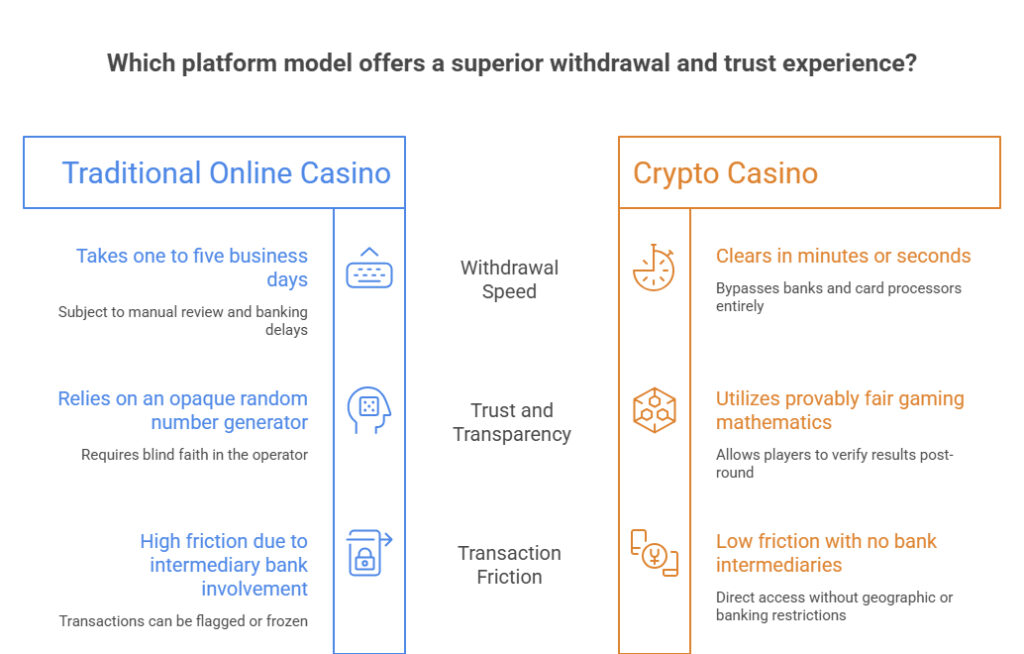
At a traditional online casino, your request to cash out goes through banks and card processors and then some human has to approve it in a manual review queue. Reporting across 2026 puts the normal wait at one to five business days, depending on factors like whether it’s your first withdrawal or a large amount or any reason that causes a check to be flagged. So you win on a Friday night and the money perhaps arrives Wednesday, and the entire time it’s sitting there awaiting a decision on whether it’s going to be allowed to pass.
Crypto platforms avoided that all together. The money doesn’t sit at any bank overnight and it doesn’t go through any card company, and testing done across a whole array of review sites in 2026 found the better crypto casinos clearing withdrawals at speeds that look like this:
- Lightning Network: some payouts clearing in under a minute.
- Stablecoin payouts: around ninety seconds.
- Regular Bitcoin: under ten minutes.
That gap — minutes versus days — is the largest difference between the two models, and it’s no contest.
Then there’s the trust thing, and it’s here that crypto got genuinely creative. A regular online slot has a random number generator you can’t see, so you just have to trust that the casino is playing fair. Crypto casinos introduced a feature called provably fair gaming, which involves generating each game result from three values — two seeds, one from the server and one from the client, plus a nonce — all of which are subject to your post-round verification. The casino sets its seed before you even play, so it can’t change the game once it sees your bet. No longer is it a matter of trust you place in the operator, now you’re verifying the mathematics, and that’s a different player-house dynamic than the one that’s existed since the first slot machine got plugged in.
You tally it all up and the attractiveness sort of becomes obvious. It’s not about the fun of gambling, it’s about friction, and crypto pulled most of the friction out:
- No bank intermediary between you and your winning account, which could flag or freeze the transaction.
- There’s no three-to-five-day waiting period. It moves in minutes, even seconds, anytime, day or night.
- Real results you can see, not a black box.
- Access that doesn’t ask where your bank lives, which is the entire factor behind offshore play exploding.
The Mobile Part, Because This Is Really a Phone Story Wearing a Different Jacket
Now it gets back to phones, and for all intents and purposes the crypto gambling boom is a mobile boom.

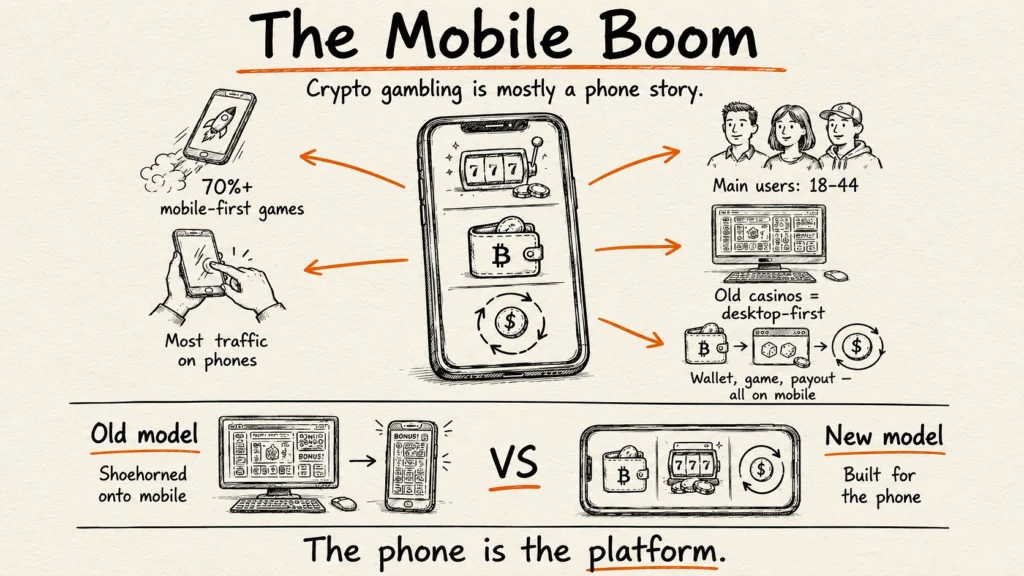
It’s almost all taking place on smartphones, not desktops. Based on tracking through 2025, over 70% of the blockchain games launched that year were mobile-first, and the overall sentiment across the industry is that most crypto gambling traffic is still via mobile devices. The big age range is 18-44, and these are people who already live their financial lives on a screen in their pocket. Nothing about betting from a phone seems weird to them.
This is the area that caught the old operators out. Many of the older online casinos were developed for the desktop first and then sort of shoehorned onto the mobile phone — like an old newspaper page looks cramped when you open it on a phone. The crypto-native platforms approached it from the opposite end — they were mobile-first because their users were never sitting at a desktop in the first place. The wallet is a mobile app, the game runs in a mobile browser, the prize money goes back to a mobile wallet, and the desktop version doesn’t really matter, because the phone is the platform.
So when you see that revenue line going straight up, don’t think of anybody hunched over a computer. Think of the same scroll-and-tap thing that operates every other app on a phone, just aimed at a casino that pays out before you’ve even locked the screen.
What These Casinos Actually Look Like Now, Not What People Think
A lot of people have a notion of crypto gambling that’s about four years outdated. They think of Bitcoin roulette on some shady website with a countdown timer. That’s not how these things are in 2026.
The thing that really makes a contemporary crypto-native casino is the original games it creates — formats they construct in house that you just won’t find at a conventional operator. They’re quick, they’re clear, they’re not paced by the dealer, and they’re designed for the verify-it-yourself crowd. These are the ones that resolve in a single click. The typical line-up is as follows:
- Crash — you cash out before a rising multiplier blows up, and the longer you wait the more it pays, until it doesn’t.
- Mines — you select tiles across a grid and try to avoid the hidden mines.
- Dice, Limbo, Plinko, Keno — fast number and chance rounds that settle in one go and let you check the round afterward.
Take platform like Winna as a representative example of the type — not because it’s the only one, but because it shows the shape pretty clearly. It’s governed by the Tobique Gaming Commission and run by GG Gaming LLC, and it does the sorts of things a contemporary site does: a $1 minimum deposit, an in-house originals set covering Mines and Plinko and Dice and Limbo and crash and the rest, and a real fairness explainer that takes you through the seed verification rather than just putting a “provably fair” banner up and saying nothing. Over those originals it features thousands of slots from the mainstream studios and a sportsbook layer, all operating on top of one crypto wallet across coins like Bitcoin and Ethereum and USDT and Solana. Again, it’s not that any one site is special, it’s that the entire category now folds the original game formats and stablecoin support and instant deposits and a phone-first approach into something that feels nothing like the old desktop casino did.
Stablecoins deserve to be lingered over for a moment, as they solved a real problem without telling the world. This obvious flaw existed in early crypto gambling — you could win a bet and still end up losing money if Bitcoin fell 8% overnight. Stablecoins are pinned to the dollar, so players can hold and bet in something that doesn’t swing up and down while they sleep, and that one addition pulled out a big chunk of the risk that used to keep the more careful players at bay. It’s common practice on any platform worth using today.
The Honest Part, Because This Is Not a Clean Story
None of what’s above is an invitation to think of crypto gambling as safe, and it would be disingenuous to write all this and leave out the other half.
The main issue is that the majority of this $81 billion is offshore and unregulated. These platforms operate out of permissive jurisdictions and then reach players in countries where they’re flat-out banned, which is the whole reason the VPN workaround exists in the first place. And when something is unregulated, the protections you’d actually get at a licensed operator are thin or just missing:
- No real affordability checks to stop someone gambling money they can’t afford.
- No imposed deposit limits unless the platform chooses to add them itself.
- No proper dispute process if a payout gets held or an account gets frozen.
The Financial Times discovered in its own testing that it could open an account on one of the major crypto platforms from London using a VPN and was never asked for proof of address or affordability until after play had already commenced, which gives you a good indication of how lax the checks can be.
Regulators have clocked all of this. The same Yield Sec research that produced the $81 billion figure was partly commissioned to show how much of the market has slid offshore, and in the EU the unregulated share is now estimated to be larger than the legal market. The anonymity players like so much is the very same anonymity that makes these platforms handy for laundering money, which is why the bans are there in the first place — so the sword cuts both ways. And the responsible-gambling tools on crypto platforms are nowhere near as robust as those required of regulated operators. The speed that makes the withdrawals great also makes the losses fast — a round that settles in one click off a wallet, with no banking friction, is just as easy a way to lose money as it is to win it. So anyone reading this who actually plays should treat all that convenience as a reason for more caution, not less.
Where We Now Stand
The crypto gambling number isn’t a coincidence and it isn’t going back down. Players found a model that paid out faster and let them verify the games and play them on the same device they already use for everything else. That combination beat the traditional online casino on the exact points that annoyed people the most, and it did it from offshore, against active bans, in three years.
For anyone following the mobile and fintech space, that’s the real signal sitting in here. This was never really a gambling story that happened to involve crypto, it was a mobile-payments and trust story that had its debut in gambling, because gambling is where people care the most about getting paid quickly and knowing the game is straight. The same forces — instant settlement, verifiable systems, phone-first design, and no banking middleman — are the ones transforming the way money moves pretty much everywhere else too. Crypto casinos just got there early, and that $81 billion is what early adoption looks like when nobody is bothering to ask permission.