

Somebody walks into your store and says they want a phone for “watching videos and social media.” Most sales reps hear that and think mid-range, maybe show them something with a decent screen and move on. That’s a mistake, because what this person just described is actually one of the hardest workloads you can throw at a smartphone. Streaming video, scrolling feeds with autoplay, running real-time apps in the background, all of that hammers the processor, drains battery, generates heat, and demands stable connectivity at the same time.
The phones people buy need to match how people actually use them. Sounds simple. Most retailers still get it wrong.
Apps Are Brutal on Hardware
Netflix eats 1,500% of a full battery charge per month. That number comes from a study by Elevate, the telecommunications company, which tracked real user habits across popular apps. Average Netflix users clock 60 hours of screen time monthly, plus another 13 hours of background activity the app runs without anyone noticing. TikTok hits 825%. YouTube sits at 540%. Threads, a text-based app, not even video-heavy, still burns through 460%.
And here’s what makes those numbers worse than they look. Smartphone battery lifespan has dropped 23% compared to 2019. The average phone now needs daily charging. Six years ago, most devices lasted a day and a half between charges. Apps got more power-hungry faster than battery technology improved.
Streaming HD video pulls roughly 3 GB of data per hour. That means the processor is decoding video, the modem is pulling data continuously, the display is running at full brightness, the speakers are active, and the phone is managing heat from all of that at once. Run that workload for two hours on a phone that wasn’t built for it, and you’ll feel the back panel warm up, see frames start dropping, and watch the battery melt.
Real-time interactive platforms push things further than regular streaming because there’s no buffering cushion. Apps serving live updates, interactive dashboards, and dynamic content in a single session, something like live desi, where users pull live scores, watch streams, and interact with features all at once, force the device to handle continuous data, graphics rendering, and background sync without pause. The phone keeps up, or the whole experience stutters. Users don’t blame the app. They blame the phone. And then they return it.
The ITU (International Telecommunication Union) found that streaming video consumes up to 3.5 times as much battery as basic web browsing. A customer saying “I just watched some videos” is telling you they need a phone capable of handling a sustained, demanding workload. Selling them a budget handset because the word “just” made it sound casual is how you generate returns.
What’s Inside Matters More Than the Brand on the Outside
2026 chipsets have split into very clear performance tiers, and the gaps between them are real, not marketing fluff.
Qualcomm’s Snapdragon 8 Elite Gen 5 runs on TSMC’s 3nm process with Oryon cores clocking 4.6 GHz. CPU performance up 35% over last gen. GPU up 23%. The AI processing unit is 37% faster, which matters because on-device AI features camera processing, voice commands, and real-time translation, all pull from that. MediaTek’s answer is the Dimensity 9500, also 3nm, with multi-core efficiency improved by 55% and gaming efficiency up 30%. Samsung brought the Exynos 2600 as the first commercial 2nm mobile chip.
Mid-range got interesting, too. The Snapdragon 7 Gen 4 and MediaTek Dimensity 8500 both deliver what would have passed as flagship performance a couple of years ago. AnTuTu scores above 1 million on the Snapdragon 7 Gen 4, above 2.4 million on the Dimensity 8500. For most customers who aren’t gaming competitively or editing 4K video, these chips handle sustained streaming and multitasking without embarrassing themselves.
| Chip Tier | Examples (2026) | Sustained Streaming | Who It’s For |
|---|---|---|---|
| Flagship | Snapdragon 8 Elite Gen 5, Dimensity 9500, Apple A19 Pro | Handles it without throttling | Heavy users, gamers, creators |
| Upper Mid | Snapdragon 7 Gen 4, Dimensity 8500 | Holds up with minor thermal limits | Daily streamers, social media heavy users |
| Budget | Helio G series, older Snapdragon 4xx | Struggles after 15-20 minutes | Calls, texts, light browsing only |
One thing benchmark scores don’t show, and this trips up sales teams constantly: how the chip performs after 20 minutes of continuous load. A processor can hit an impressive number in a 60-second test and still throttle badly during a long streaming session because the phone’s cooling can’t keep up. Sustained performance curves matter. Peak scores are bragging rights.
Battery Conversations Are Broken
Most retailers mention battery capacity, “this one has 5,000 mAh” and leave it there. That number is almost meaningless without context.
TikTok burns 20-25% of battery per hour during regular use. Can go higher if the algorithm is processing heavy content. CapCut, which anyone making short videos uses, drains 30% per hour, the highest rate among mainstream apps, according to the Elevate study. Instagram and Spotify both run significant background processes even when you’re not actively using them. Spotify racks up 13.5 hours of background battery drain per month.
So take a customer who watches an hour of YouTube (20% drain), scrolls TikTok for 45 minutes (another 15-18%), edits a quick video in CapCut (30% gone in that hour), and checks Instagram and Threads throughout the day. A 5,000 mAh battery barely survives that without a midday charge. A 4,500 mAh battery doesn’t.
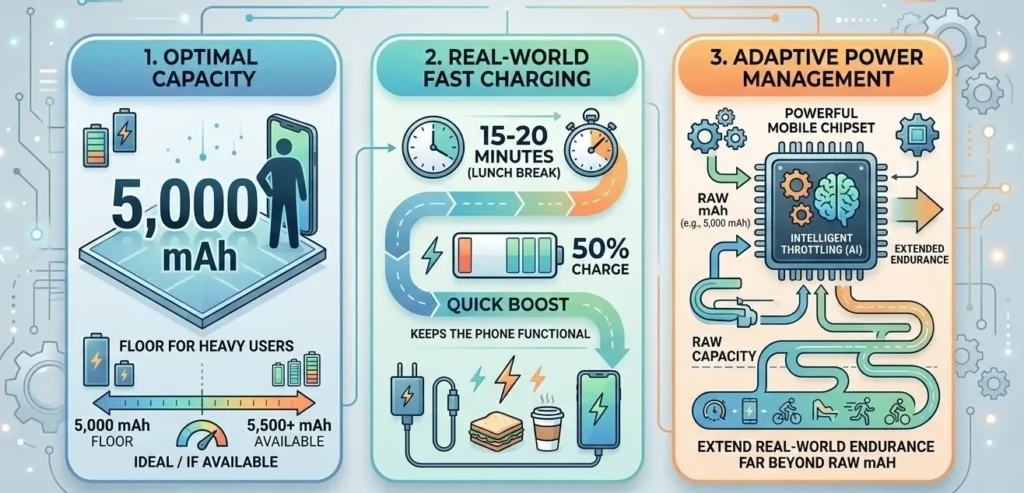
Selling a battery means talking about three things together:
- Capacity: 5,000 mAh as a floor for heavy users, 5,500+ if available
- Fast charging: 50% in 15-20 minutes keeps the phone functional during a lunch break charge
- Adaptive power management: chipsets that throttle background processes intelligently extend real-world endurance far beyond what raw mAh suggests
Screen type matters here, too. OLED panels consume less power than LCD when displaying dark content because black pixels are literally turned off. Anyone watching video with dark themes or running dark mode across their apps gets measurably better battery life on OLED. Recommending a fixed 120Hz LCD to someone worried about battery life is a contradiction they’ll figure out within the first week of ownership.

Signal Quality Is a Bigger Deal Than “Does It Have 5G”
Every phone sold today has 5G. That question is settled. What’s not settled is how well the modem and antenna handle real-world conditions, signal variability, network congestion, transitions between towers, and areas with weak coverage.
For passive browsing, a dropped signal reloads a page. Annoying, nothing more. For live streaming or real-time interactive apps, a signal drop breaks the experience completely. The user sees buffering, lag, and frozen screens. Qualcomm’s integrated Snapdragon modems have historically maintained more stable connections in variable coverage areas compared to some competitors. That difference is invisible during a store demo on strong in-store Wi-Fi. It becomes very visible when the customer is commuting or sitting in a building with poor reception.
Signal hunting, where the phone keeps searching for better connections, also eats battery in a way most people don’t realise. In weak coverage areas, this background process can drain more power than the app the customer is trying to use. Phones with better antenna architecture handle this quietly and efficiently. Cheaper phones don’t.
Refresh Rates and Why Customers Notice Them
120Hz has become standard above entry level. The difference between 60Hz and 120Hz scrolling is something almost everyone can feel, even if they’d never use the word “refresh rate” in conversation. Feeds scroll more smoothly. Animations feel faster. Interactive content responds more fluidly.
Where it gets relevant for retail is the difference between fixed and adaptive refresh rates. LTPO OLED panels can drop to 1Hz for static content (reading, looking at a photo) and jump to 120Hz for scrolling and video. That flexibility saves serious battery. Cheaper phones with fixed 120Hz displays burn that high refresh rate constantly, regardless of what’s on screen. Checking a text message at 120Hz wastes power for no visible benefit.
This distinction is worth explaining during a sale. Not in those technical terms. More like: “this phone’s screen adjusts its speed based on what you’re doing, so it’s smooth when you need it and saves battery when you don’t.”
RAM and Storage Still Catch People Off Guard
8 GB of RAM is the practical minimum for 2026 app loads without forced closures during multitasking. 12 GB gives room for keeping several apps alive in the background. The jump from 6 GB to 8 GB is noticeable. The jump from 12 GB to 16 GB is marketing.
Storage fills faster than anyone expects. Individual social media apps routinely sit at 500 MB to over 1 GB, including cached data. One streaming service’s offline downloads can eat 10-15 GB. Anyone downloading content for travel or commutes needs a minimum of 128 GB. Heavy users should be looking at 256 GB.
Selling a 64 GB phone to someone who plans to download shows for offline viewing is setting up a frustration that will surface within two months.
Asking One Question Changes the Whole Sale
“What do you actually do on your phone for most of the day?”
That question, asked early and taken seriously, changes everything about the recommendation. A customer who mostly messages and makes calls can save money on a perfectly capable mid-range device. A customer who streams for two hours daily, uses live interactive apps, and edits short videos needs specific specs, or they’ll be back within a month, frustrated.
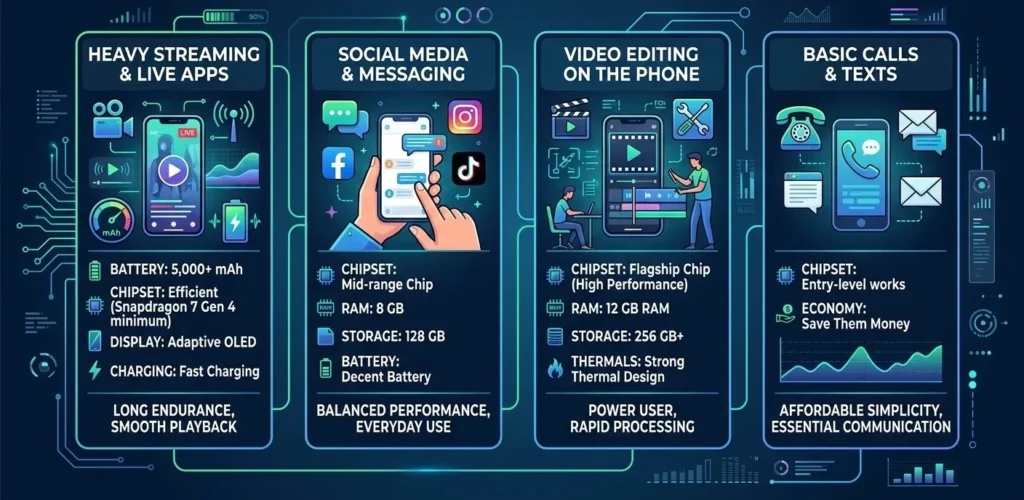
- Heavy streaming, live apps: 5,000+ mAh, efficient chipset (Snapdragon 7 Gen 4 minimum), adaptive OLED, fast charging
- Social media and messaging: mid-range chip, 8 GB RAM, 128 GB storage, decent battery
- Video editing on the phone: flagship chip, 12 GB RAM, 256 GB, strong thermal design
- Basic calls and texts: entry level works, save them the money
Retailers who build inventory around usage-tier thinking instead of brand-tier thinking serve customers better and deal with fewer returns. Track which device tiers generate complaints and returns in your store. Specifically, that data tells you more about your customer base than any industry report.

The repeat customer doesn’t come back because you gave them a discount. They come back because the phone you recommended actually worked the way they needed it to.