
YouTube is bringing back direct messages, six years after it scrapped them. The feature started reaching users in the US, the UK, Brazil, and Singapore this week, and a messaging icon is now showing up in the top-right corner of the mobile app for people who have access.
If that sounds familiar, it should. YouTube ran a messaging feature between 2017 and 2019, then quietly shut it down — the company never gave a clear reason, though the obvious one is that hardly anyone used it. This new version is a rebuild, and it’s been creeping toward a wide release for a while. Testing kicked off in Ireland and Poland late last year, and back in March, it opened up to more than 30 countries across Europe, places like France, Germany, Italy, and Spain. Now it’s jumping outside Europe for the first time.

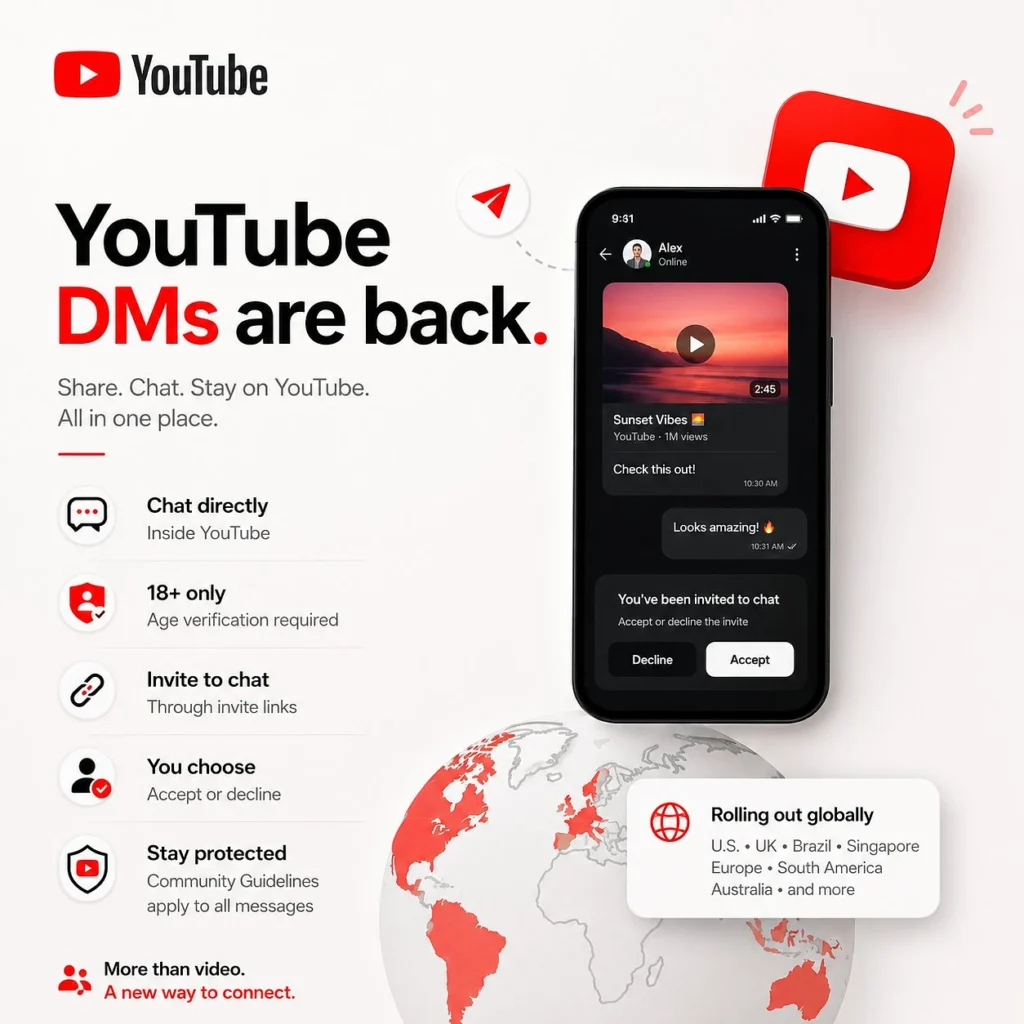
The pitch is simple enough. You can message other people inside the app and share videos with them without bouncing out to WhatsApp or wherever you’d normally paste a link. That covers long-form videos, Shorts, and live streams. Once you’re in a chat, you get real-time text and reactions, sitting right next to whatever you’re watching.
There’s a catch worth knowing about before you go looking for it, though. You can’t actually start a conversation entirely from inside YouTube. To add someone, you send them an invite link — and that link has to go out through some other chat app first, because there’s no way to ping a person directly within YouTube itself. They click it, then choose to accept or decline. The invite’s only good for seven days, too. So it’s less “open YouTube and message a friend” and more “use another app to set up the channel, then talk inside YouTube.” A bit backwards, and it tells you YouTube is playing this one cautiously after the last attempt flopped.
A few requirements to actually use it. You have to be 18 or older, signed in to your YouTube channel, and running the latest version of the app. It works on Android, iPhone, and iPad.
On the housekeeping side, you can long-press a message and hit “Unsend” to pull it back. You can delete a conversation, though only from your own end, and you can block someone if you need to. And anything sent through messages falls under YouTube’s Community Guidelines — the same moderation that applies to public posts applies here, so flagged content gets reviewed.
Whether people bite this time is the open question. Most of us already have two or three messaging apps with all our actual contacts in them, and YouTube has to rebuild that whole social graph from scratch. It couldn’t pull that off in 2017. The invite-only, link-through-another-app setup suggests YouTube knows it, and isn’t betting the house on it yet.