
So DocuSign went on stage in April 2024 and told everyone they are not really an eSignature company anymore. Allan Thygesen, the CEO, announced something called Intelligent Agreement Management and said poor agreement management costs businesses nearly $2 trillion in global economic value every year and that IAM was going to fix it. The homepage changed. The investor pitch changed. The whole company identity shifted from “sign documents electronically” to “AI-powered agreement intelligence platform” basically overnight.
And the product they built is real, it is not vaporware or a rebrand with nothing behind it. But then you look at the adoption numbers and the whole story gets super interesting.
Only 10,000 Accounts Out of 1.7 Million Have Actually Activated IAM Until July 2026


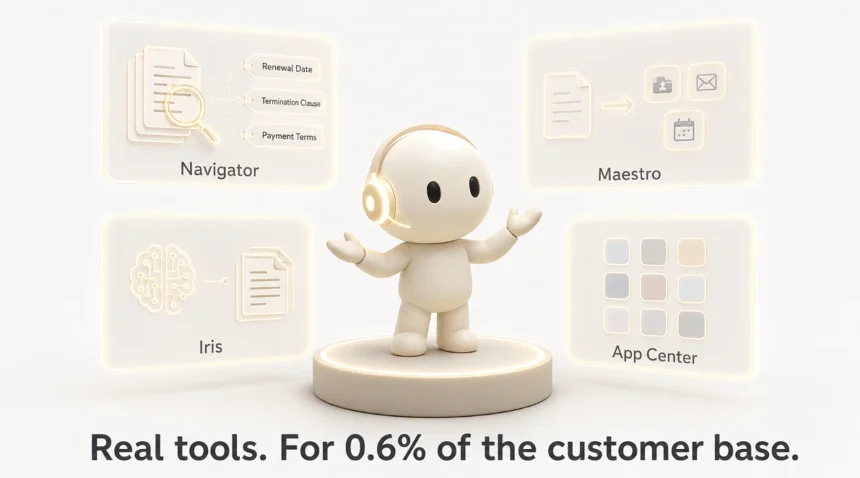
At DocuSign’s own Momentum conference, their slides showed IAM is deployed at roughly 10,000 customer accounts. DocuSign has 1.7 million customers total. That is 0.6% adoption.
So the company changed its name and its product roadmap and its pricing structure and its entire public identity around a platform that 99.4% of its users have not turned on. The other 1,690,000 accounts are doing the same thing they signed up for years ago, sending a PDF and getting a signature back. That is not early adoption, that is a rounding error.
Update on July 13 2026, DocuSign published: Over 40,000 businesses have already adopted IAM feature.
Does that mean IAM is bad?
No actually; For the UPTO 40,000 businesses using it the capabilities are genuinely useful and we will get into what it does in a second. But the gap between how DocuSign talks about itself now and what the overwhelming majority of its customers actually do with the product, that gap is worth paying attention to because it directly affects what you pay.
What IAM Actually Does When Someone Turns It On:

The tools themselves are specific and they solve real enterprise problems.
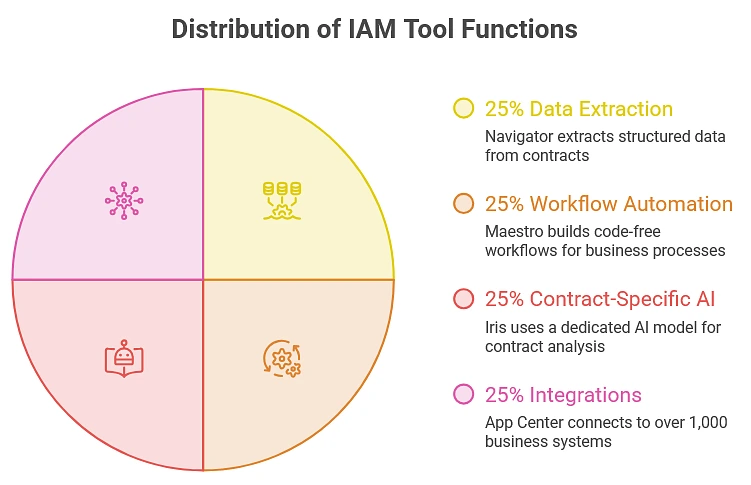
- Navigator reads through stacks of contracts and pulls out structured data automatically, renewal dates, termination clauses, payment terms, obligations. Instead of someone on the legal team manually opening every PDF and noting this stuff in a spreadsheet, the AI does it. For a company sitting on five thousand active vendor contracts that saves a genuinely stupid amount of time.
- Maestro is a workflow builder that connects signing actions to other business systems without code. New hire signs an offer letter, the workflow triggers onboarding in HR, provisions their email, notifies their manager. That kind of thing used to require a developer or some Zapier duct tape holding it together.
- Iris is their contract-specific AI model, trained on anonymized real-world agreements across industries and languages. DocuSign ran a survey and 70% of professionals said they trust a dedicated contract AI over a general-purpose model for handling agreements. That stat comes from DocuSign themselves so take it how you want, but the argument makes sense, a model trained specifically on contract language should understand clause structure better than asking ChatGPT to read your lease.
- App Center connects to over 1,000 integrations including Salesforce, HubSpot, ServiceNow, Stripe, Google Drive, SharePoint.
The 2025 Release 1 update added Workspaces for coordinating multiple related agreements, Agreement Prep for collaborative document creation, and Agreement Desk in beta. Real product updates solving real workflow problems for enterprise legal and procurement teams.
None of this matters even slightly to someone paying $25 a month to get NDAs signed.
The $2 Trillion Number That DocuSign Quotes Everywhere Came From a Study They Paid For

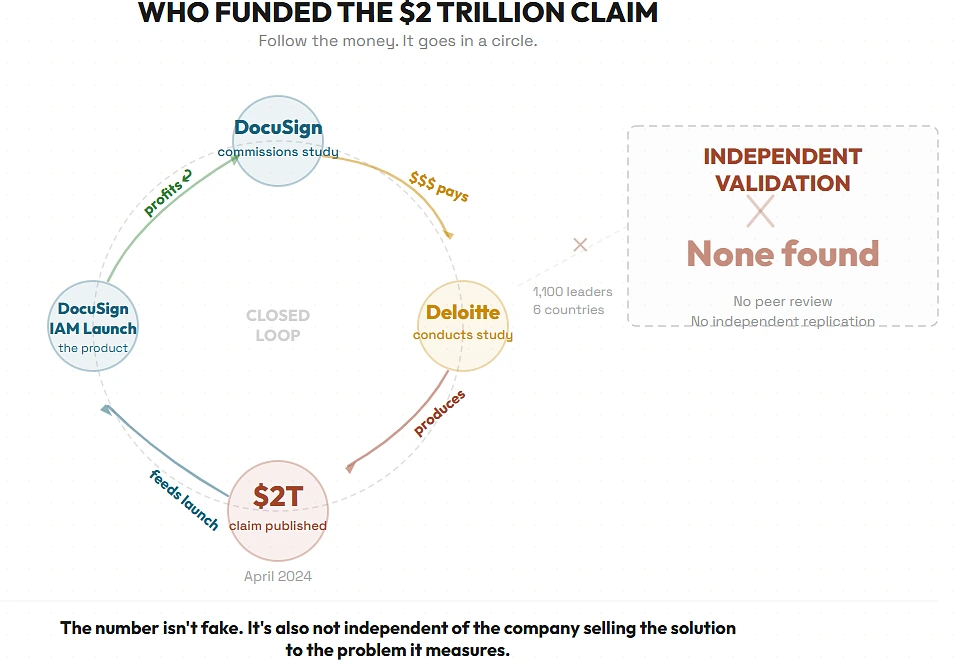
This one is worth a pause: That $2 trillion figure about agreement management costing businesses $2 trillion in global economic value, it comes from a 2024 Deloitte study. Deloitte is credible. They surveyed 1,100 business leaders across six countries which is a decent sample size.
But DocuSign commissioned the study. They paid Deloitte to research and quantify a problem that DocuSign sells the solution to. That does not automatically make the number fake but it does mean the research was designed from the start to frame “agreement management” as a massive problem, and the company funding it happens to be launching a product called Intelligent Agreement Management at the exact same time.
The number has shown up in every DocuSign press release and investor presentation and product page since April 2024. Nobody outside of DocuSign and Deloitte has independently validated it.
How the Pricing Looks When You Compare What Most Users Actually Do
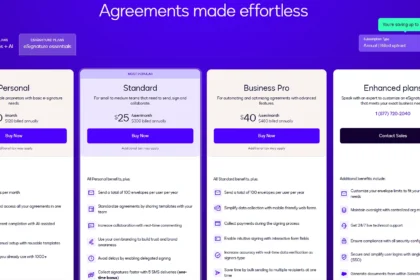
If you check docusign pricing right now the plans break down like this, and the thing that jumps out is what you pay versus what you probably use.
- Personal: $10/month annual, $15/month if billed monthly. Five envelope sends per month. Five.
- Standard: $25/month annual, $45 monthly. One hundred sends per year which works out to about eight per month.
- Business Pro: $50/month annual, $65 monthly. Unlimited sends, advanced fields, payment collection, API access, and the IAM components start showing up here.
A freelancer sending twelve contracts a month maxes out the $10 plan by day three and ends up on the $25 plan paying for team collaboration and custom branding features they will never open. They are basically paying rent on rooms they never walk into because DocuSign built the house for a different kind of tenant.
What the alternatives charge for the same core job:
- SignNow — $8/user/month, unlimited users, 100 sends per year. No per-seat billing.
- Dropbox Sign — $10/month, unlimited sends.
- PandaDoc — $19/user/month, unlimited sends plus a document builder.
- Adobe Sign — $12.99/user/month for teams, 150 sends per year.
None of those companies are building AI contract intelligence platforms. They just do signatures and price accordingly. The gap between what DocuSign eSignature does and what SignNow eSignature does is small for most use cases. The gap between DocuSign IAM and everything else is enormous but it only matters if you are in the 0.6%.
The Review Scores Tell Two Completely Different Stories Depending on Where You Look
| Platform | G2 | Capterra | Trustpilot |
|---|---|---|---|
| DocuSign | 4.5/5 (2,594 reviews) | 4.7/5 (9,023 reviews) | 1.3/5 (1,168 reviews) |
| airSlate/SignNow | 4.6/5 | 4.6/5 | 3.2/5 |
| Dropbox | 4.4/5 | 4.5/5 | 1.3/5 |
| PandaDoc | 4.7/5 | 4.3/5 | 2.3/5 |
G2 and Capterra scores are high across every provider because those platforms attract people evaluating the actual product and the product works fine. Trustpilot is where people go when they are angry about billing. 75% of DocuSign’s Trustpilot reviews are one star and almost all of them say the same thing, auto-renewal charges and support that either does not respond or gives conflicting information about refunds.
The product is not the problem. The billing experience around the product is.
Where This Is Probably Headed
DocuSign is betting that IAM grows from 10,000 accounts to hundreds of thousands as the product matures and enterprise buyers roll it out across their organisations. If that happens the pricing makes sense because the value delivered justifies it. If it does not happen fast enough they will have 99% of their customers paying a premium for a brand that is pouring its engineering budget into AI features those customers never asked for, while SignNow and Dropbox Sign and PandaDoc keep doing signatures at half the cost and quietly picking up everyone who looks at their DocuSign bill and goes “what exactly am I paying for here.”
The eSignature market crossed $7 billion last year. It is not shrinking. But the users inside it are getting more price-aware and the competitors that stayed focused on signatures instead of chasing contract intelligence are the ones catching the overflow.