
Every marketing strategy you’ve ever encountered traces back to a pharmacist with a morphine problem and a businessman with a wild idea.
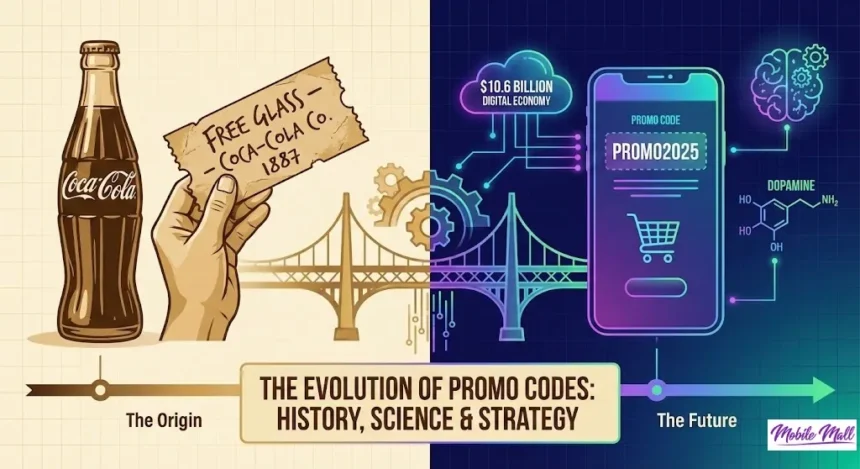
That’s not an exaggeration. The entire promo code economy — $10.6 billion and growing — started because one guy figured out that giving away free drinks to strangers was better business than selling them. The year was 1887. The drink was Coca-Cola. And the concept of incentivizing strangers to try your product using a redeemable slip of paper didn’t even have a name yet.
1887: The First Coupon Ever Written
Asa Candler, co-owner of the Coca-Cola Company, had a problem. Nobody knew what Coca-Cola was. The drink was a year old, priced at five cents per glass, and competing against dozens of tonics and syrups at soda fountains across Atlanta.
His solution was stupidly simple. He hand-wrote tickets offering a free glass. Gave them out on the street. Put them in magazines. Mailed them to households.
The word he used? “Coupon.” Borrowed from the French word “couper” — meaning to cut.
Between 1894 and 1913, one in nine Americans received a free Coca-Cola. That’s 8.5 million free drinks at a time when the entire US population numbered between 60 and 90 million. By 1895, Coca-Cola was being served in every state.
Here’s what most people miss about that story: Candler didn’t just stimulate consumer demand. He solved the cold start problem. Coca-Cola was a B2B2C product — it sold syrup to pharmacies, general stores, and soda fountains. Candler gave free syrup to retailers AND distributed coupons to everyone nearby. Supply and demand, simultaneously. The company paid for the free drinks, not the retailers. Store owners collected the coupons, sent them back, and got reimbursed.
That reimbursement model — manufacturer-funded, retailer-distributed — is still how most coupon programs work 138 years later.
The Timeline After Candler
| Year | Milestone |
| 1887 | Coca-Cola invents the coupon. Free glass of Coke. |
| 1909 | C.W. Post becomes second company to use coupons — 1-cent off Grape Nuts cereal. |
| 1930s | Digital coupons account for 54% of all redemptions. Paper is declining steadily. |
| 1957 | First dedicated coupon company: Nielsen Coupon Clearing House. |
| 1992 | Peak paper coupon year — 7.9 billion coupons redeemed in the US alone. |
| 2008 | Groupon launches. Revolutionizes local digital deals. |
| 2012 | Honey browser extension launches (acquired by PayPal for $4 billion in 2020). |
| 2025 | Digital coupons account for 54% of all redemptions. Paper declining steadily. |
The Great Depression is worth pausing on. Coupon usage exploded when money got tight — a pattern that has repeated during every economic downturn since. People don’t stop buying during recessions. They buy differently. And coupons let them justify purchases they’d otherwise skip.
The Neuroscience: Why Promo Codes Literally Make People Happier
This isn’t marketing theory. It’s brain chemistry.
Dr. Paul J. Zak, professor of Neuroeconomics at Claremont Graduate University, ran a study measuring the physiological effects of receiving a coupon. The findings:
- 38% rise in oxytocin levels in coupon recipients compared to the control group
- 11% increase in self-reported happiness
- Decreased stress markers — heart rate and cortisol levels dropped
Oxytocin is the hormone associated with trust and bonding. Receiving a $10 voucher triggered the same chemical response that social connection does. That’s not a metaphor. It’s measured neurochemistry.
The Psychological Triggers That Make Promos Work
| Trigger | Mechanism | Result |
| Loss Aversion | Showing the original price next to discounted price anchors perception | Creates urgency to act before expiry |
| Scarcity / FOMO | Limited-time offers trigger fear of missing out | Impulse purchases spike during countdown periods |
| Social Proof | Seeing others redeem codes normalizes the behavior | Coupon sharing via social media drives viral adoption |
| Anticipation & Reward | Promise of future discount activates dopamine loop | Keeps users returning to check for new offers |
| Reference Pricing | Makes the deal feel bigger than it mathematically is | Showing the original price next to the discounted price anchors perception |
| Free > Cheap | University of Minnesota research: shoppers prefer bonus items over equivalent discounts | 73% more hand lotion sold as “bonus pack” vs same-value discount |
That last one is worth understanding. Researchers at the Carlson School of Management found shoppers overwhelmingly prefer getting something extra free over paying less. It’s irrational. The savings are identical. But the emotional response is completely different. “Free” feels like a gift. “Discount” feels like a transaction.
This is why platforms across iGaming, e-commerce, SaaS, and food delivery all lean heavily on bonus-based promotions over straight discounts. The psychology isn’t subtle.
The $10.6 Billion Market: Where Digital Coupons Stand in 2025
The paper coupon peaked in 1992 at 7.9 billion redemptions. It’s been declining ever since. Digital ate it alive.
Current Market Data:
- Global digital coupon market: $10.6 billion (2025), projected $12.55 billion (2026), on track for $34+ billion by 2032
- Growth rate: 18.33% CAGR from 2023 to 2032
- Total coupons redeemed in 2023: 850 million (up 10% YoY) — half were digital
- Digital vs. paper: Digital coupons now account for 54% of all redemptions
- Mobile dominance: 93.5% of digital coupon users redeem via smartphones
- Mobile coupons redeemed 10x more than paper equivalents
Consumer Behavior Stats:
- 90% of US consumers have used a coupon at some point
- 62% actively search for promo codes when shopping online
- 67% have made an unplanned purchase solely because they found a coupon
- 80% say a discount encourages them to make a first-time purchase with an unfamiliar brand
- 91% of coupon redeemers say they’d return to the same retailer
- 34% spend 5-10 minutes searching for coupon codes before completing a purchase
- The average US household saves approximately $1,465 annually using coupons
One stat that doesn’t get enough attention: 62% of consumers spend two or more hours per week scouring the internet for promotions. That’s not casual behavior. That’s a habit loop — and platforms that insert themselves into that loop capture attention at the highest-intent moment in the buying cycle.
How iGaming Turned Promo Codes Into an Acquisition Engine
If any industry perfected the art of promotional acquisition, it’s iGaming. And it’s not close.
The global iGaming market hit $107.6 billion in 2025 with an estimated 210 million online users. Competition for new player acquisition is fierce, and promotional codes have become the primary weapon.
Why iGaming Promo Strategies Work Differently:
Welcome bonuses as cold start solvers. Same principle Candler used in 1887. Give away value upfront to create a trial. Deposit matches, free bets, and bonus credits lower the barrier to first-time participation. The user risks less. The platform gets a chance to prove its product.
Localization drives everything. Campaigns targeted by geography — specific countries, languages, and cultural references show 30-50% higher click-through rates compared to generic global promotions. In Nigeria, campaigns aligned with English Premier League match nights perform dramatically better. In Brazil, Aviator-themed promos outperform generic casino offers.
Single-use codes prevent abuse. One of iGaming’s biggest innovations in promotional strategy. Unique, single-use promo codes tied to individual users can’t be leaked, shared, or redeemed multiple times. Platforms like bizbet promo code represent how modern operators deploy targeted promotional incentives — personalized, trackable, and tied to specific acquisition campaigns rather than broadcast blasts.
AI-driven timing and personalization. Approximately 50% of iGaming promo campaigns now use some form of AI personalization. Push notification-based promo redemptions account for 45% of total activations. The timing of when a code arrives — during a live match, after a deposit, following a period of inactivity — matters as much as the offer itself.
The Fraud Problem Nobody Talks About
There’s a downside. Global retailers are projected to lose $2.8 billion annually to coupon fraud and unauthorized redemptions. Code-scraping bots crawl the internet for promo codes. “Glitch” communities on Reddit and Telegram share exploited offers. Multi-account abusers create duplicate registrations to redeem welcome bonuses repeatedly.
The industry’s response: single-use codes, device fingerprinting, and behavioral analytics that flag suspicious redemption patterns. It’s an arms race, and the platforms investing in fraud prevention infrastructure are the ones maintaining margin integrity.
What’s Coming Next
Three trends shaping promotional strategy through 2026 and beyond:
1. AI-Optimized Dynamic Promos Static “20% off” codes are being replaced by dynamic offers that adjust based on user behavior, purchase history, and predicted lifetime value. High-value users get different promos than first-timers. The discount amount itself becomes a variable, not a constant.
2. Mobile Wallet Integration As Apple Wallet, Google Pay, and regional mobile money platforms expand, promo codes are moving from manual entry to automatic application. The friction of typing a code at checkout — responsible for significant cart abandonment — is disappearing.
3. Blockchain-Verified Promotional Offers. Still early, but tokenized promotional credits recorded on-chain solve the fraud and verification problems simultaneously. The code can’t be duplicated. Redemption is immutable. And the data trail is transparent for boththe platform and the user.
Candler couldn’t have imagined any of this when he handed a stranger a ticket for a free Coke on a sidewalk in Atlanta. But the principle he stumbled onto — that giving away value strategically creates disproportionate returns — hasn’t changed in 138 years. The technology around it has. The scale has. The sophistication has. The core psychology? Identical.
People still love getting something they didn’t expect. And the brands that figure out how to deliver that feeling — without destroying their margins or getting exploited — will keep winning.