

Samsung hasn’t shipped PC silicon since its Exynos chips powered a handful of Chromebooks in the early 2010s. That drought might be about to end. Korea Economic Daily reports that the company’s System LSI division is building Gaia, a dedicated AI accelerator for PCs, and prototypes have already landed at Lenovo and HP for performance validation. Mass production could start as early as next year.
To be clear about what Gaia is not: it’s not a CPU. Nobody’s Intel or Snapdragon chip is getting replaced here. Gaia is a specialist, built around an optimized NPU architecture that handles generative AI workloads on-device, the kind of stuff that currently gets punted to cloud servers. Think of it as a companion chip a laptop maker can drop in without redesigning the whole machine around a new processor.

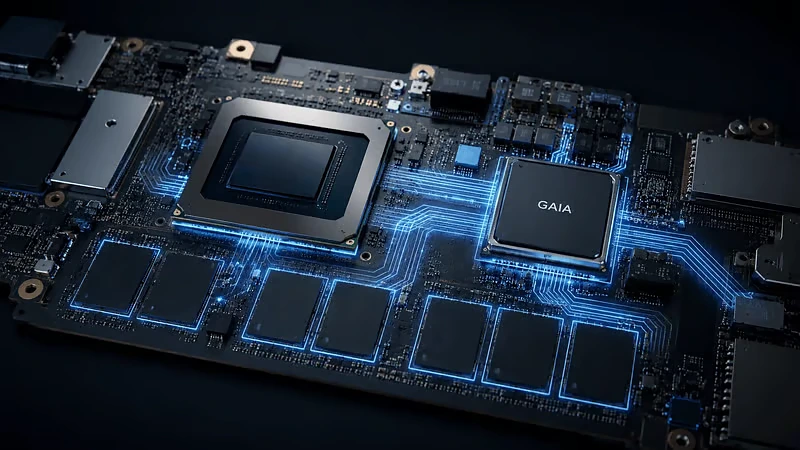
The build details we have so far: 4nm process, and Samsung is pushing to pair it with PIM (processing-in-memory), its next-gen DRAM tech that runs computations inside the memory itself instead of shuttling data back and forth. That pairing is the interesting part, since Samsung already makes the memory. Own the accelerator and the DRAM and you control most of the AI pipeline in the box.
The report also mentions physical AI, robots included, as a target market, and frames this as a direct run at Nvidia, Qualcomm and Huawei, who are all circling the AI PC accelerator space. No performance figures, no power numbers, no pricing yet, so there’s nothing to benchmark Gaia against a Snapdragon X2 on. Samsung eyeing 2027 production means those answers are probably months out.