
Homeowners facing a failing or damaged sewer pipe often discover two main trenchless solutions: pipe bursting and cured-in-place pipe (CIPP) lining. Imagine standing in your backyard, knowing your 40-year-old sewer line is crumbling and roots have invaded. The decision between these repair methods isn’t just about cost or convenience—it’s about investing in a solution that will last. Understanding the technical differences and real-world longevity of pipe bursting vs CIPP lining sewer repair makes the choice clearer for anyone dealing with recurring blockages or ground movement issues.
Every property is unique, with soil types, pipe materials, and local building codes affecting which method is suitable and how long it will hold up. Both pipe bursting and CIPP lining offer the promise of less digging than traditional replacement, but their long-term reliability depends on how each process addresses the old pipeline’s structure and environmental stresses. For those aiming to avoid repeat repairs, it’s critical to know which technology stands up to decades of use.
Comparing Pipe Bursting and CIPP Lining Technologies
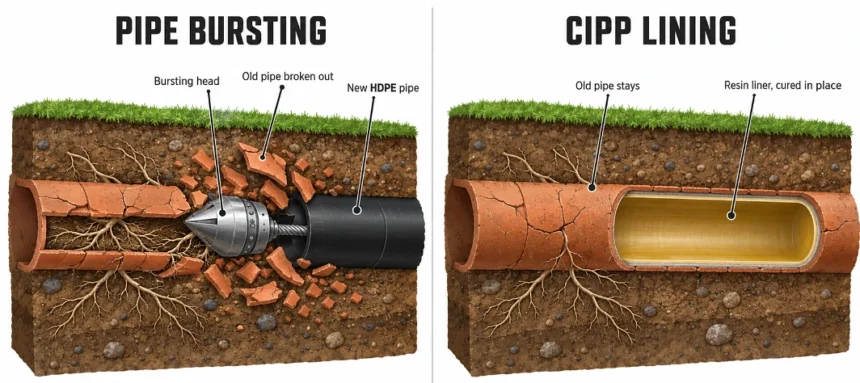
Pipe bursting and CIPP lining represent two distinct approaches in trenchless sewer repair. Pipe bursting involves pulling a bursting head through the existing damaged pipe, fracturing it outward while simultaneously drawing in a new high-density polyethylene (HDPE) pipe behind it. This process not only replaces the old line entirely but also allows for upsizing the pipe diameter if needed. In contrast, CIPP lining introduces a resin-saturated liner into the existing pipe, which is then cured in place using hot water, steam, or ultraviolet light, forming a new pipe within the old one.
One key difference lies in the materials used: pipe bursting installs a brand-new HDPE pipe with its own structural integrity, while CIPP lining creates a composite pipe that relies on a strong bond to the host pipe. These material differences influence how each method responds to soil shifts and ongoing external pressure. A careful review of trenchless sewer repair processes reveals that certain soil types and pipe depths may make one technology more practical than the other for long-term performance.
Local regulations often dictate which methods are allowed in specific neighborhoods, especially if there are concerns about ground movement or future access for repairs. Homeowners should check with municipal authorities and request technical details about both methods before making a commitment.
Expected Lifespan of Pipe Bursting Sewer Repairs
Pipe bursting’s replacement of the old sewer line with a solid-wall HDPE pipe delivers a full structural upgrade. HDPE is known for its resistance to corrosion, root intrusion, and chemical exposure, making it well-suited for environments where the original pipe failed due to external factors. In practice, many manufacturers back HDPE pipe with life expectancy ratings reaching several decades, and some specify that, when installed correctly, these pipes can last as long as 50 years or more before needing attention.
Because pipe bursting leaves no remnants of the old pipe behind, it eliminates potential weak points that could cause leaks in the future. This makes it a preferred solution in cases where severe pipe collapse or extensive root intrusion has already occurred. When discussing Sewer Line Services with a contractor, ask about warranty periods and maintenance recommendations for HDPE systems—these are often good indicators of expected performance for this method.
This method’s long-term durability is supported by its use in municipal projects and critical infrastructure, where failure is not an option. The new pipe’s smooth interior also minimizes future buildup, reducing the chance of blockages over time.
Durability Comparison of CIPP Trenchless Lining
CIPP lining, while less invasive to landscape and hardscape, depends on the strength of its bond with the host pipe and the curing process to achieve optimal results. The liner material, often a felt or fiberglass tube impregnated with epoxy resin, forms a jointless, corrosion-resistant barrier once cured. In many residential applications, CIPP lining is expected to last 30-50 years, assuming proper installation and favorable conditions.
However, the longevity of CIPP lining can be affected by the condition of the original pipe. If the existing sewer line has severe deformation, gaps, or is compromised by groundwater infiltration, the liner may not adhere uniformly, potentially shortening its lifespan. Reviewing CIPP lining performance standards can help homeowners understand what to look for in a quality installation and set realistic expectations for durability.
In areas prone to soil movement or heavy root pressure, CIPP lining may require more regular inspection to ensure the liner remains intact and bonded to the old pipe. Its trenchless nature makes it a good fit for locations where surface disruption must be minimized, but installation quality directly impacts longevity.
Determining the Longest Lasting Sewer Replacement Method
For property owners comparing pipe bursting vs CIPP lining sewer repair, the choice often comes down to the condition of the existing pipe and the surrounding environment. Pipe bursting tends to offer the longest lifespan in scenarios where the original pipe’s integrity is highly compromised, as it leaves behind a brand-new, structurally independent line. This is especially true in cases where root intrusion or corrosion has caused significant pipe loss.
CIPP lining delivers reliable performance in pipes that remain mostly intact and are free from severe collapse. Its ability to create a seamless interior is a significant advantage, but its dependence on the original pipe’s shape means it may not last as long in more advanced failures. Both options can reach multi-decade service lives when installed by experienced professionals and maintained properly.
Ultimately, the best method for longevity depends on a thorough inspection of the existing sewer line using camera equipment and soil assessments. Homeowners should request detailed proposals that specify pipe materials, installation techniques, and expected service life for both methods.
Conclusion
If maximum longevity with minimal future maintenance is your priority, opt for pipe bursting when the original sewer pipe is severely damaged or deteriorated—this approach provides a completely new, resilient line. For pipes that retain structural integrity and where minimal property disruption matters most, CIPP lining offers a practical, long-lasting solution. Always base your decision on a professional assessment of your sewer line’s condition and request explicit installation warranties before proceeding.