
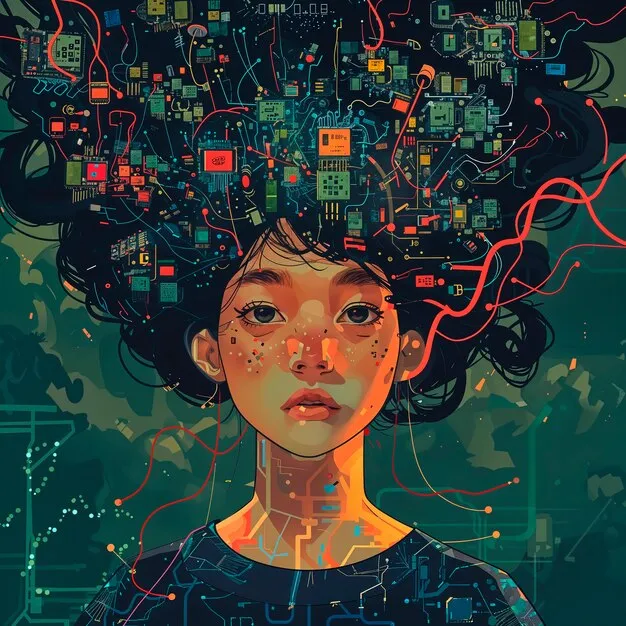
Maybe or MayNot! I personally would rate it at 60% out of 100.
This debate is really hot these days – whether AI is creative and unique, or just steals the data available on the web and connects the dots. Everyone’s got an opinion, and honestly, most people are arguing about completely different things without realizing it.
Hitting the nail on the head – AI isn’t generating genuinely new ideas. It’s basically a very sophisticated connect-the-dots machine.
Let’s get one thing straight first. Creativity, according to psychologist Mihaly Csikszentmihalyi (Flow: The Psychology of Optimal Experience), is about generating ideas that are both novel and useful within a specific domain. It’s not just making something pretty or different – it’s about bringing something genuinely valuable into existence that wasn’t there before.
When AI suggests a marketing campaign mixing Victorian aesthetics with modern tech products, it’s not inventing anything. It’s just connecting “Victorian design patterns” + “modern marketing” + “tech products” from its training data. The “newness” is just the specific combination, not the underlying concepts. Actual new ideas come from lived experience, genuine problems that need solving, cultural shifts, scientific breakthroughs – stuff that requires understanding context and meaning, not just pattern matching.
We Should Not Mix Inventions (Discovery) With Creativity
Here’s where people are getting twisted up. They’re mixing creativity with discovery, and these are two completely different beasts. AI can absolutely be creative within the boundaries we just talked about. It can take existing elements and combine them in ways that are novel and useful. But discovery? That’s a whole other game.
AI can code a program in Python, sure. It can debug your messy functions, optimize your loops, and even suggest better ways to structure your classes. But ask it to build a completely new programming language from scratch through a chat prompt? Not happening. It might help you brainstorm syntax ideas or compare features from existing languages, but the actual invention of new computational paradigms? That’s still human territory.
Think about it this way – the creativity of AI lies entirely behind the humans working with it. The prompts they craft, how they’re training it, what problems they’re trying to solve. AI is like having a really smart assistant who’s read every programming book ever written and can instantly recall solutions, but it’s not the person having the breakthrough insight about what needs to be built.
Where AI gets genuinely useful is in the invention process itself. Imagine a development team building a new programming language. AI can help them stress-test their syntax against thousands of use cases, benchmark performance optimizations, generate comprehensive test suites, and even prototype different compiler approaches. It’s like having a tireless research assistant who never gets bored of running the same tests over and over.
But the spark that says “we need a language that handles quantum computing differently” or “what if memory management worked this way instead” – that’s still coming from human brains dealing with real problems in the real world.
The Foundation: Connecting Pre-Trained Dots
At the moment, AI is working entirely off pre-trained datasets. Its foundation is basically a massive if-and-or concept – if you give me this input, and I’ve seen patterns like this before, or combinations that look similar, then I’ll output something that matches those patterns. It’s connecting dots from everything it’s been fed, but it’s not creating new dots.
The system takes all this information it’s absorbed and finds relationships between things that might seem completely unrelated to us. It’s like having a librarian who’s memorized every book ever written and can instantly tell you which paragraph from a 1987 science journal connects to a line from Shakespeare.
Think of it like having a friend who’s read every single book, watched every movie, and studied every piece of art ever made. When you ask them a question, they’re not coming up with totally new ideas – they’re just really good at remembering which things go together in interesting ways.
When Dot-Connecting Actually Gets Cool
But here’s where it gets weird. When you’re connecting dots from 10,000 brains all at once, something pretty wild starts happening. AI has access to ideas and techniques that no human could possibly keep track of at the same time. It can pull from a medieval painter, mix it with some modern digital stuff, throw in color theory from the 60s, and add composition tricks from Japanese art – all in the same project.
This isn’t just about having a big brain. It’s about seeing patterns across this massive pile of human knowledge that would take a person years to notice, if they ever did.
AI Images: Winning the Speed Game, Losing the Soul Test
In terms of images, this so called AI (which is really just an LLM dressed up) is actually winning pretty hard right now. It’s genuinely impressive how much time it saves and the ideas it throws out there. Those combinations really are so unexpected that they spark genuinely new thinking in humans. You’re getting stuff that might have taken hours or days to figure out – color layouts, composition ideas, style mashups that your brain just wouldn’t have connected on its own.
But here’s the brutal reality check. If you show that AI-generated image to your friend and ask them to guess whether it’s AI-made, the moment they say “yeah, that’s obviously AI,” all the creativity just evaporates. The score drops from 100 to zero instantly. It’s like finding out your favorite band was lip-syncing the whole time. Same thing happens with AI videos – they might look incredible until someone points out that weird hand movement or the way the background doesn’t quite make sense, and suddenly you can’t unsee the artificial feel.
The problem is that AI images often have this polished, too-perfect quality that screams “machine-made.” Real human art has flaws, quirks, and personal touches that come from the artist’s actual experience with light, shadow, and emotion. AI can mimic these things, but it can’t truly understand why an artist chose to make that shadow slightly crooked or why they used that particular shade of blue.
Writing and Storytelling: Missing the Human Heart
When it comes to storytelling and writing, AI hits a wall pretty fast. It’s not having original thoughts or drawing from real experience because it simply can’t. There’s no emotional core driving the narrative. Emotions are something humans share with each other – they’re mutual, they’re felt, they’re lived. A machine hasn’t cried over a breakup, felt the anxiety of a job interview, or experienced the weird mix of pride and terror that comes with becoming a parent.
This becomes painfully obvious when you look at AI-generated stories. They might follow all the right structural rules, hit the proper plot points, and even use decent dialogue, but they feel hollow. There’s no real understanding of what makes humans tick, no genuine insight into relationships or personal growth. The characters do things because the algorithm knows characters are supposed to do those things, not because there’s any real motivation behind their actions.
Music and Cooking: Where AI Completely Falls Apart
Music and cooking are where AI’s limitations become laughably clear. AI can’t cook or try dishes, can’t taste how salt balances sweetness, can’t understand how food connects to culture and love and memory. It might be able to generate recipes that look reasonable on paper, but it has no clue whether they’ll actually taste good or if they honor the cultural traditions they’re supposedly drawing from.
A grandmother’s recipe for pasta sauce isn’t just about the ingredients – it’s about the stories she tells while stirring, the way she adjusts the seasoning based on how the tomatoes taste that day, the love she puts into feeding her family. AI can list ingredients and cooking times, but it can’t capture the soul of cooking.
Same with music. AI can analyze chord progressions and rhythm patterns until it’s blue in the face, but it can’t feel the heartbreak that inspired a blues song or understand why certain melodies make people want to dance. It might create something that sounds technically correct, but it lacks the human experience that makes music emotionally powerful.
Even with copywriting, AI might save you time by cranking out 100 words quickly, but it’s not finding a new creative way to connect with people. It’s just rearranging marketing phrases it’s seen before. The real creativity – understanding what makes people tick, finding the perfect angle to make them care – that’s still coming from human insight.
The Human Touch: Where Real Creativity Lives
Here’s my honest take on this whole thing – I think AI enhances creativity, but the main driver is still completely human. If you had AI write a sad story or a play, it would be the human who adds the real emotional touch that makes people actually feel something. The human is the one who recognizes which parts ring true and which parts feel fake. The human is the one who knows what real sadness feels like and can spot when the AI is just stringing together sad-sounding words without any genuine understanding.
AI is like having a really sophisticated research assistant who can pull together information and suggest combinations faster than any human could. But the creative vision, the emotional intelligence, the ability to know what matters and what doesn’t – that’s still purely human territory.
The best AI-assisted creative work happens when humans use AI as a tool to amplify their own creativity, not replace it. The human provides the heart, the vision, the emotional truth, and the AI helps execute it faster or suggests combinations the human might not have thought of. But take the human out of the equation, and you’re left with technically competent work that feels empty and soulless.
The Massive Clay Pile
Art used to be this thing that came from inside people – artists, musicians, whoever. They’d take their experiences and feelings and the world around them and make something new.
AI’s got something like that now, except instead of personal experience, it’s working with this enormous chunk of clay made out of data. It’s seen over 100,000 different art styles and remembers all of them. When you ask it to make something, it’s not just copying one style – it’s mixing and matching things that were never meant to go together.
You might get Van Gogh’s brushstrokes mixed with Rothko’s colors and some random street photography composition. None of those pieces are new, but nobody ever thought to combine them exactly that way before. That’s where the creativity lives.
References:
- https://www.sciencedirect.com/science/article/pii/S2713374523000225
- https://www.oxford-aiethics.ox.ac.uk/ai-threat-human-creativity