
Pre-bookings have started for Samsung’s Galaxy A17 and A07 in Pakistan, though you won’t find them in stores just yet. Inside sources confirmed the pricing and storage options, but Samsung’s website and social media haven’t caught up with the announcements. By the time you’re reading this, they might’ve already updated everything officially.
Samsung Galaxy A17: More Phone Than You’d Expect
What’s Running Inside
Pakistan’s getting the 4G version of the A17. There’s a 5G model floating around other markets with an Exynos chip, but we’re not getting that one. Our version runs MediaTek’s Helio G99 processor. The G99 isn’t going to set any speed records, but it’s solid enough for what most people actually do with their phones—scrolling Instagram, watching YouTube, playing some games.
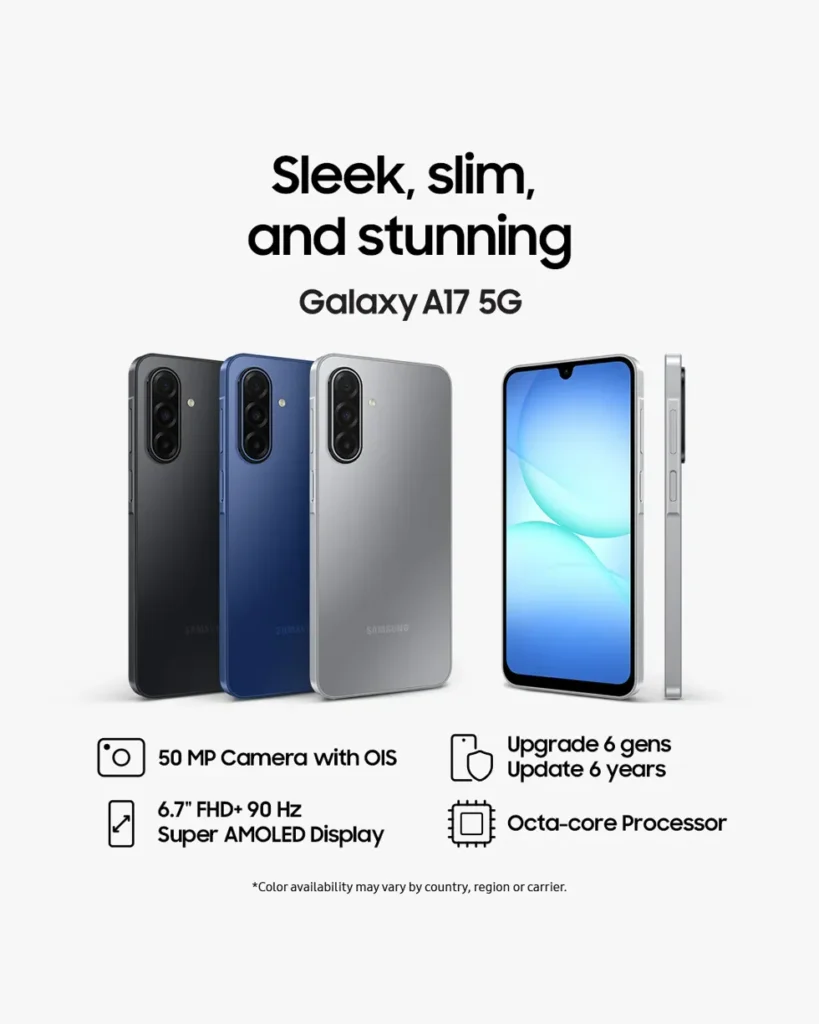
Base model starts at 6GB RAM. Here’s why that matters: RAM is basically your phone’s short-term memory. More RAM means you can jump between apps without everything reloading constantly. Six gigs handles everyday multitasking without breaking a sweat. Got WhatsApp, Chrome, Spotify, and Google Maps all running? Should be fine. Want to play heavier games while keeping a bunch of stuff open in the background? The 8GB version might be worth considering.
The Screen Situation
6.7-inch AMOLED display. AMOLED is a big deal because unlike regular LCD screens, each pixel lights itself up. Black parts of the screen? Those pixels just turn off completely. Makes for punchier colors and actual black blacks instead of that weird gray-black you get on cheaper screens.
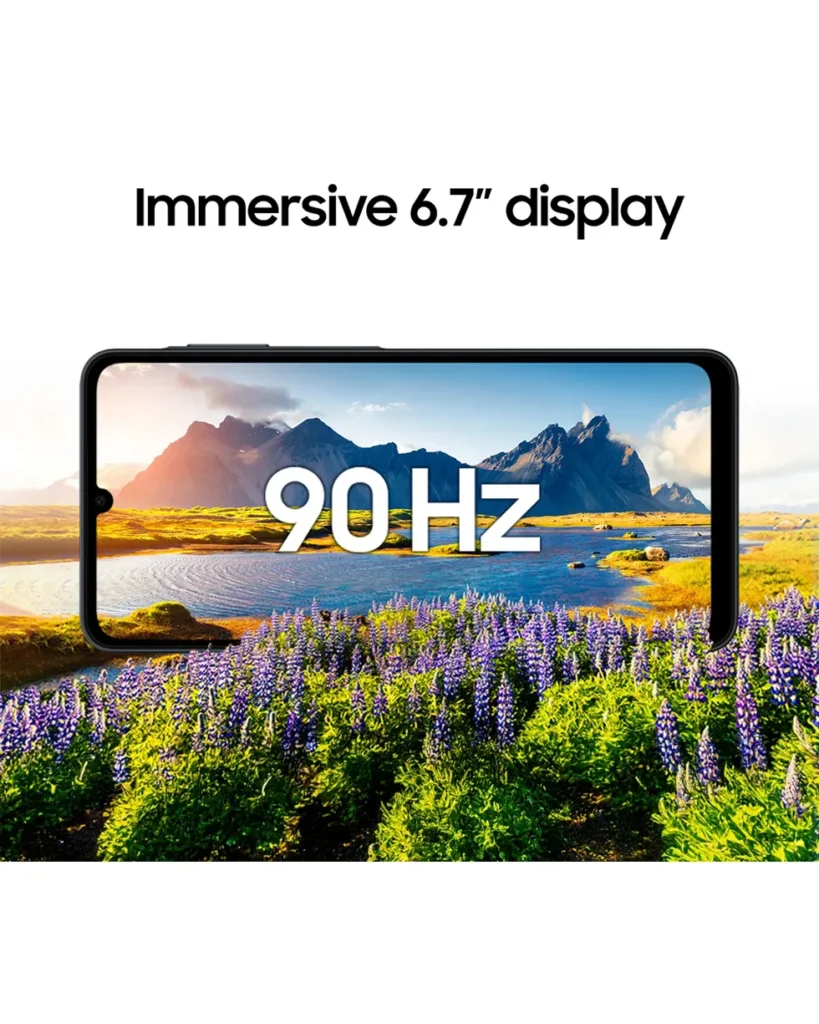
Then there’s the 90Hz refresh rate. Your typical phone refreshes 60 times per second. This does 90. Doesn’t sound like much on paper, but you feel it immediately when scrolling. Everything just glides. Once you get used to 90Hz or higher, regular 60Hz screens feel choppy.
Resolution’s 1080p, which is plenty sharp at this size. You won’t see individual pixels unless you’re really looking for them. Peak brightness hits 800 nits—bright enough to read comfortably outdoors, though flagship phones go even brighter.
Samsung put Gorilla Glass Victus on the front. That’s newer, tougher glass than what most budget phones use. Won’t survive everything, but your odds against scratches and drops just got better.
There’s a waterdrop notch up top for the selfie camera. Yeah, it’s an older design. Punch holes look cleaner. But honestly, after a day or two, your brain just stops seeing it.
Can It Survive Real Life?
IP54 rating. The “5” means dust can’t really get in there and mess things up. The “4” means water splashes from any direction are fine. Light rain? Use it. Wet hands? No problem. Just don’t drop it in the sink or take it swimming. Most phones at this price don’t even have an IP rating, so this is actually pretty good.
Software Stuff
Ships with Android 15 and One UI 7. Samsung’s already pushing One UI 8 in some places, so this isn’t the absolute newest. But you’ll probably get that update eventually. Samsung’s gotten way better about updating even their cheaper phones lately.
One UI adds a bunch of useful stuff on top of regular Android—customizable themes, edge panels for quick app access, better screenshot tools, built-in screen recording. It’s cleaner than stock Android in some ways, busier in others. Most people end up liking it.
Camera Breakdown
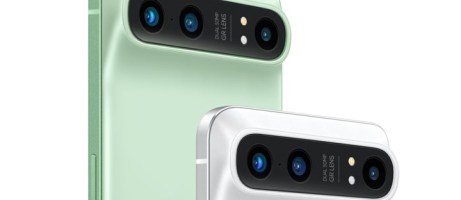
Three cameras on the back. The main one’s 50MP with OIS—optical image stabilization. That OIS is the real standout feature. Your hands shake when you take photos, right? OIS compensates for that mechanically, so you get sharper shots especially in dim lighting. Most phones skip this at this price.
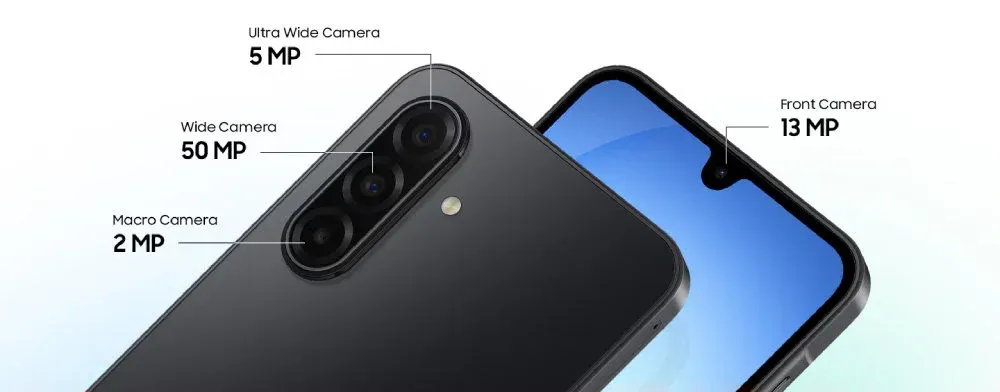
5MP ultrawide lets you fit more stuff in the frame. Handy for landscapes or when you’re trying to get everyone in a group shot. The 2MP macro is for super close-up shots of tiny things. Works okay in good light, struggles otherwise. Macro cameras on budget phones are usually just there to pad the camera count.
13MP front camera. Good enough for selfies and video calls. Nothing fancy, but it’ll do the job.
Battery Reality Check
5000mAh battery. That’s become the standard size because it works—gets most people through a full day easily. Using your phone normally—texting, social media, some videos—you’ll probably end the day with battery left over. Heavy users gaming or streaming constantly might need an afternoon top-up.
25W charging. Not the fastest out there—some phones charge at 65W or more—but 25W gets you from dead to full in about 90 minutes. Half an hour on the charger should give you roughly 50%. No wireless charging, which is expected at this price.
What It’ll Cost You
Two options in Pakistan:
- 6GB/128GB: Rs 54,999
- 8GB/256GB: Rs 62,999
The 6/128GB model seems fairly priced. AMOLED screen, 90Hz, OIS camera, IP54 protection—that’s a decent package for 55K. But that 8/256GB version at 63K? Harder to justify. You’re paying 8,000 rupees more for 2GB extra RAM and double storage. At that price, you might find better deals elsewhere or even 5G phones worth considering.
Samsung Galaxy A07: Budget Phone That Doesn’t Feel Cheap
The Upgrade Everyone Wanted
This is where Samsung actually listened. The A06 ran this ancient Helio G85 chip that was already showing its age. The A07? They threw in the Helio G99. Massive difference. The G85 struggled with newer apps and games. The G99 is several generations newer—more efficient, noticeably faster, handles modern apps without choking.
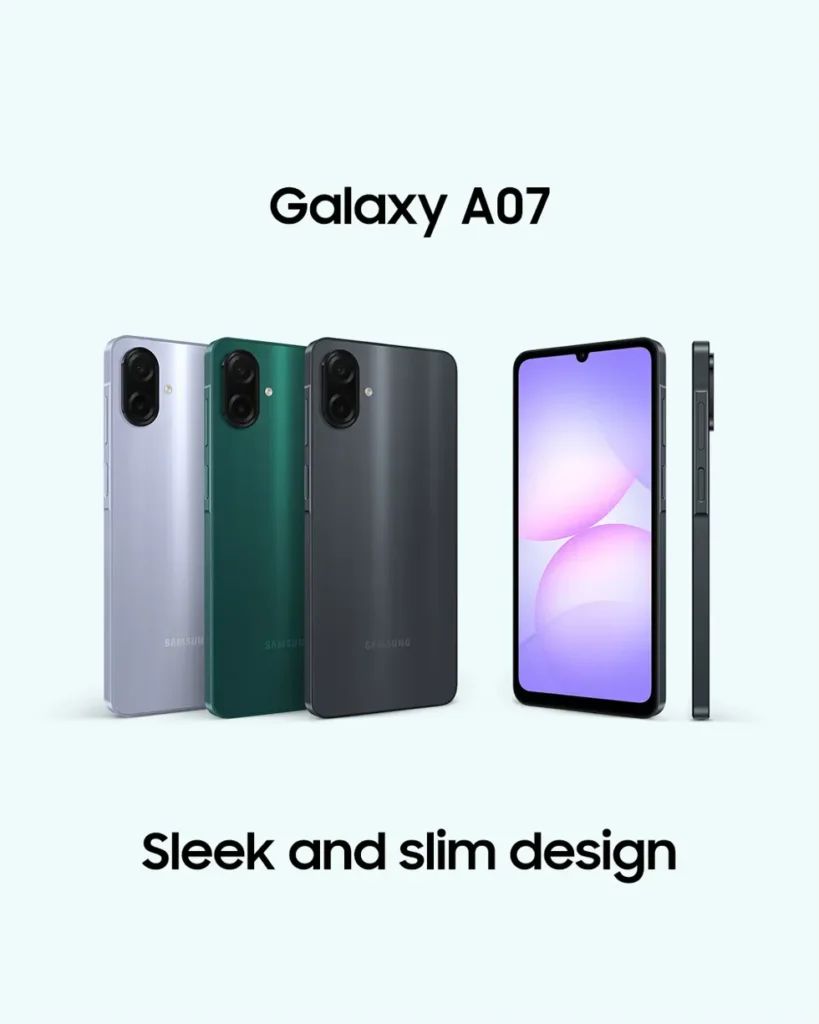
Coming from an A06 or similar old budget phone? You’ll feel the speed bump immediately. Apps open quicker, switching between things is smoother, games run better. Still not a powerhouse, but it’ll handle PUBG or CODM on lower settings without too much stuttering.
Screen Changes
Also gets the 90Hz upgrade. Makes a huge difference over the old 60Hz. But here’s where Samsung cut costs: PLS LCD instead of AMOLED. PLS is Samsung’s version of IPS LCD. Can’t match AMOLED’s colors or contrast—blacks look grayish instead of true black. But for everyday use? Perfectly fine. Actually saves battery when you’re looking at bright content like web pages.
Screen’s still 6.7 inches, but resolution’s HD+ (1600×720). Lower resolution than the A17’s Full HD+. At this size, you can kinda see it if you look close—text isn’t quite as sharp. Most people won’t care for normal use, but if you read a lot or watch high-quality videos, you might notice.
Samsung trimmed the bezels and shrunk the notch compared to the A06. Changes are subtle. Put both phones side by side and yeah, you can tell. Otherwise? Not really noticeable.
Same Protection
IP54 rating, just like the A17. Unusual for ultra-budget phones to have any water resistance at all. Means you don’t have to baby it quite as much—light rain, damp hands, dusty environments, whatever. Just don’t get crazy with it.
The Update Bombshell
Here’s the shocking part: Samsung’s promising six years of OS updates. Six. Years. The A06 only got two. This is insane for a budget phone.
What this means: the A07 should get Android updates through Android 21, assuming Google keeps the yearly release cycle. That’s security patches and new features for six years. Makes this phone a way better long-term investment. Most people keep their phones 3-4 years anyway, so you’re covered.
Samsung probably feels confident doing this because the Helio G99 is capable enough that it won’t become unbearably slow after a few Android versions. Still, six years of support on a budget phone? That’s genuinely impressive.
Camera Setup
Simpler than the A17. Just two cameras: 50MP main and 2MP depth sensor. The depth sensor helps with portrait mode blur effects—separating subject from background.
No ultrawide, no OIS on the main camera. Photos will be decent in good light, worse in dim conditions compared to the A17. 8MP selfie camera is okay for video calls and casual selfies. Not as detailed as the A17’s 13MP, but gets the job done.
Same Battery Deal
5000mAh battery, 25W charging. Identical to the A17. Battery life should actually be excellent because the G99 is efficient and LCD screens use less power than AMOLED when showing bright content. Most people will easily get a full day. Lighter users might push two days between charges.
The Price Ladder
Three versions:
- 4GB/64GB: Rs 27,500
- 4GB/128GB: Rs 32,999
- 6GB/128GB: Rs 38,999
That base price at 27,500? Pretty aggressive. You’re getting the G99 chip, 90Hz screen, IP54 protection, and six years of updates for under 28K. The catch is 64GB storage fills up fast—apps, photos, videos eat it quickly.
Middle option at 33K seems like the sweet spot. Doubles your storage for 5,500 rupees, which is reasonable. You won’t constantly fight for space.
Top variant at 39K adds 2GB RAM. Whether that’s worth 6,000 extra rupees depends entirely on how you use your phone. Casual users won’t notice much difference. Heavy multitaskers or gamers might appreciate it.
So Which One Should You Actually Get?
Depends on what matters to you and what you can spend.
Want better everything—screen quality, camera, more RAM? A17 at 55K delivers. But you’re paying a premium.
Need something reliable that won’t break the bank? A07 at 33K (the 4/128GB version) is stupid good value, especially with those six years of updates. You can use this phone well into 2030 and still get security patches.
The A17’s 8/256GB version at 63K is questionable. You’re creeping into territory where other options might make more sense. And the A07’s base 4/64GB model will frustrate you with that storage limitation pretty quickly.