Somewhere between 2019 and now, Africa stopped being a “potential market” for mobile betting. It became the market.
The numbers tell a story that most Western analysts still haven’t fully absorbed. A continent of 1.3 billion people, median ages hovering around 20 in some countries, smartphone adoption climbing month over month, and mobile money infrastructure that makes traditional banking look slow and expensive. That combination didn’t just create a market. It created an entirely different model for how people interact with digital platforms.
The Revenue Picture: $3 Billion and Climbing
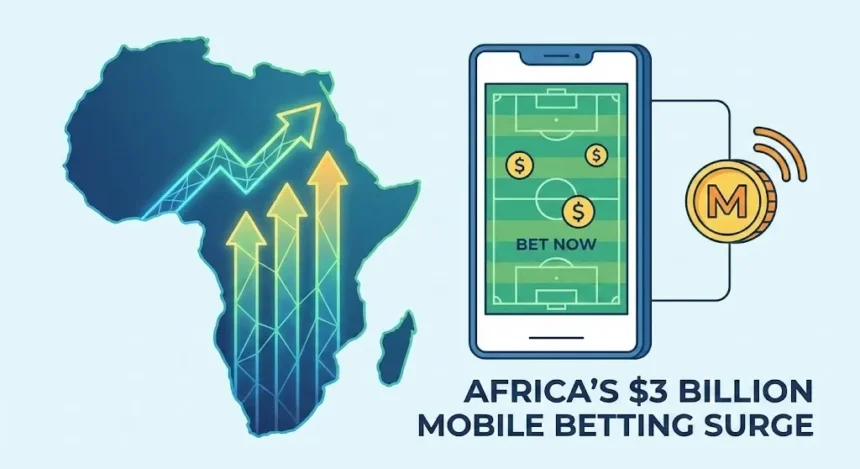
Africa’s sports betting market alone is projected to generate $3.08 billion in 2025. The broader gambling market across the continent sits at $17.63 billion, growing at a CAGR of 4.23% through 2029. By that point, Statista estimates the total will approach $19.70 billion with 64.7 million active users.
But the aggregate numbers mask how concentrated this growth really is.
Country-Level Breakdown
| Country | Revenue / Turnover | Standout Metric |
| South Africa | R1.5 trillion ($86B) turnover 2024/25 | Online betting = 60% of gross gambling revenue. Casino revenue dropped 4.1%. |
| Nigeria | M-Pesa integration is driving mobile-first adoption. | ~60M daily bettors. 103 mobile subs per 100 people. |
| Ghana | $54.5M online volume in H1 2025 | $3.63B projected by the end 2025 |
| Uganda | $90.2M gaming revenue 2024/25 | Tax revenue from betting tripled to Shs 75 billion. |
| Kenya | Growing rapidly, tax raised to 15% | Regulatory modernization is attracting licensed operators. |
| Tanzania | $9.8M online sports betting (2025) | 45% of adults hold mobile money accounts. |
| Mozambique | Tax revenue up 29% to $7.8M | $3.63B projected by the end of 2025 |
South Africa is the heavyweight. A R1.5 trillion turnover figure — up from R1.1 trillion the year before — with 52% of working adults participating in some form of wagering. Traditional casinos are bleeding customers to digital. That 4.1% decline in casino revenue isn’t a blip. It’s structural.
Nigeria operates on a different scale entirely. Roughly 4 in 10 Nigerians between 18 and 40 are regular sports bettors. The Cross River State Lottery Gaming Agency estimates 60 million people bet daily. And here’s what makes it uniquely mobile-first: only 36% of Nigerians have conventional internet access, but there are 103 mobile subscriptions per 100 people. The phone isn’t a secondary device. It’s the primary gateway to everything digital.
Why Mobile Money Changed Everything
This is where Africa’s betting boom diverges from every other market globally.
In Europe or the US, placing a bet means linking a bank account or credit card. In sub-Saharan Africa, users access betting apps through digital wallets that bypass traditional banks entirely. M-Pesa in East Africa. Opay and Palmpay in West Africa. Settlement of wins happens in minutes — not days.
The impact is measurable:
- Operators integrated with M-Pesa see significantly higher engagement than those using legacy payment systems
- Sub-Saharan users complete deposits and withdrawals without ever touching a bank branch
- Mobile penetration in South Africa is projected to reach 67% by 2026
- Football betting via mobile is the dominant vertical across nearly every African market
The infrastructure story matters here. Africa largely skipped the desktop internet era. There was no broadband buildout in most countries, no era of sitting at a PC to browse. People went straight from no connectivity to smartphones. That leap created behavioral patterns that are fundamentally mobile-native, and betting platforms designed for that reality are winning.
GeoPoll data backs this up: 65.32% of Nigerian respondents have participated in gambling, and the overwhelming majority do so via mobile apps. In South Africa, household spending on recreation that goes toward gambling sits at nearly 55%.
The Regulatory Shift: AGRA 2026
Fragmented regulation has been one of Africa’s biggest challenges. Different licensing requirements in every country. Inconsistent tax structures. Gray markets operating between jurisdictions.
That’s changing. The African Gaming Regulators Association (AGRA) launched an initiative targeting continental unification of licensing and taxation by the end of 2026.
What AGRA 2026 aims to fix:
- Licensing fragmentation — operators currently navigate completely different frameworks in each country
- Offshore tax leakage — reports suggest unified rules could recover up to $11 billion currently lost to unregulated offshore operators
- Consumer protection — mandatory player verification being enforced, protecting the 60% of users in the 18-35 age range
- Taxation inconsistency — Kenya already raised betting tax to 15% via the Tax Laws Amendment Act; other countries are considering similar moves
South Africa operates under the National Gambling Board with strict responsible gambling measures. Nigeria has the National Lottery Regulatory Commission and Lagos State Lottery Board. Ghana’s Gaming Commission handles sports betting, casinos, and lotteries. But there’s no cross-border alignment.
If AGRA delivers — and it’s ambitious — operators would deal with a single compliance framework instead of 15 different ones. That reduces costs, attracts more licensed operators, and pushes gray-market players out.
The Demographics Powering the Boom
Numbers that explain why this isn’t slowing down:
- Ghana’s median age: 21 years old
- Nigeria: 4 in 10 citizens aged 18-40 are regular bettors
- South Africa: 75% of the population has gambled at least once (GeoPoll)
- Continental user base: Expected to reach 64.7 million active gambling users by 2029
- English Premier League matches correlate with the highest betting volumes across West Africa
This is a young, mobile-native, sports-obsessed population with increasingly frictionless access to digital payments. Every macro trend points in the same direction.
Marketing strategies reflect this, too. In Nigeria, promotional campaigns frequently align with cultural touchpoints — EPL match nights, Afrobeats partnerships, Telegram-based communities. Localized campaigns targeting specific geographies show 30-50% higher click-through rates than generic approaches.
What’s Next: 2026 and Beyond
Three trends to watch heading into the next 12 months:
1. Fintech-Betting Convergence Mobile money providers aren’t just payment rails anymore. They’re becoming distribution channels. Operators that build deeper integrations with M-Pesa, Opay, and Palmpay will capture disproportionate market share.
2. AI-Driven Personalization Platforms are adopting machine learning to personalize odds presentation, push notification timing, and promotional offers based on individual user behavior. This is already standard in European markets — Africa is catching up fast.
3. Regulatory Maturation Beyond AGRA, individual countries are tightening frameworks independently. Mandatory KYC verification, advertising standards, and responsible gambling programs are expanding. This is healthy for the industry long-term, even if it creates short-term compliance costs.
This report draws on data from Statista Market Forecast, GeoPoll surveys, South Africa’s National Gambling Board filings, the African Gaming Regulators Association, and Astute Analytica market research. Special thanks to the research team at download 1xbet for contributing mobile platform analytics and regional download data that informed sections of this analysis.