
Two investment styles. One provides you with stability via companies decades-old. Other bets on areas that the government is actively throwing money at. Both can build wealth. But they act in a very different way- and the past 12 months has caused that difference to be very noticeable.
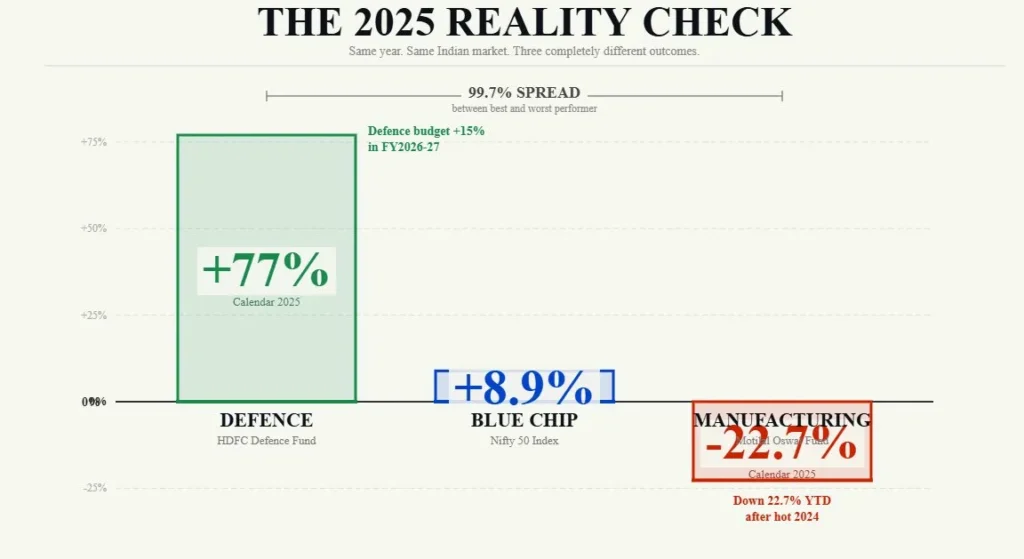
There was a slow 2025 in nifty 50 blue charts where it gave about 8-9 percent during the calendar year. In the meantime, defence-related funds recorded 77% returns in one year (HDFC Defence Fund) and the sector recorded 34.8% returns over six months leading to July 2025. Thereafter manufacturing-focused funds that were boiling in 2024 fell 22.7% YTD in 2025.
That’s the reality of this comparison. Not theory. Not projections. Actual numbers from funds people hold in their portfolios right now.
What blue chip investing in India actually looks like
Blue chip stocks in India are in the Nifty 50 stock list — the top 50 large-cap companies listed on the National Stock Exchange. These stocks account for over two-thirds of the free-float market cap of all traded securities on Indian exchanges. Names like Reliance Industries, HDFC Bank, Infosys, TCS.
The historical track record tells a specific story:
| Holding Period | Average Return | Worst Case | Best Case | Chance of Loss |
|---|---|---|---|---|
| 1 year | Varies wildly | -44% (2009 crisis) | +117.9% (1992) | Significant |
| 7 years | 11.6% avg | 0.06% (barely flat) | 24.7% | Zero negative returns ever |
| 10 years | 11.7% avg | 2.9% | 19.2% | Zero |
| 15 years | 12.2% avg | 5.7% | 17.0% | Zero |
Source: BMSMoney analysis of Nifty 50 rolling returns 1991-2025.
That is the line that counts 7 years. The entire history of the Nifty 50 has not shown a negative performance in 7 years. The poorest 7 years record was -0.06 percent – technically a loss but not much. Any period of more than 7 years is positive. Every single one.
Over the last ten years, nifty 50 ETFs have provided returns ranging between 12-16% CAGR (HDFC Sky). It is not alluring on a regular Tuesday. When added up over 10 or 15 years, however, it is the kind of slow build-up that does not cause you a heart attack in the process of getting richer and richer.
What thematic investing looks like — with real examples from 2025-2026
Thematic investing means putting money into a specific trend or sector expected to grow. In India, SEBI classifies these as Sectoral/Thematic Funds and requires at least 80% of total assets to be invested in the declared theme. That concentration is what creates both the upside and the risk.
64 new thematic/sectoral funds launched since 2020 out of 161 total available in India. The space expanded fast because the returns attracted attention.
Some popular themes in India include renewable energy, defence stocks, and so on.
Here’s what actually happened in specific themes:
Defence — the headline performer:
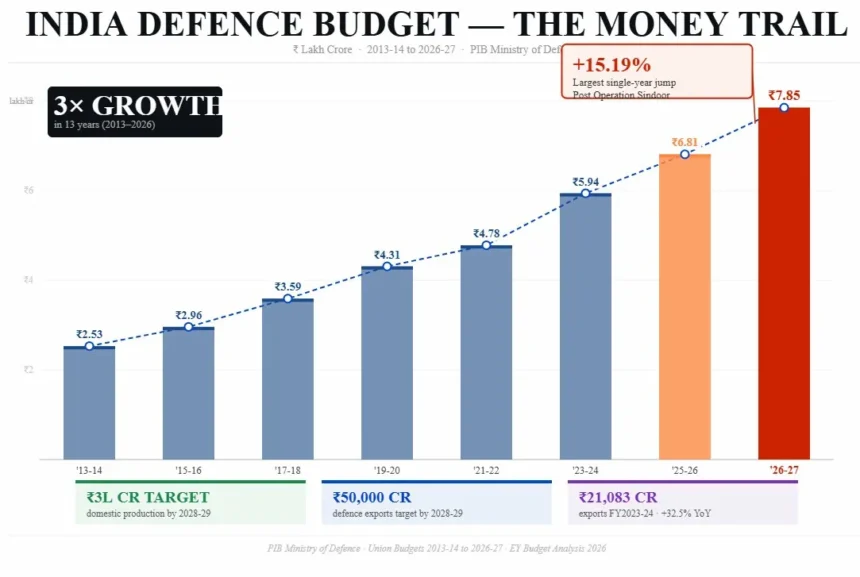
- India’s defence budget for FY 2025-26: ₹6.81 lakh crore ($78.6 billion), a 9.5% increase from the previous year. (PIB, Ministry of Defence)
- FY 2026-27 budget post Operation Sindoor: ₹7.85 lakh crore — a 15.19% jump, the highest allocation to any ministry. ₹2.19 lakh crore earmarked for capital outlay — modernisation of Armed Forces. (PIB, February 2026)
- India’s defence budget grew from ₹2.53 lakh crore in 2013-14 to ₹7.85 lakh crore in 2026-27 — roughly a three-fold increase in 13 years.
- Government target: ₹3 lakh crore in annual indigenous defence production and ₹50,000 crore in defence exports by 2028-29. (EY Budget Analysis)
- Defence exports hit record ₹21,083 crore in FY 2023-24, a 32.5% increase over previous fiscal. Private sector contributed 60%. (PIB)
- HDFC Defence Fund returned 77% in one year. Defence sector outperformed all other sectoral indices with 34.8% returns in six months to July 2025. (Smallcase, GetBelong)
The money followed the government spending. When a country increases defence allocation by 15% in a single year and explicitly targets domestic manufacturing through Atmanirbhar Bharat, companies in that supply chain benefit directly. That’s the thematic thesis working exactly as intended.
Renewable Energy — massive capacity, volatile returns:
- India added a record 44.51 GW of renewable energy capacity in 2025 (January-November), nearly double the 24.72 GW from the same period in 2024. (DD News, Government of India)
- Solar capacity crossed 100 GW in January 2025. Reached 132.85 GW by November 2025 — a 41% increase from 94.17 GW in November 2024. (MNRE)
- Wind installations surged 88.8% YoY in the first nine months of 2025. (JMK Research)
- India’s total renewable capacity reached 253.96 GW by November 2025 — over 52% of the country’s total installed electricity capacity now comes from non-fossil sources. (MNRE, Wikipedia)
- On July 29, 2025, renewables met 51.5% of India’s total electricity demand for the first time ever — 203 GW. (Ministry of Power)
- Union Budget 2026 allocated ₹600 crore to the Green Energy Corridor for 6,000 km of intra-state transmission.
The sector is growing at record pace. But energy-themed mutual funds averaged about 20.83% annualised over 3 years — strong but with heavy volatility. When government policy shifts or grid constraints hit, these funds correct sharply.
Manufacturing — the cautionary tale:
- Manufacturing-themed funds were the hot pick through 2024. Motilal Oswal Manufacturing Fund delivered strong returns.
- Then came the 2025 correction. Down 22.7% YTD in 2025.
- Investors who bought at peak 2024 valuations are sitting on losses.
This is the thematic risk in one real example. The same sector that attracted the most excitement produced the sharpest pain when sentiment shifted.
The core comparison — side by side
| Factor | Blue Chip (Nifty 50) | Thematic Investing |
|---|---|---|
| What you’re buying | Top 50 established companies across sectors. | One sector or trend — defence, energy, manufacturing, etc. |
| SEBI concentration rule | Diversified across 50 stocks. | 80% minimum in declared theme. |
| 2025 calendar year return | ~8-9%. | Defence: 77% (HDFC Defence Fund). Manufacturing: -22.7%. |
| 7-year track record | Zero negative returns in entire Nifty 50 history. | Depends entirely on whether the theme performs. |
| Worst-case 10-year outcome | 2.9% annual return. Still positive. | Theme could underperform for years if policy or sentiment shifts. |
| Government policy sensitivity | Low — diversified across sectors. | Extremely high. Defence funds surge when budgets increase. Energy funds depend on renewable targets. |
| Best suited for | Long-term investors who want steady compounding. | Investors who understand sector cycles and can tolerate drawdowns. |
A practical way to combine both
In India, most financial advisors recommend that thematic fund must be no more than 5-15 percent of a portfolio, but not the center. The core remains in diversified exposure to large cap or Nifty 50.
A simple structure:
- 70-80 percent in Nifty 50 or large-cap diversified funds. This is the foundation. This is the part that has never recorded a negative payoff in the history of 7 years.
- 10-20% in a single or two thematic bets in which you have a legitimate conviction and the government expenditure data is in support of the thesis. There are multi-year government commitments currently in support of defence and renewable energy.
- Rebalancing opportunities: 5-10% of cash or debt in case markets are correcting.
The most common error of beginners is to reverse this ratio. On a defence fund they make a 77 percent return and bet the farm on the theme. Then as the manufacturing decreases 22.7, they panic and sell at the bottom. The ratio is there to avoid that cycle.
Things to check before investing in either
- Don’t chase last year’s returns. Fund houses typically launch thematic funds after a theme has already performed well. By the time you see advertisements and media buzz, you’re often late.
- Check what the government is actually spending on. India’s defence budget increasing 15% in one year is a verifiable fact that supports the defence theme. That’s different from speculation.
- Look at 5-year data, not 1-year. A fund that returned 77% last year might drop 25% this year. Thematic funds by nature are volatile.
- Understand what “80% concentration” means. SEBI requires thematic funds to keep 80% in the theme. When that theme falls, there’s no diversification to cushion you.
- For Nifty 50 specifically — the index gets reconstituted semi-annually in March and September. Companies that fall below the top 50 get removed. This built-in quality filter is why the long-term track record is so consistent.
FAQs
They can — but only if the theme itself grows over that period. Defence has multi-decade government backing. Renewable energy has binding climate commitments to 2030 and beyond. Manufacturing depends more on policy cycles. The risk is picking a theme that peaks and fades within your holding period.
Not in the short term. The worst single-year return was -44% during the 2008 crisis. But over 7+ years, the Nifty 50 has never produced a negative return. “Safe” depends entirely on how long you hold.
Most advisors cap it at 5-15% of total portfolio. The core should be diversified. Thematic exposure is for targeted bets where you’ve done the research, not for your entire savings.
The government data supports the sector — ₹7.85 lakh crore allocation, 15% increase, ₹3 lakh crore domestic production target by 2028-29. But strong fundamentals don’t mean the fund can’t correct short-term. Valuations matter. Entry timing matters.
The Motilal Oswal Manufacturing Fund and similar products that delivered strong 2024 returns corrected sharply in 2025, with some down over 22% YTD. This is the concentration risk of thematic investing — when sentiment shifts in your specific sector, the entire portfolio feels it.
References
- BMSMoney, “Decades of Nifty 50 Performance: A Comprehensive Analysis of Returns from 1991 to 2025.”
- HDFC Sky, “Nifty 50 ETF 10-Year Returns.”
- PIB, Ministry of Defence, “A record over Rs 6.81 lakh crore allocated in Union Budget 2025-26 for MoD,” February 1, 2025.
- PIB, Ministry of Defence, “Ministry of Defence allocated an all-time high of Rs 7.85 lakh crore in Union Budget 2026-27,” February 1, 2026.
- DD News, “India adds record 44.5 GW renewable energy capacity in 2025,” December 29, 2025.
- MNRE, Government of India, “Physical Achievements — Renewable Energy Installed Capacity as on 28.02.2026.”
- JMK Research, “India Adds Record 34.4 GW of Solar and Wind Capacity in First Nine Months of 2025,” October 2025.
- PIB, Ministry of Power, “Renewables met 51.5% of India’s total electricity demand on July 29, 2025,” October 2025.
- Smallcase, “Best Defence Industry Mutual Funds in India 2026.”
- GetBelong, “Thematic Mutual Funds for NRIs: Best Themes, Returns & How to Invest.”
- EY, “#EYonBudget2026: Reinforcing Defence,” February 2026.
- GoInRI, “Thematic Mutual Funds: 25.8% annualised returns over 5 years.”