
Key Takeaways:
- AI valuation tools analyze trillions of data points today, but remote coastal real estate still exposes blind spots that need boots-on-the-ground research.
- LiDAR drone surveys deliver land assessments 40% faster and detect erosion risks missed by satellite images.
- Blockchain-recorded property titles in Dubai have already cut transaction fraud and processing time by up to 90%.
- Starlink reached 153 Mbps in a private island test, turning unbookable places into luxury rentals.
- PropTech is projected to exceed $119 billion globally by 2032, with beachfront and resort properties among the fastest adopters.
Buying a private beach used to mean six flights, three lawyers, and hoping the title documents weren’t forged. That was 2019. In 2026 the process looks completely different.
Property technology (PropTech) has moved well past the “interesting experiment” stage. Morgan Stanley expects AI could automate 37% of real estate tasks, producing roughly $34 billion in efficiency gains by 2030. Last year, blockchain platforms eased over $4 billion in property sales, while drone surveys that once cost tens of thousands of dollars now deliver centimeter-accurate terrain maps for a fraction of that.
For buyers of private beachfront land in Belize, the Bahamas, or the Indonesian archipelago, those tools are table stakes by now.
Here’s how each of these technologies is being used now, and where the gaps still are.
AI Finds Properties Fast in Cities. Remote Beaches Are Another Story
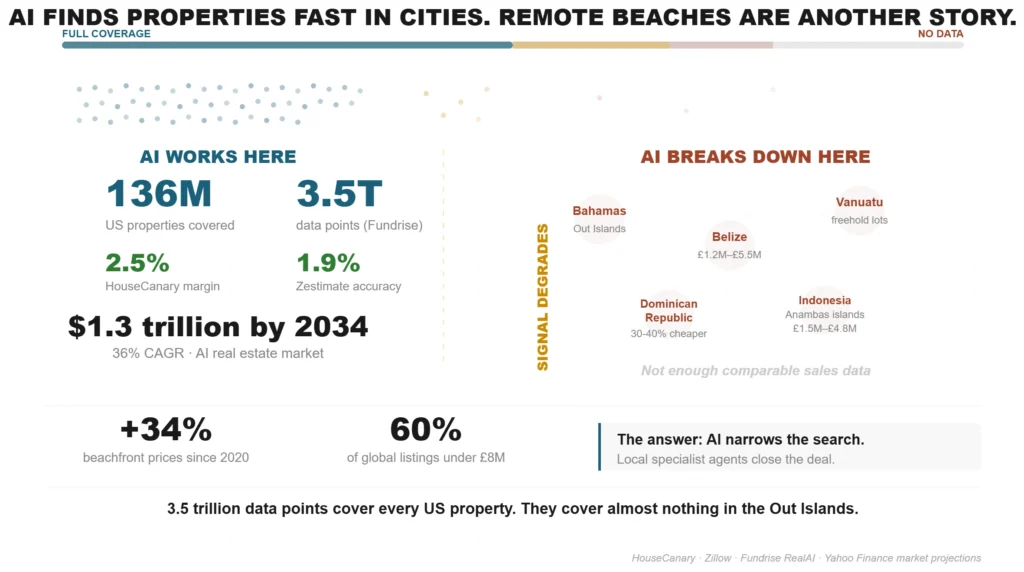
The real estate AI market is projected to reach $1.3 trillion by 2034, growing at a compound annual rate of 36%. HouseCanary covers 136 million U.S. properties with a valuation margin of error around 2.5%. Last year, Zestimates were off by less than 1.9% on average for off-market listings. Fundrise just launched a tool called RealAI. The company’s CEO says the database contains 3.5 trillion data points covering “every property in America”.
Sounds incredible. And for domestic markets it really is.
But here lies the problem which no one in Silicon Valley is willing to face: these tools tend to break down when reaching beyond the better-documented urban markets. Try getting an AI-generated price for a 2.5-acre waterfront lot in the Bahamian Out Islands or a freehold lot in Vanuatu. There simply isn’t enough comparable sales data in these systems to generate good valuations.
This matters because beachfront property prices have risen about 34% since 2020, and close to 60% of global listings still sit under £8 million. Properties in Belize are available for between £1.2 million and £5.5 million. Prices in the Dominican Republic are 30-40% cheaper than the Bahamas. Southeast Asia has cheaper options still, with individual Indonesian islands in the Anambas Archipelago costing between £1.5 million and £4.8 million.
AI can help narrow the search, flag up pricing anomalies and work out rental returns. In remote coastal locations, that’s just the starting point. Savvy buyers are combining algorithmic tools with the expertise of specialist agents who really know these markets.
Drone Surveys Catch What Ground Crews and Satellites Miss
This is where PropTech delivers its most tangible value for beachfront buyers, and it changed more quickly than most realize.
A typical land survey on an isolated stretch of coast used to mean hiring a ground crew, getting results back in weeks, and still possibly missing local issues such as erosion patterns or flood exposure. Drones have compressed that process. A drone equipped with LiDAR can use a single flight to create 3D terrain models, orthomosaic imagery, and elevation data with centimeter-level accuracy, work that took survey teams days to piece together by hand.
The impact on the ground is hard to ignore. According to McKinsey, monitoring by drones has reduced the cost of construction rework by about 25 percent. Zoning and entitlement approvals move about 40 percent faster when applications include high-resolution aerial documentation. With coastal real estate, repeat passes over time can track not only changes to shorelines, but also sediment and vegetation, indicating, in effect, whether a beachfront parcel is gaining or losing ground.
Satellite imagery is useful for the macro picture. Investors with properties around the world can use satellite data to perform site selection and market analysis without all of the regulatory burden that comes with flying drones in every jurisdiction. With image resolution improving year after year and frequent update cycles, decisions are not made from stale snapshots.
This combination of the two technologies matters most on high-cost development sites. In the Caribbean, construction runs between £320 and £560 per square foot, while South Pacific projects often exceed £680. Marine infrastructure like docks and sea walls can easily push past £1 million. When you’re committing capital at that scale, a $2,000 drone survey that shows a bluff is unstable, or finds a drainage problem hidden by vegetation, doesn’t just pay for itself. It can save the entire project.
The DJI Matrice 300 RTK paired with Zenmuse L2 LiDAR is the go-to rig among geospatial professionals working coastal sites for the precision work. And simply using off-the-shelf drones for visual reconnaissance during initial due diligence can save buyers from costly mistakes.
Blockchain Puts Title Records Where Nobody Can Quietly Alter Them
So if AI and drones help you find and appraise beach property, blockchain is starting to solve the part that really makes lawyers’ palms sweat: proving you actually own it.
Anyone who has ever purchased property abroad will know the pain. In the Philippines you cannot own land as a foreigner and generally set up a local company on a 60/40 basis. Thailand has the 30-year renewable leasehold title and Indonesia has an 80-year leasehold structure known as HGB (Hak Guna Bangunan). Even in buyer-friendly jurisdictions like the Bahamas, Turks and Caicos, and the Cayman Islands, a title search can take months to complete.
Blockchain does not change the law. It creates instead an immutable, timestamped record of every transaction and transfer of ownership which no single party can alter after the fact.
The Dubai Land Department was among the earliest large-scale government adopters. After moving thousands of real estate transactions to the blockchain, average processing times dropped by 80 to 90 percent. Sweden piloted an on-chain land registry and projected savings of over €100 million per year. Propy, a platform that allows property deeds to be filed on-chain, handled more than $4 billion in transactions in 2025 and helped reduce fraud and turnaround time by around 40%.
Tokenization is another trend gaining momentum. Tokenized real estate assets were worth more than $10 billion globally last year. Platforms convert ownership rights to digital tokens on a blockchain, allowing fractional ownership of a piece of real estate that previously required a full-ticket purchase. As an illustration: a boutique resort on a freehold island in Fiji listed at £5 million could be fractionalized into dozens of tokens, with on-chain proof of ownership for each investor.
Smart contracts are self-executing agreements that can handle tasks such as escrow releases, rental payouts, and lease renewals without relying on an intermediary. In Southeast Asian leasehold structures, where renewal terms and compliance tracking are key, they can help eliminate administrative lapses that compromise a buyer’s position.
We are still early, and regulatory approaches vary widely from jurisdiction to jurisdiction. Many island nations have not yet adopted blockchains as land registries. But the trajectory is clear. The global PropTech market is projected to reach $119.45 billion by 2032, and blockchain-based property tools are among its fastest-growing segments.
Prospective buyers of private beach property across multiple countries will want to understand these tools. The buyers who use them close faster, with better protections, and at lower transaction costs.
Starlink and Off-Grid Systems Decide Whether a Remote Parcel Is Livable
Every waterfront piece of property has at least one thing in common: the farther and prettier it is, the more difficulty there is in getting utilities to it. Power, water and internet are what make a parcel of land a functioning retreat, and not just an expensive piece of sand.
That equation has changed considerably.
Start with connectivity. Starlink bandwidth was measured at 153 Mbps on a private island estate in Indonesia’s Kepri region. Four devices were simultaneously streaming and downloading content, with no apparent buffering delays. In the remote South Pacific, a resort in Rarotonga adopted Starlink’s business service to provide complimentary unlimited high-speed Wi-Fi for guests, giving it a competitive edge over other resorts there. Starlink advertises speeds of above 400 Mbps and 99.9% uptime across its global coverage area, which covers 150-plus countries and most of the Caribbean and Pacific island nations.
That one piece of infrastructure unlocks everything else. Without reliable internet, a remote beach property cannot:
- Provide smooth connectivity for luxury rental guests.
- Run cloud-based property management, booking platforms, or security monitoring.
- Enable the “work from paradise” remote professional market, one of the fastest growing guest segments globally.
With it, occupancy rates climb, nightly rates justify premium pricing, and absentee owners can monitor their investment from anywhere in the world.
With solar panels and battery storage included, the utilities picture shifts even further. Connecting power, water and internet to a raw beachfront site costs between £200,000 and £800,000. Solar arrays in combination with rainwater harvesting and greywater recycling typically pay off within four to seven years. Native landscaping and development with local materials reduce the property’s carbon footprint and appeal to a growing number of travelers interested in “regenerative travel.”
Smart security cameras, water leak detectors, climate and energy management systems are no longer optional luxuries for remote beachfront estates but an operational necessity, permitting an owner to manage a property in Belize from a laptop in London.
The financial case also stacks up. Boutique beachfront resorts can charge from £600 to £1,400 a night. An annual ROI of 8-14% is possible with 45-65% occupancy. Caribbean property values can rise 5-8% per year. And the fundamental scarcity of beachfront land (they’re not making any more of it) is a natural hedge against inflation and market volatility.
The Bottom Line
PropTech hasn’t turned private beach buying into a one-click checkout. It probably never will. Remote coastal real estate has too many environmental, legal and cultural variables for algorithms to replace human judgment and local knowledge.
But the gap between “risky adventure” and “informed investment” has narrowed dramatically. AI narrows the search. Drones reveal what photos hide. Blockchain protects what contracts alone cannot. And Starlink makes places that were off the grid five years ago genuinely viable as both lifestyle retreats and commercial assets.
So for buyers and investors, the practical playbook looks something like this:
- Screen the regions and price points that suit you. The Caribbean for accessibility, Southeast Asia for value, the South Pacific for total seclusion.
- Commission drone surveys before committing capital, not after.
- Retain local legal experts familiar with regional title structures, and ask whether blockchain-verified documentation is available or forthcoming.
- Budget smart infrastructure from day one: Starlink, solar, IoT monitoring. These aren’t extras, they make the investment actually work.
- Consider certifications such as LEED or EarthCheck to attract high-end clientele and improve long-term asset value.
The market for beachfront properties under £8 million remains one of the most attractive sectors in luxury property, and the technology to find, validate, develop and run these assets has never been better. The question isn’t whether PropTech belongs in this space. It’s whether you can afford to ignore it.