Qatar doesn’t manufacture a single smartphone. There’s no local brand competing with Samsung or Xiaomi. And yet, nearly every resident walks around with a flagship device in their pocket – often two.
That disconnect between production and consumption tells you everything about how this tiny Gulf state approaches mobile technology. They’re not building the hardware. They’re building the infrastructure to use it better than almost anyone else on the planet.
The 99% Reality
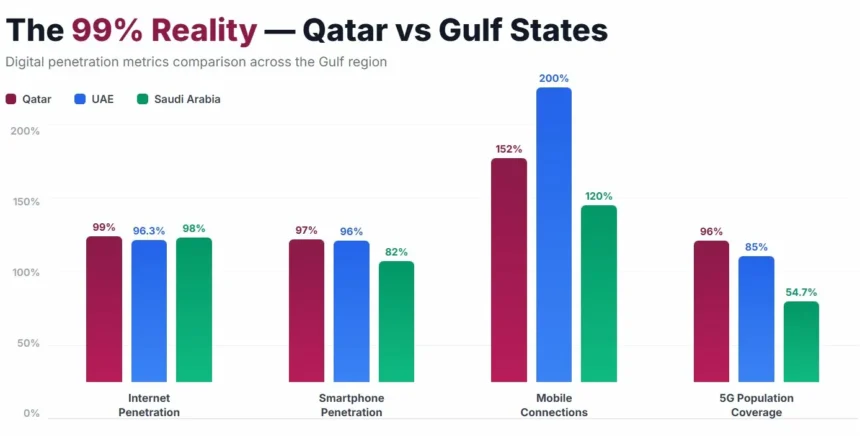
Internet penetration in Qatar sits at 99%. Not a typo. Virtually everyone online, virtually all the time.
| Metric | Qatar | UAE | Saudi Arabia |
| Internet Penetration | 99% | 96.3% | 98%+ |
| Smartphone Penetration | 95-97% | 96%+ | 79-82% |
| Mobile Connections (% of population) | 152% | 200%+ | 120%+ |
| 5G Population Coverage | 96% | 85%+ | 54.7% |
That 152% mobile connection rate means most people carry multiple SIMs. Expats juggling work and personal lines. Business owners with separate devices. The duopoly of Ooredoo and Vodafone Qatar competing hard for every account.
Speed That Actually Matters
Here’s where Qatar punches above its weight. Ookla’s Speedtest Global Index has consistently ranked the country #1 or #2 globally for mobile internet speeds throughout 2024 and into 2025.
Mobile Download Speeds (Median):
- Qatar: 517-522 Mbps
- UAE: 543-546 Mbps
- Kuwait: 378 Mbps
- South Korea: 218 Mbps
- United States: ~100 Mbps
The FIFA World Cup 2022 forced a massive infrastructure upgrade. Stadiums hit median 5G speeds of 757 Mbps during matches. That investment didn’t disappear when the tournament ended – it became the backbone for everyday connectivity.
Who’s Actually Buying What
Brand loyalty in Qatar skews premium. When your GDP per capita ranks among the world’s highest, budget phones don’t dominate the market.
Market Share (May 2024 – StatCounter):
- Apple: 28.57%
- Samsung: 23.7%
- Xiaomi: 18.14%
- Others: ~30% (Huawei, OPPO, Honor, etc.)
Apple leads despite having zero official retail stores in the country. No Apple Store experience, no Genius Bar walkups. Qataris buy through authorized resellers like iSpace (3 locations) and GAIT, or they order online and from Dubai trips.
Compare that to the UAE’s five official Apple Stores – Dubai Mall, Mall of the Emirates, Yas Mall, The Galleria, Al Jimi Mall – and you see the gap in retail infrastructure.
The “Leader” Question
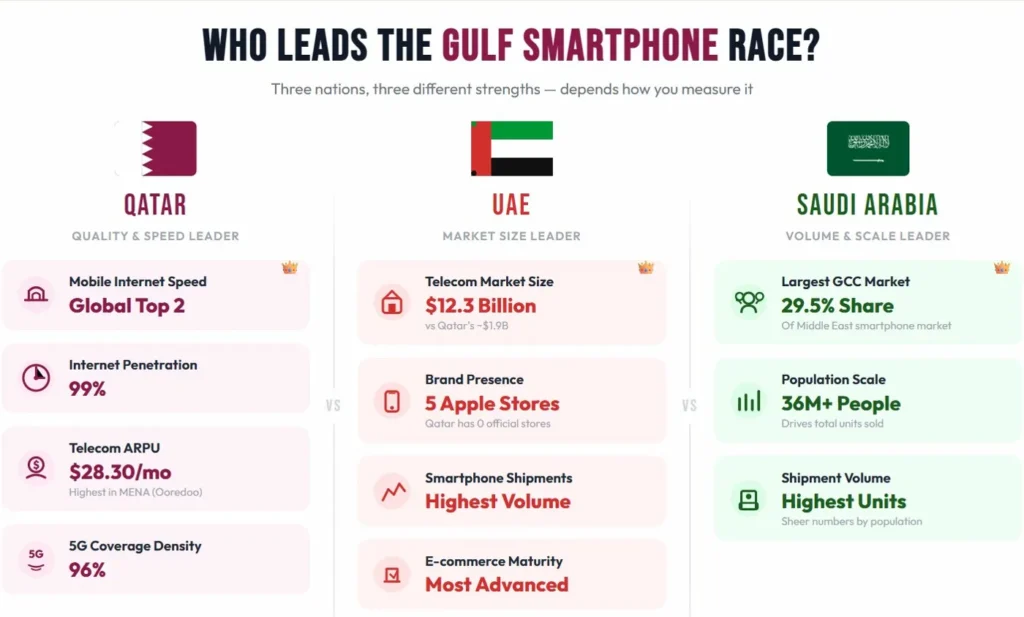
Is Qatar the smartphone leader in the Gulf? Depends how you measure it.
Where Qatar wins:
- Mobile internet speed (global top 2)
- Internet penetration (99%)
- Telecom ARPU – Ooredoo pulls $28.30 per user monthly, highest in MENA
- 5G coverage density (96%)
Where UAE wins:
- Market size ($12.3B vs Qatar’s ~$1.9B)
- Official brand presence (5 Apple Stores vs 0)
- Smartphone shipment volumes
- E-commerce maturity
Where Saudi Arabia wins:
- Largest GCC market by volume (29.5% of Middle East share)
- Population scale driving total units sold
Qatar’s market is smaller but more concentrated at the premium end. Everyone’s connected, everyone wants the latest device, and the infrastructure supports whatever you throw at it.
What People Actually Use Phones For
With 99% online and 95%+ carrying smartphones, mobile devices handle pretty much everything in daily Qatari life:
- Government services – The TASMU program pushed most administrative tasks to mobile
- Banking and payments – QR3.66 billion processed online in March 2024 alone (43.5% YoY increase)
- E-commerce – 70% of Qatar’s $4.5B e-commerce market runs through mobile devices
- Entertainment – Streaming, gaming, international platforms
That last category covers a wide range. With high disposable income and universal connectivity, Qatari residents access global entertainment platforms extensively – streaming services, mobile gaming apps, even online casinos accepting players from Qatar that operate internationally but cater to Gulf users seeking digital entertainment options. The common thread isn’t any single category. Smartphones serve as the secure gateway for anything requiring identity verification, payment processing, or regular account management.
The Infrastructure Behind It
Two operators control everything: Ooredoo and Vodafone Qatar.
| Operator | Customers | 5G Speed | Strength |
| Ooredoo | 3M | 422 Mbps avg | Download speed, consistency |
| Vodafone Qatar | 2.1M | 312 Mbps avg | Gaming experience, growing fast |
Both government-majority owned. Both investing heavily. The Communications Regulatory Authority (CRA) mandated 3G shutdown by end of 2025 – all spectrum getting repurposed for 4G/5G. They’ve even restricted imports of legacy devices to push the transition.
Ooredoo handled 300 terabytes of mobile data and 6 million voice calls during major 2024 events with 99.99% call success rate. That’s not a marketing stat – that’s infrastructure proving itself under pressure.
The Import Reality
Qatar imports every smartphone sold in the country. Zero local manufacturing, zero assembly plants.
2023 Import Data:
- Total Value: $645 million
- Total Units: ~2.2 million
- Primary Source: China (80%)
- Secondary: Vietnam, India
Average import price hit $220 per unit in 2023 – reflecting that premium device preference. Compare that to global averages around $150 and you see the market positioning.
Where This Goes Next
The GCC smartphone market overall should hit 98.9 million units by 2033, growing at 5.4% CAGR. Qatar’s slice stays relatively small in volume but high in value.
Key trends to watch:
- E-commerce acceleration – Online smartphone sales growing at 16.3% CAGR across the Middle East
- Foldable adoption – UAE saw 61% YoY growth in foldables; Qatar typically follows premium trends
- iOS growth – Apple’s gaining share region-wide at 7.6% CAGR as status symbol appeal strengthens
- 3G sunset – December 2025 deadline forces device upgrades across the board
The market’s mature in penetration terms – not much room to add new users when 97% already have devices. Growth comes from upgrades, premium tier movement, and adjacent services.
Bottom Line
Qatar isn’t the biggest smartphone market in the Gulf. That’s Saudi Arabia by volume, UAE by revenue. But it might be the most intense per capita – highest connectivity rates, fastest speeds, strongest premium device preference, and infrastructure built for a World Cup that now serves 3 million residents.
For anyone tracking where Gulf mobile trends head next, Qatar’s worth watching. When nearly everyone’s already connected with flagship devices on world-class networks, the interesting question becomes: what do they do with all that capability?
Data sources: IMARC Group, Statista, Ookla Speedtest Global Index, StatCounter, GlobalData, Mordor Intelligence, Oxford Business Group