
4G isn’t dead. Qualcomm quietly released two budget chipsets this week – the Snapdragon 6s 4G Gen 2 and the Snapdragon 4 Gen 4. Neither will power anything exciting by Western standards, but these are the chips that’ll end up in phones selling by the tens of millions across India, Southeast Asia, Africa, Latin America. Markets where a $200 phone is the phone.
Snapdragon 6s 4G Gen 2: 4G gets another year
The Kryo CPU hits 2.9GHz. Qualcomm says that’s 51% faster than Gen 1, which sounds impressive until you remember Gen 1 wasn’t exactly setting records. The Adreno GPU – unnamed, because Qualcomm apparently couldn’t be bothered – gets a 20% bump and supports 1080p+ displays at 120Hz.
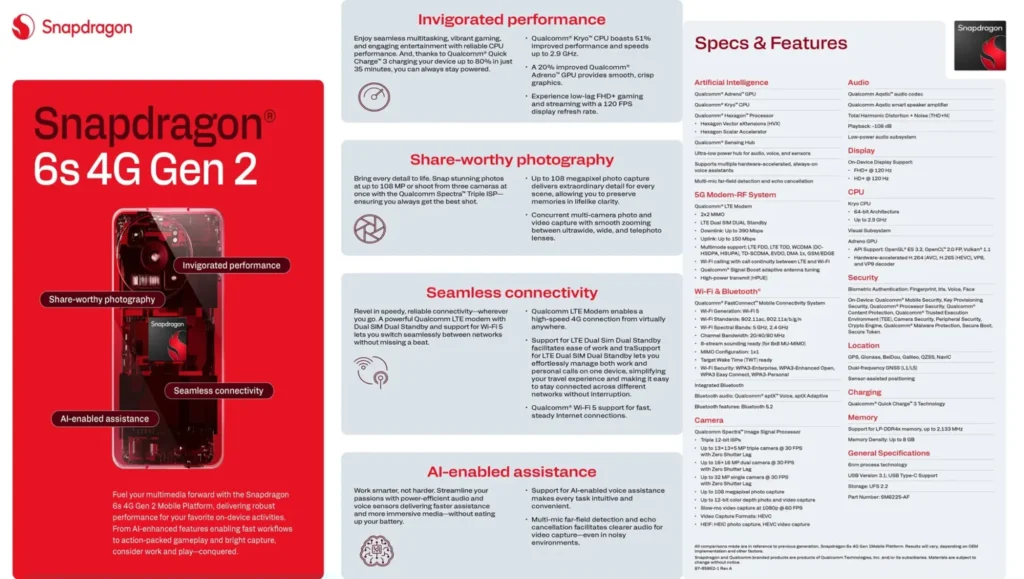
Fabrication jumped from 11nm to 6nm. Not cutting-edge by any measure, but meaningful for battery life and thermals in cheap plastic phones with mediocre cooling. Memory caps at 8GB LPDDR4X running 2,133MHz. Storage uses UFS 2.2. Quick Charge 3 supposedly hits 80% in 35 minutes, though Qualcomm didn’t mention what size battery they tested with. Could be 4,000mAh, could be 5,500mAh. Who knows.
Camera support reaches 108MP on paper. The triple ISP handles 13+13+5MP simultaneously, or 16+16MP dual setups with zero shutter lag. HEIC and HEVC work fine. Video caps at 1080p 60fps. No 4K, which tells you exactly where this chip sits in the pecking order.
Connectivity is the giveaway. This is 4G LTE – 390Mbps down, 150Mbps up. Wi-Fi 5 dual-band, Bluetooth 5.2 with aptX Adaptive. GPS covers everything: dual-band GPS, GLONASS, Galileo, BeiDou, QZSS, NavIC. Qualcomm added sensor-assisted positioning for better accuracy when you’re moving. Useful for ride-sharing drivers, delivery workers – the people actually buying these phones.
Snapdragon 4 Gen 4: Budget 5G without the Gen 3
Gen 3 never happened. Qualcomm jumped straight to Gen 4 and added 5G – sub-6GHz Release 16 supporting SA and NSA networks. Speeds reach 2.5Gbps down and 900Mbps up, which is overkill for the target market but future-proofs the chip as 5G networks expand.
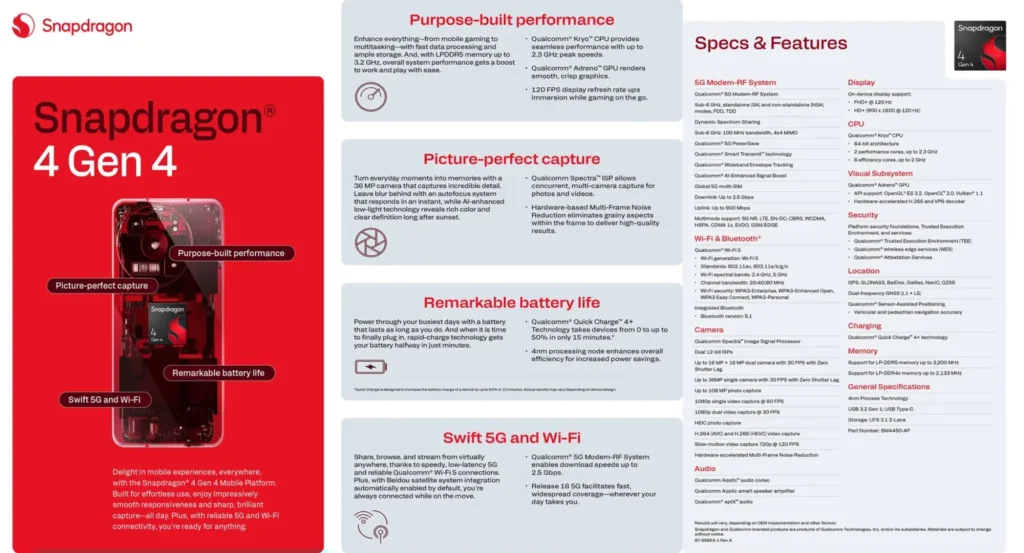
The 4nm process is genuinely modern. Two Kryo cores at 2.3GHz, six more at 2.0GHz. Same 1080p+ 120Hz display support from an unnamed Adreno GPU.
Memory options improved. LPDDR5 at 3,200MHz is available alongside LPDDR4X – manufacturers can pick based on cost targets. Storage moved to UFS 3.1 with dual-lane support, a real upgrade for app load times. Quick Charge 4+ claims 50% in 15 minutes.
Camera setup is actually worse than the 4G chip, which seems backwards. Same 108MP sensor support, but only a dual ISP instead of triple – 16+16MP with zero shutter lag. Video stays at 1080p 60fps. Neither chip decodes AV1, so streaming newer codecs will hit the CPU instead.
Wi-Fi stays at Wi-Fi 5. Bluetooth drops to 5.1 with standard aptX, losing the Adaptive support from the 4G chip. Strange tradeoff – you’d expect the newer chip to match or beat the older one across the board.
Devices coming next year
Phones running both chips should show up in 2024. Budget lineups from Chinese OEMs first, then everyone else. These won’t make headlines, but they’ll outsell flagships by a wide margin.