
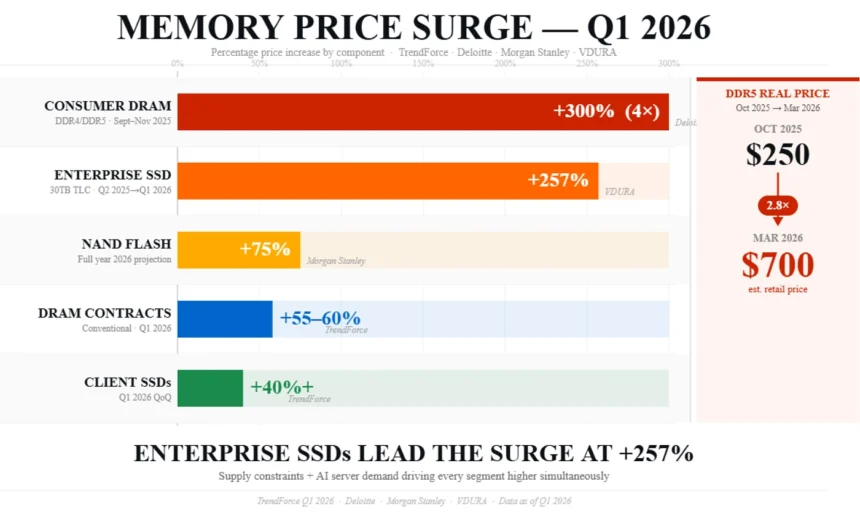
What happened in 60 seconds:
- The three companies that manufacture 95% of the world’s memory chips (Samsung, SK Hynix, Micron) are diverting production away from consumer devices toward AI data centres.
- DRAM prices surged roughly 4x between September and November 2025. They haven’t come back down.
- Client SSD prices jumped over 40% in Q1 2026 alone (TrendForce).
- Smartphone prices are projected to rise 6-8% globally in 2026. PC prices could climb 15-20% (IDC).
- Industry insiders are calling it “RAMageddon.” Some analysts think it could last a decade.
RAM Prices Quadrupled in Three Months. SSDs Are Following. Why Your Next Phone and Laptop Will Cost More.
This isn’t a temporary shortage that’ll sort itself out by Christmas. It’s a structural shift in how the world’s memory gets allocated — and ordinary buyers are on the losing end of it.
Before I begin special thanks to Deltahost https://deltahost.com/ team, for providing the research and information for this article.
What Exactly Is Happening to Memory Prices Right Now?
A quick snapshot of where things stand as of Q1 2026:
| Component | Price Change | Timeframe | Source |
|---|---|---|---|
| Consumer DRAM (DDR4/DDR5) | ~4x increase | Sept – Nov 2025 | Deloitte |
| Conventional DRAM contracts | +55-60% QoQ | Q1 2026 | TrendForce |
| Client SSDs | +40%+ QoQ | Q1 2026 | TrendForce |
| Enterprise SSDs (30TB TLC) | +257% | Q2 2025 → Q1 2026 | VDURA |
| NAND Flash (average forecast) | +75% for full year | 2026 projection | Morgan Stanley |
| Popular DDR5 config | $250 → est. $700 | Oct 2025 → Mar 2026 | Deloitte |
One semiconductor distributor president told Reuters he’d observed 1,000% price inflation on certain products. That’s not a typo.
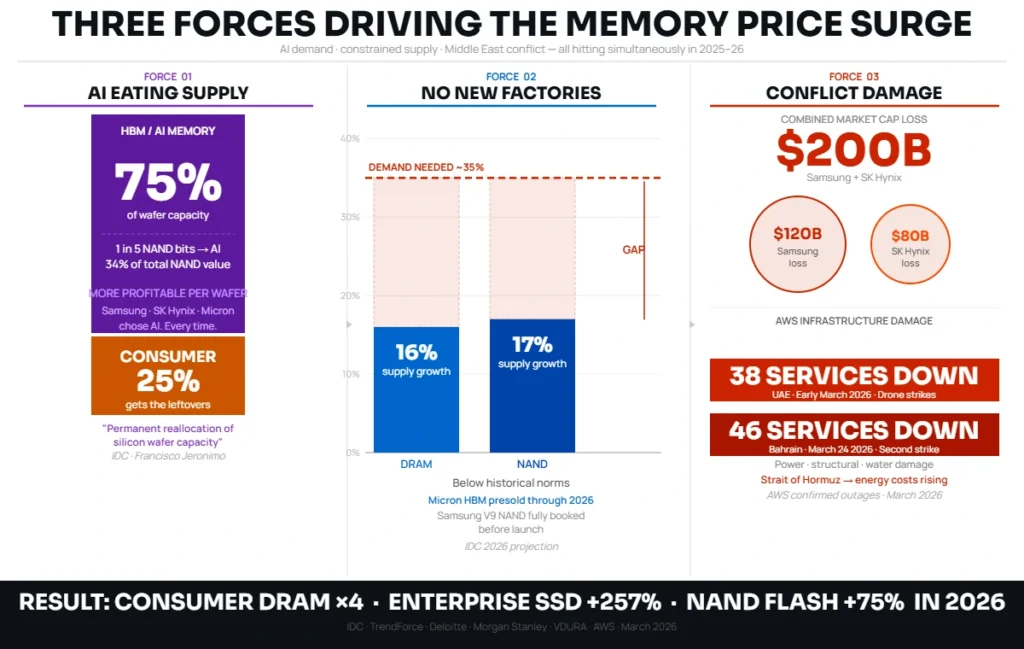
Why Is This Happening? Three Forces Colliding at Once:
1. AI Data Centres Are Swallowing the World’s Memory Supply
This is the big one. Every major AI company — Microsoft, Google, Amazon, Meta — is building out data centre infrastructure at a pace that’s consuming memory faster than manufacturers can produce it.
AI workloads need a specific type of memory called High Bandwidth Memory (HBM). It’s what sits inside Nvidia’s AI chips and enables the massive data throughput that large language models require. HBM is manufactured on the same production lines that make your phone’s RAM and your laptop’s SSD storage.
Here’s the problem: making HBM is far more profitable than making consumer memory. A single wafer allocated to HBM generates substantially more revenue than the same wafer turned into smartphone LPDDR5X or a consumer NVMe drive. Samsung, SK Hynix, and Micron have done the maths and made their choice.
IDC’s Francisco Jeronimo called it a “potentially permanent, strategic reallocation of the world’s silicon wafer capacity.” For decades, smartphones and PCs drove memory production. That dynamic has now inverted. AI comes first. Everything else gets whatever capacity is left over.
By 2026, one in five NAND bits produced globally will be consumed by AI applications — contributing roughly 34% of total NAND market value despite being a fraction of units shipped.
2. Memory Makers Aren’t Building More Factories to Fix It
In a normal shortage, manufacturers ramp up production. Build new fabs. Expand capacity. Prices stabilise within a few quarters.
That’s not happening this time. Samsung, SK Hynix, and Micron are increasing capital expenditure only modestly, and most of that investment is going into R&D for next-generation AI memory products — not into expanding production lines for the DDR5 and NAND that goes into consumer devices.
Why? Because the memory industry got badly burned by overproduction in 2022-2023, when a glut of chips crashed prices and wiped out profits. They’ve learned that controlling supply is more profitable than chasing volume. The strategy is deliberate: keep production tight, prioritise high-margin AI products, and let consumer prices rise.
IDC projects 2026 DRAM supply growth at just 16% year-over-year and NAND at 17% — both below historical norms and nowhere near enough to meet combined AI and consumer demand.
Micron has presold nearly all of its HBM output through 2026. Samsung’s next-generation V9 NAND is almost fully booked before it’s even launched. Hyperscaler contracts that used to cover a quarter now span years. The consumer market is, bluntly, getting the leftovers.
3. The Middle East Conflict Is Adding Physical Infrastructure Damage on Top
As if the supply-demand imbalance wasn’t enough, the ongoing conflict between the US-Israel alliance and Iran has directly damaged cloud infrastructure in the region.
In the first week of March 2026, drone strikes physically hit AWS data centres in the UAE and damaged facilities in Bahrain. AWS confirmed that 38 services went down in the UAE and 46 in Bahrain. Structural damage, power delivery disruptions, and water damage from fire suppression were all reported. A second disruption hit AWS Bahrain again on March 24.
This matters for semiconductor pricing because of the energy connection. Electricity accounts for roughly half of a data centre’s operating expenses, and about half of that goes to powering memory. If energy costs climb due to regional instability — and the Strait of Hormuz closure has already rattled global oil markets — data centre operators may cut AI infrastructure spending. That sounds like it would help. But in practice, it creates more uncertainty in the supply chain, not less.
Samsung and SK Hynix have lost over $200 billion in combined market value since the conflict started. Investors are nervous about demand wobbling at the exact moment when supply is already stretched thin.
How Does This Actually Hit You as a Buyer?
Your Next Phone Will Probably Cost More (or Have Less RAM)
Memory accounts for 15-20% of a mid-range smartphone’s total component cost. When DRAM prices quadruple, manufacturers have two options: raise the retail price or downgrade specs.
Both are happening simultaneously. Counterpoint Research forecasts smartphone shipments could fall 2.1% in 2026, while average selling prices jump 6.9% year-over-year — nearly double their original forecast of 3.6%.
Xiaomi’s CFO publicly warned that memory costs will push smartphone prices higher. Internal analyst projections reportedly show Xiaomi budgeting a 25% increase in DRAM expense per phone for 2026 models. Other Android OEMs — Oppo, Vivo, Realme — are optimising configurations to stretch supply. That means you might see phones shipping with 4GB + 256GB storage instead of 8GB + 128GB, because storage is slightly cheaper to source than high-spec DRAM right now.
Apple is somewhat insulated. Their massive negotiating power and long-term contracts provide a buffer. But even Apple is reportedly keeping iPhone Pro models at 12GB RAM rather than upgrading to 16GB — a spec freeze that wouldn’t normally happen between generations.
Laptops and PCs Are Getting Hit Even Harder
PC manufacturers have been more vocal about the damage. Lenovo, Dell, HP, Acer, and ASUS have all signalled broad price increases, with industry sources citing 15-20% hikes and contract resets heading into H2 2026.
IDC warns that retail PC prices could rise by 20% or more in 2026, driven primarily by memory cost inflation. Memory’s share of a PC’s total bill of materials has roughly doubled compared to 2024 — sitting at about 18% and climbing.
CyberPowerPC sent its customers a direct notice in December 2025 warning of a “dramatic 500% surge in RAM prices” and forthcoming price adjustments. Japanese retailers in Akihabara started rationing RAM and SSDs — purchase limits of 2 SATA SSDs, 2 NVMe SSDs, and 4 SO-DIMM modules per customer visit.
SSDs Have Left the “Cheap Storage” Era Behind
Remember when a 1TB NVMe SSD cost barely more than a mechanical hard drive? That era ended in late 2024 and it’s not coming back soon.
SSD lead times — the gap between ordering and receiving components — are moving from the normal 8-16 week range to 20-30+ weeks. Enterprise-grade SSDs have been hit hardest: one analysis found that a 30TB TLC enterprise SSD went from $3,062 in Q2 2025 to nearly $11,000 in Q1 2026. That’s a 257% increase in nine months.
Consumer SSDs haven’t jumped that dramatically yet, but the direction is clear. TrendForce forecasts 40%+ QoQ price increases in client SSD contracts for Q1 2026. Suppliers are actively shifting NAND production away from consumer drives toward enterprise SSDs for AI servers, where margins are significantly higher.
Phison’s CEO and Adata’s chairman have both publicly warned that SSD supply crunches could persist into 2027. Some analysts at Tom’s Hardware have projected tightness lasting a decade.
Even Cars Are Affected
This might sound unrelated, but modern vehicles use DRAM for infotainment systems, autonomous driving features, and onboard computing. Tesla CEO Elon Musk said in January 2026 that the company faces a binary choice: “hit the chip wall or make a fab.”
Automakers may respond by deprioritising budget-friendly vehicle production. If memory costs make entry-level models financially unviable, manufacturers will focus production on higher-margin vehicles where the component cost can be absorbed.
Why Can’t Someone Else Just Make More Memory?
Good question. The answer is that building a semiconductor fab takes 3-5 years and costs $15-20 billion. There’s no quick fix.
Samsung, SK Hynix, and Micron hold the technology, the patents, the manufacturing processes, and the relationships with equipment suppliers like ASML. New entrants can’t just replicate that overnight. Chinese manufacturers like YMTC (Yangtze Memory Technologies) are producing NAND, but US export controls limit their access to cutting-edge equipment, keeping their output constrained to older generations.
Government subsidies — the US CHIPS Act, European Chips Act, and similar programmes — are funding new fab construction. But those facilities won’t be operational at scale until 2027-2028 at the earliest. The shortage is a now problem. The solutions are years away.
Is This Actually Temporary, or a New Normal?
The honest answer is somewhere in between, and it depends on which component you’re asking about.
Short-term (2026): Prices will continue rising across DRAM, NAND, and SSDs. Smartphone and PC prices will increase. Specs may get downgraded on budget and mid-range devices. SSD availability will remain tight.
Medium-term (2027-2028): New fab capacity comes online. Government-subsidised facilities in the US, Europe, Japan, and India begin producing. Some price relief is possible, but only if AI demand growth stabilises — which nobody can predict with confidence.
Long-term structural reality: Memory manufacturers have discovered that prioritising AI over consumers is far more profitable. Even when capacity expands, there’s no guarantee they’ll redirect wafers back to consumer products. The incentive structure has permanently shifted. IDC’s description of it as a “potentially permanent reallocation” isn’t hyperbole — it’s a reflection of where the money is.
The consumer electronics industry built its pricing assumptions on decades of memory getting cheaper year after year. That assumption is broken. For buyers in 2026, the practical takeaway is straightforward: if you need a phone, laptop, or SSD upgrade, the price you see today is probably lower than the price you’ll see in six months.