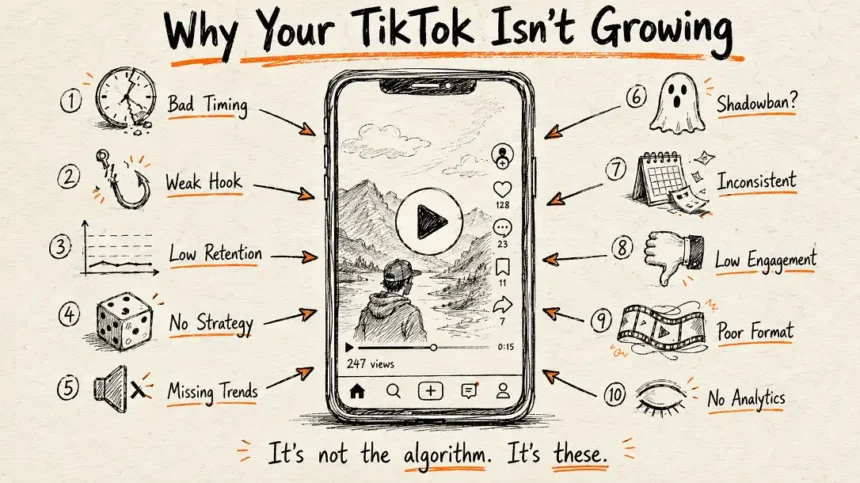
Every video is first tested by the algorithm with a small group of 200 to 500 viewers, and it only advances if that group participates sufficiently. The majority of view drops can be fixed; the typical reasons are poor hooks, irregular posting, or unclear content direction.
TikTok has completely changed how growth operates by showing new videos to your current followers before spreading them to non-followers. As comapred to past algorithm a lot is changed.
The issue is usually never “the algorithm hates me” if your videos are only receiving a few hundred views when accounts in your niche are receiving tens of thousands. The algorithm is opinionless. It has signals. Additionally, those signals indicate that your material isn’t worth for the views, attention long enough to warrant being shown to more individuals.
The real causes are broken down in this guide along with solutions for each.
For Those Who Want to Know What Tech Is Behind This Algorithm:
TikTok’s recommendation engine is called Monolith. ByteDance presented the paper at the ACM RecSys conference in 2022 and later open-sourced parts of it on GitHub.
- Built on top of TensorFlow 2 — so the framework is Python with C++ underneath for the heavy computation.
- Uses Bazel as the build system, only compiles on Linux.
- The architecture is a Worker-ParameterServer setup where one master machine splits training across worker and parameter server pairs.
- Uses Cuckoo HashMap for collision-less embedding tables — basically two hash maps per ID, if one slot is taken it tries the second, like a cuckoo bird kicking eggs out of a nest to make room.
- The key innovation that makes TikTok’s feed feel almost creepy in how well it reads you — real-time online training. Unlike batch-trained systems that update on a schedule, Monolith updates its parameters while it’s still serving recommendations. New parameters sync to the serving models roughly every minute. So when you start watching cricket videos after a match, the system is already adjusting your feed within minutes, not hours.
- It uses expirable embeddings and frequency filtering — videos need a minimum number of views and users need a minimum number of logins before they even enter the embedding table. This keeps the system lean and focused on active signals
Reason #1: Low Watch Time Stops Distribution
Watch time and completion rate carry roughly 40 to 50 percent of the algorithm’s total weight. That figure comes from multiple independent breakdowns of how TikTok’s recommendation engine actually operates, and it lines up with what creators who have tested this obsessively keep finding.
A video watched to completion by ten thousand people will outperform one seen by a hundred thousand who scrolled past after two seconds. Raw view counts do not matter. Whether people stayed does.
Why Low Retention Happens
Opening does not grab attention quickly enough so viewers scroll before the video gets going. The material wanders without a clear point and people check out midway through. Or there is simply no payoff, the viewer finishes and feels like they gained nothing from sitting through it.
How to Fix Watch Time
Worth understanding how the mechanics work at a slightly technical level here. TikTok operates a batch testing system. When you upload something it gets shown to an initial group of around two to five hundred users. If that batch watches most of it, replays it, shares it, or drops a comment, the algorithm pushes it to a larger group. That process repeats in expanding waves and each wave has its own engagement threshold to clear before it advances again.
A video that clears four or five waves can reach millions regardless of follower count. But everything starts with that first batch. If your first two hundred viewers scroll past in three seconds, there is no second wave. It is over.
The completion rate threshold for wider distribution has gone up to around 70 percent, up from roughly 50 percent a couple of years back. The bar is higher than it used to be.
One more thing worth mentioning — the old advice about keeping videos between seven and twenty seconds is pretty much outdated at this point. The algorithm has shifted to reward videos over a minute long, largely because of the Creator Rewards Programme and TikTok wanting longer session times on the app. Videos between sixty and ninety seconds are consistently pulling higher reach in testing. Short clips still work but the blanket “always go short” thinking does not hold anymore.
If your material can hold attention for sixty seconds, let it run. If it cannot, do not pad it. Just make a tighter fifteen second version and nail the retention on that instead.
Reason #2: Weak Hooks Kill Your Video Early
Almost everything is decided in the first three seconds. Not because it’s a marketing gimmick, but because that’s exactly how batch testing works. The system detects low retention and ceases to distribute if the first two hundred viewers swipe away.
To be honest, this idea goes much beyond TikTok. Consider it from a wider angle: Google tracks the speed at which users return to search results after seeing your page. Whether or not someone reads the body of an email marketing campaign depends on the subject line. The title and region above the fold on a landing page determine whether or not a user scrolls. You have roughly five seconds before a customer decides whether to browse or turn around, even in a physical store. Regardless of the media, the window in which you demonstrate that the others are worth their time is always very little.
Signs Your Hook Is Weak
The video starts with a logo animation or “hey guys welcome back to my channel” — that is dead time the viewer did not ask for and nobody sticks around for introductions from people they do not follow yet. No reason to keep watching is established in the first two seconds. Or the opening could belong to any video about any topic, there is nothing specific pulling the viewer in.
How to Fix Your Hook
Open with the most interesting part of your video, not the setup. If the best moment sits at the forty second mark, restructure so a glimpse of it appears in the first two seconds. Curiosity gaps work because they force someone to stay — “I tested this for 30 days and the result was not what I expected” keeps a viewer around because the payoff is ahead of them and they cannot get it without watching. Text overlays in the first frame also work because they give the viewer something to process immediately while the audio kicks in.
I personally think the most underrated hook format is the mid-action open. Do not introduce what you are about to do. Start doing it. A cooking video that opens with the chef already plating the dish and then cuts to “let me show you how I got here” outperforms one that starts with ingredients laid out on a counter pretty much every single time. The viewer’s brain fills in the gap and they stay to compute how it connects.
Reason #3: Low Engagement Signals Limit Reach
The algorithm uses engagement as a quality signal but not all engagement is equal anymore and this is where a lot of creators are still playing the wrong game entirely.
Shares and saves now outweigh likes by a significant margin. A like is a single tap — the lowest effort action a viewer can take. TikTok weights it far below shares, saves, comments, and replays. Optimising your material to get likes instead of shares is basically running on a treadmill wondering why you are not getting anywhere.
The priority order based on current algorithm behaviour:
- Shares to DMs and external platforms — strongest positive signal
- Saves — indicates the material has enough value to revisit
- Comments, especially replies and actual conversations — not just emoji drops
- Replays — the algorithm reads this as high-value material worth watching twice
- Likes — bottom of the list, barely moves anything
Why Engagement Stays Low
No call to action, which sounds basic but an alarming number of videos just end without asking the viewer to do anything. The material is not relatable enough for someone to feel compelled to tag a friend or share it. Or there is no emotional trigger, nothing that makes a person react beyond a passive scroll.
How to Increase Engagement
This is where creativity matters more than any formula. Ask people to relate to the video in a way that is genuinely easy for them.
Say you create content about food and restaurants. You could end with “share your review in the comments” but most people are not going to write a full review, that is too much effort for a casual viewer. Instead try something like “comment 1 if you did not like it, comment 3 if your experience was average, comment 5 if it was superb.” Now the barrier is almost zero — someone just types a single number and they have participated. Your comment count goes up, the algorithm registers activity, and the video gets pushed further.
There is a reason those Twitter giveaway posts work so well, you know the ones — “a comment with 0 likes gets $100.” Whether the giveaway is real or not, the engagement is real. Hundreds of people commenting because the barrier to entry is a single comment. That same principle applies on TikTok. Make participation effortless and more people will participate. It is not complicated, it is just that most creators overthink it or do not think about it at all.
Polarising questions also work extremely well. “Pineapple on pizza — yes or no?” generates more comments than “what is your favourite pizza topping?” because the first one forces a side. People love picking sides.
Reason #4: No Clear Content Strategy Confuses the Algorithm
TikTok’s recommendation engine works by building a profile of what your account is about based on what you post and who engages with it. If you are posting a cooking tutorial on Monday, a gym vlog on Wednesday, and a conspiracy theory breakdown on Friday, the system genuinely does not know who to show your material to.
Signs of a Weak Strategy
Your content jumps between completely unrelated topics from one video to the next. There is no recognisable theme or niche that a new viewer could identify within ten seconds of landing on your profile. Your follower growth is flat even though individual videos occasionally perform because the people who watched one video have no reason to follow for more of the same.
How to Fix Content Strategy
Select a lane. This does not imply that you can only write about one topic at a time, but your main content must have a consistent theme. Meal preparation, exercise videos, and supplement reviews can all be posted by a fitness creator because they all target the same demographic. A fitness creator who also shares relationship advice and gaming material divides their audience in three ways, and the algorithm is unable to optimize for all three at once.
One thing I’ve observed about accounts that expand steadily is that they stick to successful formats rather than continuously experimenting. They don’t switch to something entirely different the following week if a “day in my life” format received 50,000 views. They work on it repeatedly. Similar structure, slightly different angle. The pattern is identified by the algorithm, which also determines who should see it.
Reason #5: Inconsistent Posting Slows Growth
Irregular posting reduces your chance for getting views, because fewer uploads mean fewer chances for the algorithm to test your material with audiences. But the bigger issue is that TikTok seems to actively penalise burst-then-silence patterns.
Accounts that go quiet for two weeks and then suddenly upload five videos in one day often see worse performance than accounts posting one video every other day consistently. The system apparently interprets sudden bursts after inactivity as suspicious behaviour, similar to how it flags bot-like engagement patterns.
Why Posting Gaps Hurt
You lose momentum with the algorithm. Your existing followers stop seeing your material in their feed because TikTok deprioritises inactive accounts. And when you come back, you are essentially rebuilding trust with the system from a weaker position than where you left off.
How to Fix Posting Consistency
Posting one to three times a day was the previous recommendation. At this point, that is rather out of date. Nowadays, quality is more important than quantity, and one excellent video each week really outperforms seven mediocre ones in terms of growth.
For most creators, three to five posts a week is a reasonable timetable. Frequency is not as important as consistency; posting at the same time every Tuesday and Thursday teaches your audience and the algorithm what to expect from you. Posting at random whenever you feel like it doesn’t help you establish that routine.
Since the algorithm is essentially built as a content sorting machine, I believe that posting frequently—even twice a week—matters more than people realize. To determine what your account is about and who your audience is, it requires continuous data. Each upload is a single piece of data. It will no longer know what to do with you if you cease providing it data.
Reason #6: Poor Video Format Reduces Retention
An unstructured video loses viewers because people can feel when something has no direction, even if they cannot articulate it. They just scroll. The pacing feels off, there is too much information crammed in, or the video tries to cover three topics instead of one.
Common Format Mistakes
No clear flow from one point to the next. Too much information packed into a single video when it should have been split into a series. Weak or nonexistent storytelling — the video is just a person talking at the camera with no visual variation or narrative arc.
How to Fix Video Structure
The simplest framework that works is hook, value, call to action. Open with something that stops the scroll. Deliver one clear piece of value in the middle. Close with something that drives engagement, whether that is a question, a prompt to comment, or a reason to share.
Focus on one idea per video. If you find yourself trying to fit three tips into sixty seconds, that is three videos, not one. Splitting it up gives you more uploads, each one tighter and more focused, and the algorithm has more material to test with audiences.
Layered content also works extremely well for retention. Put a detail in the background that viewers only catch on a second watch. Add a quick text overlay that flashes for half a second. These small touches drive replays, and replays are one of the strongest signals you can send to the algorithm.
Reason #7: Ignoring Trends Limits Discoverability
Trending sounds and formats exist because TikTok actively pushes material that aligns with what the platform is currently promoting. Ignoring trends entirely means you are swimming against a current that could be carrying you.
Why Trends Matter
When TikTok is actively promoting a sound or format, material using it gets a distribution boost that original content without it does not receive. It is essentially free reach.
How to Use Trends Correctly
Make use of popular sounds, but modify them to fit your niche. Working with the trend is a finance maker who uses a popular audio to illustrate compound interest. It seems inappropriate for a finance maker to perform a haphazard dance only because the music is popular, and their audience won’t participate.
With trends, speed is also important. A trend has most likely already peaked by the time you notice it on your For You page. The innovators who identify trends early—typically within the first 48 hours—and act swiftly stand to gain the most from them. There are thousands of videos with the same sound if you wait a week to follow a trend.
However, I believe that trends should be used as a supplement rather than as the entire plan. Accounts that don’t have their own unique content identity and merely follow trends wind up with an audience that came for the trend rather than the author. That is a vacuous fan base that doesn’t consistently show interest in non-trendy topics.
Reason #8: Poor Timing Affects Initial Performance
When you post matters because the batch testing system relies on early engagement velocity. If you upload at three in the morning when your audience is asleep, your first 200 to 500 test viewers are going to be random users who may have no interest in your niche. Low engagement from that batch means the video stalls before it ever reaches the people who would actually care about it.
Why Timing Matters
The algorithm measures how quickly engagement comes in, not just how much. A video that gets fifty comments in the first hour signals more than one that gets fifty comments over three days. Early velocity tells the system the material is resonating right now.
How to Fix Posting Time
Check your TikTok analytics for when your followers are most active. That data is available in the app under your profile’s analytics section. Post during those windows and track performance across different time slots over a couple of weeks.
One thing worth noting — lunch and dinner hours often show high user counts but also high bounce rates. People are scrolling while eating or chatting and do not have the patience to watch longer material. Late evening, roughly between eight and eleven PM in your audience’s time zone, tends to produce better engagement because people are actually settled in and willing to watch.
Reason #9: Shadowban Myths vs Reality
Probably the most misunderstood topic in the entire TikTok creator community. Every time views drop, the first reaction is “I am shadowbanned.” Sometimes that is true. Often it is not.
What People Think Is a Shadowban
Views suddenly drop by 80 to 90 percent compared to the average. Material stops appearing on the For You page. Engagement from non-followers disappears completely.
What Is Actually Happening Most of the Time
TikTok compares your new material against your recent performance baseline. If your last five videos had strong watch time and your new one does not perform at that level, distribution drops. That is not a shadowban. That is the algorithm doing exactly what it is designed to do — sending more people to material that holds attention and fewer people to material that does not.
A genuine shadowban is a sustained 70 to 95 percent drop in views lasting days or weeks, specifically tied to For You page and hashtag suppression. TikTok does not officially acknowledge the term. They call it “content distribution prioritisation” which is a polite way of saying they have reduced your reach without telling you.
Real shadowban triggers are usually behavioural, not content-based:
- Posting bursts after periods of inactivity — uploading ten videos in one day after two weeks of silence
- Artificial engagement patterns — sudden spikes in likes or follows that look automated
- Content that skirts community guidelines without clearly violating them — TikTok suppresses rather than removes in these cases
- Mass liking, mass commenting, or any pattern that resembles bot activity
A survey found about 3.2 percent of social media users have experienced a TikTok shadowban. Small percentage, but if it happens to you it feels like the world ended. The fix is usually boring — pause activity for a few days, remove any flagged material, then resume posting at a normal pace. Most accounts recover within one to two weeks if the underlying issue is addressed.
Reason #10: Lack of Data Analysis Slows Improvement
You cannot fix what you do not measure, and honestly I am still surprised by how many creators post consistently without ever opening their analytics tab. It is right there in the app and it tells you almost everything you need to know about why certain videos worked and others did not.
Why Data Matters
Your analytics show you which videos had the highest completion rate, where viewers dropped off, which ones drove the most shares versus likes, and what time your audience is most active. Without checking any of that you are essentially guessing what works and hoping the next video lands better.
Use Analytics
Keep track of how long you’ve watched the last twenty videos. Find the ones with the highest completion rate and determine what they have in common. Was the format the problem? The subject? How long? The style of hook?
In particular, pay attention to the share-to-like ratio. According to the algorithm, a video with 200 likes and 80 shares outperformed one with 500 likes and 10 shares. Your content is entertaining but not interesting enough for someone to forward it to a friend if it is liked but not shared. The analytics make it abundantly evident that this differentiation is important.
Repeat what is effective. This may seem apparent, but it is truly perplexing how many creators have a video with 50,000 views before posting something entirely different the following day. Iterate on a format if it worked. Maintain the structure while gently altering the subject. Give the algorithm more of that signal to work with after it has learned what your audience reacts to.
Frequently Asked Questions
Zero views typically happen due to one of three things — your account or video is set to private without you realising, the video is still under review by TikTok’s moderation system, or the material was flagged and suppressed before it entered distribution. Check your privacy settings first, then check notifications for any review alerts.
Start with the hook. If your first three seconds are not stopping scrollers, nothing else matters. Then check your analytics for completion rate. If people are watching less than 50 percent of your videos on average, the material is either too long or not engaging enough to hold. Fix retention first, then work on engagement prompts and posting consistency.
The initial batch test happens within the first few hours. If the video clears that threshold it can start gaining momentum within 24 to 48 hours. But TikTok videos can also go viral days or even weeks after posting if someone shares an older video and it re-enters the distribution cycle. Do not delete a video just because it did not perform in the first day.
Hashtags play a minimal role in distribution at this point. TikTok’s machine learning analyses the actual material — visual elements, audio, text overlays, pacing — rather than relying on the hashtag string you type in. Use two or three relevant hashtags for categorisation but do not expect them to drive reach on their own. Watch time and engagement are what actually move the needle.
Yes. Accounts recover all the time. Improving material quality, posting consistently at a sustainable pace, and rebuilding engagement patterns is usually enough. Some creators have found that slightly shifting their niche or format after a slump gave the algorithm a fresh signal to work with, almost like resetting how the system categorises the account. It takes patience though — expect two to four weeks of consistent effort before the numbers start responding.