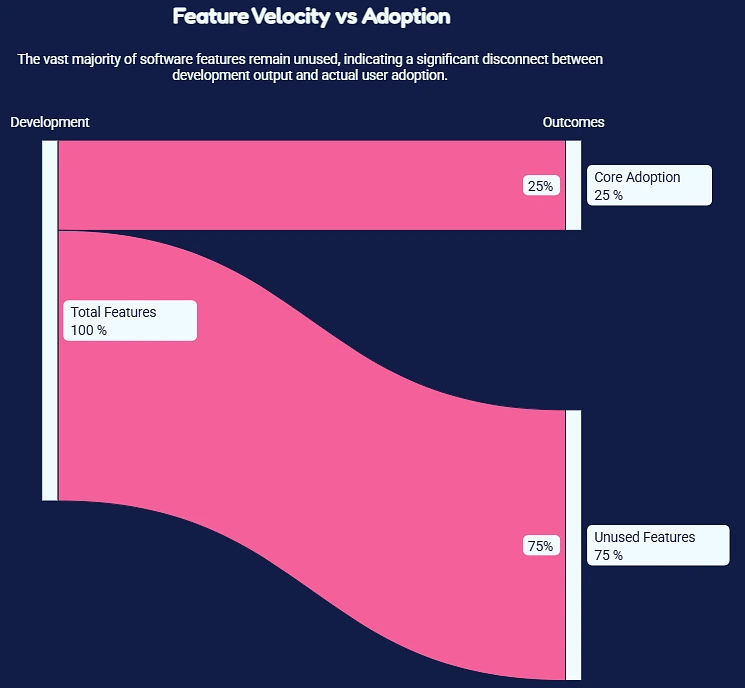
Pendo released their 2024 Product Benchmarks and the number that should bother anyone paying for SaaS right now is this: across the average software product, only 6.4% of features generate 80% of all user clicks. The other 93.6% got built, shipped, documented, priced into a tier, and then ignored.
Let that land for a second.
UserPilot ran their own benchmarks and the picture’s similar. Average core feature adoption rate for SaaS products sits at 24.5%. Meaning 75% of features aren’t adopted at all.
And according to SQ Magazine’s 2026 SaaS analysis, companies lose up to 50% of their SaaS budget on unused licenses and overlapping subscriptions. Not because the software’s bad. Because the software does forty things and the person paying for it needs three of them.
This is the cable TV problem showing up in a different industry. You wanted ESPN and the news, you got two hundred channels you scrolled past every night, and the bundle cost what the bundle cost because that’s how the pricing worked. Eventually people cancelled and bought exactly what they watched.
The same correction is starting to happen in SaaS. Just slower, because nobody gets fired for renewing a subscription the way they might get fired for cancelling one.
Netflix Gives You Thousands of Hours for Seven Dollars – A Signature on a PDF Costs More
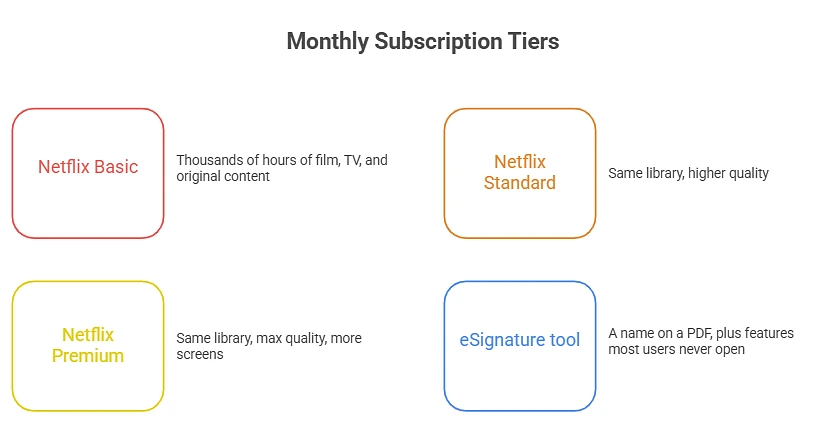
The comparison sounds unfair and it sort of is because Netflix and an eSignature tool are completely different products. But the price gap is real and it’s worth sitting with because it tells you something about how this market prices itself.
- Netflix Basic: $6.99 a month.
- Standard: $15.49 a month.
- Premium: $22.99 a month.
Thousands of films, series, documentaries, original content that cost billions to produce.
A mid-tier eSignature plan from most providers costs between $15 and $50 a month. For a tool where the core user action is putting a name on a PDF. The pricing isn’t based on what the signature costs to process, it’s based on the feature tier surrounding it, and most of those features are the 93.6% that Pendo says nobody clicks on anyway.
I’m not saying eSignature tools should cost seven dollars. There’s compliance infrastructure and legal validity and encryption and audit trails behind that signature that genuinely cost money to maintain. But the tiered pricing model where you pay more to unlock features you’ll never use, that model survives because switching costs are high and most businesses renew on autopilot without ever asking whether the plan they’re on matches what they actually do.
Satya Nadella Shipped 400 Features in a Year – Ask Around and See How Many People Can Name Ten
In April 2021 Nadella told analysts that Microsoft Teams had added more than 300 new features over the previous twelve months. At Ignite 2025, Microsoft announced 400+ new features for Microsoft 365 Copilot alone. Cisco did the same thing at one point, over 1,000 Webex innovations in twelve months. Genesys now markets “more than 400 new features each year, released weekly” as a headline on their website.
Feature velocity became a marketing metric. The number of things shipped is what gets announced on stage. Whether anyone uses them is a separate conversation that happens much more quietly.
NoJitter wrote about this a few days ago and the headline was blunt: “Vendors ship thousands of features. Users adopt dozens.”
And here’s the part that makes it worse. Nadella did a podcast in late 2024 where he essentially said SaaS as a model might be dying. Not immediately, but the direction is toward AI agents replacing the interfaces these features are built into. So the industry is shipping more features per year than at any point in history, most of those features go unused, and the underlying product model might not exist in its current form within five years.
My question from MR Nadella, Is Copilot Dying?
That’s a strange place to be charging customers more money per month for access to bigger feature tiers.
The eSignature Version of This Is Especially Easy to See
eSignature is one of those product categories where the core job is super narrow. Send a document. Collect a signature. Get a legally valid record of who signed what and when.
Everything else, the workflow automation, the team collaboration, the advanced field types, the API access, the AI-powered contract analysis, the custom branding, the payment collection, all of that is real functionality that someone somewhere genuinely needs.
But for most users, most of the time, it’s the two hundred channels they scroll past to get to the one they actually watch.
I went through my own eSignature account last week and tried to count the features I’ve actually clicked on.
Took about four seconds. Send, sign, download. Occasionally a template. That is the entire relationship.
What the simpler docusign alternatives charge for just the signature part:
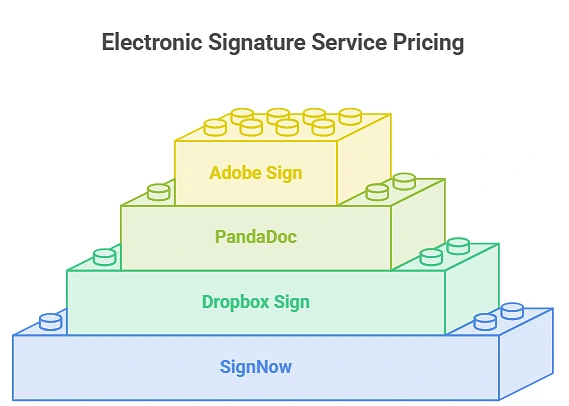
- SignNow – $8/user/month. Unlimited users. 100 sends per year.
- Dropbox Sign – $10/month. Unlimited sends.
- PandaDoc – $19/user/month. Unlimited sends plus document builder.
- Adobe Sign – $12.99/user/month for teams. 150 sends per year.
None of these companies are trying to build agreement intelligence platforms. They do signatures, they do them well, and the pricing reflects what the product does rather than what the product might do if you turned on every feature.
Check docusign pricing against what you’ve actually used in the last six months. Not what you might use someday. What you opened.
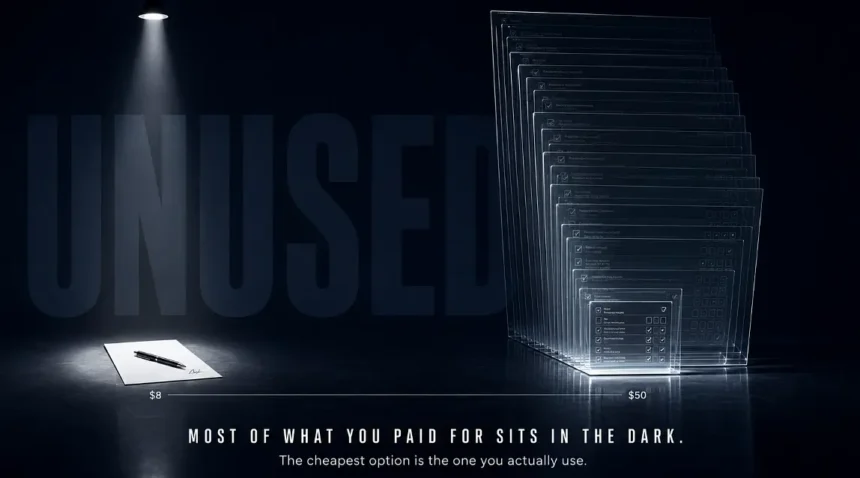
The gap between $8 and $25 for functionally the same core output, a signed PDF with an audit trail, that gap is the feature tax. You’re paying for the menu, not for what you ordered.
The Correction Might Already Be Starting
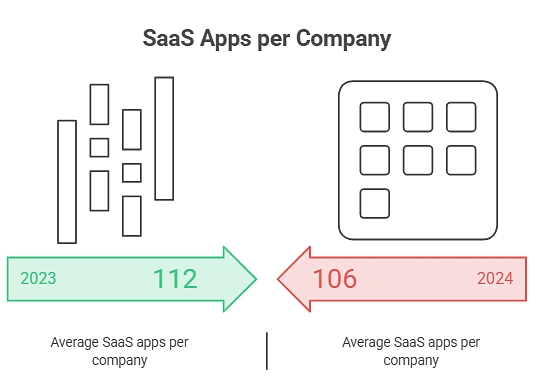
The average company used 106 SaaS apps in 2024 according to BetterCloud’s tracking, down from 112 the year before.
That’s the first real decline in SaaS app count since anyone started measuring. The consolidation rate dropped from 14% to 5% year-over-year, meaning fewer companies are actively cutting apps, but the trend line moved for the first time.
Average SaaS spend per employee is somewhere between $4,830 and $17,000 per year depending on which report you read and how they count it. At either end of that range, the question of whether every tool on the stack is earning its subscription is getting asked more often than it was two years ago.
In eSignature specifically, the users who need enterprise agreement management and AI contract analysis and workflow orchestration across departments, those users exist and they should probably be paying enterprise prices for enterprise tools. That’s fair.
But the freelancer paying $25 a month to send twelve contracts, the small business owner paying $50 because bulk send is locked behind the top tier, the team of five paying per-user pricing for features only one person ever touches, those users are subsidising a product roadmap that’s being built for someone else. And at some point enough of them will check what alternatives charge for the same signature and wonder why they didn’t look earlier.
Boring advice, yes. Annoyingly effective.