Put on a hit from 1986 and then a hit from last year, back to back, and you will feel the difference before you can name it. The old one takes its time. There is a drum fill, a bit of guitar, a bass line settling in, twenty-odd seconds of a band walking into the room before anybody sings. The new one does not do any of that. The voice is there almost before you have finished pressing play, the hook lands inside the first breath, and the whole thing is built to grab you by the collar in the time it takes to decide you do not hate it.
That is not a fashion. That is money, and a skip button, and a very specific number that the entire industry now writes songs around.
A Peer-Reviewed Study Put a Real Number on the Vanishing Intro
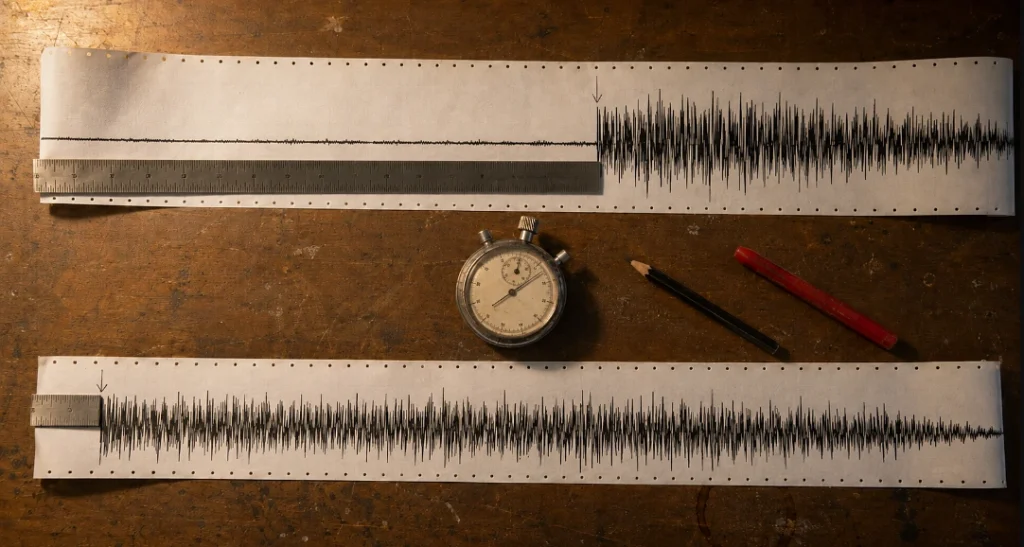
This is not a vibe somebody had on a podcast. Somebody actually measured it. Hubert Léveillé Gauvin, then a music theory doctoral student at Ohio State, went through the year-end Billboard top 10 from 1986 all the way to 2015 and timed how long each song waited before the first vocal came in. The result got published in Musicae Scientiae, the journal of the European Society for the Cognitive Sciences of Music, so this is a proper study, not a listicle.
In 1986 the average intro ran about twenty to twenty-five seconds before anyone sang a word. By 2015 that same average had collapsed to around five seconds. He also clocked the tempos speeding up and the song titles getting mentioned in the lyrics far sooner, artists basically shouting the name of the thing at you before you can wander off. Gauvin tied it directly to Spotify and the rest, and to the one button that did not exist in 1986, the skip. When a listener can bail on your song for free and instantly, and there are, as we will get to, tens of thousands of other songs one tap away, the twenty-second instrumental intro stops being artful and starts being a way to lose the listener before the singer even shows up.
Why It Is Specifically Thirty Seconds, and Then Even Fewer
Here is the mechanical part, and it is worth getting exactly right because it is the thing everything else hangs off.
On Spotify and most major platforms a play only counts as a paid stream once the listener has been there for thirty seconds. Cross that line and the stream pays out. Skip before it and the play is worth precisely nothing to the artist, and worse, the skip itself is a signal, it tells the recommendation engine that this track did not hold the person, so the algorithm gets more reluctant to push it to the next listener.
So thirty seconds is the gate the money sits behind. But the real fight happens much earlier than that, because nobody who is going to skip waits until second twenty-nine to do it. The decision to stay or go gets made in the first handful of seconds, which is why the intro did not just shrink to thirty seconds, it shrank to five, to seven, to almost nothing. You are not writing to survive to the thirty-second mark. You are writing so that the person never even reaches for the skip in the first place. The intro became a liability, so the intro mostly died.
Ryan Tedder Explained the Real Problem, and It Is Bigger Than Attention Spans
The easy story is that everyone’s attention span rotted and that is why songs got shorter. Ryan Tedder, who has written hits for Adele, Beyoncé, Ed Sheeran and Taylor Swift on top of his own band, put a harder number on the actual problem when he spoke to the BBC.
His line was blunt. <cite index=”40-1″>”The frustrating thing about music is that now there’s too much of it,”</cite> he said. <cite index=”40-1″>”There’s 62,000 songs a day uploaded to Spotify, so it’s a lot harder to get heard.”</cite>
Sixty-two thousand a day. That is the pressure. Your song is not competing with the other singles on the radio this week, the way it would have in 1986. It is dropped into a pile that grows by sixty-two thousand every single day, and on top of that, as Tedder pointed out, it is competing with every song ever recorded, because a teenager hearing David Bowie for the first time on a playlist is not thinking of it as an old song, it is brand new to them. <cite index=”40-1″>”So you’re competing with every song that has ever come out.”</cite> When that is the shelf your track is sitting on, a slow build is not a bold artistic choice, it is a few seconds of silence during which the listener’s thumb is already drifting toward the next thing.
The Skip Rate Is the Number That Actually Follows a Song for Life
None of this would matter so much if a bad opening only cost you the one listener. It costs you far more than that, because the platforms treat early skips as a verdict, and the verdict compounds.
Tracks that get skipped hard in the opening seconds do not just lose that play, they lose their place in the machine that finds new listeners, the Radio, the Autoplay, the Discover Weekly slots that are the difference between a song that quietly grows for months and one that dies in a week. A song that holds people, on the other hand, keeps earning those placements and keeps getting fed to strangers. So the opening seconds are not a first impression that fades, they are the thing that decides whether the algorithm ever bothers introducing your song to anyone new again. Get the front of the song wrong and you are not fighting an uphill battle, you are fighting one where the hill keeps getting steeper on its own.
What This Actually Means When You Sit Down to Make a Track
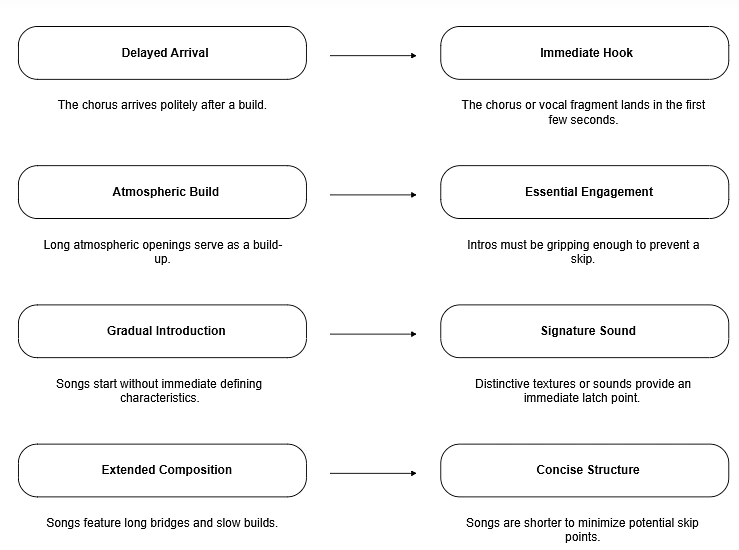
So the craft changed, genuinely, at the level of how a song gets built, and it changed in a few concrete ways worth naming.
- The hook moves to the front. The chorus, or a fragment of it, or at minimum a real human voice, lands in the first few seconds instead of arriving politely after a build. The best part is no longer saved for later, it is spent immediately, because later might never come.
- The intro earns its keep or it goes. A long atmospheric opening is fine only if the atmosphere itself is gripping enough to stop a skip. If it is just throat-clearing before the real song, it is dead weight now, and it gets cut.
- The first five seconds carry a signature. A distinctive vocal texture, an odd sound, something the ear can immediately latch onto, so the listener has a reason to stay before the song has even properly started.
- Songs got shorter overall. Fewer long bridges, fewer slow builds, because every stretch where a casual listener might drift is a stretch where the skip rate climbs.
Now, and this is the honest part, none of that guarantees anyone hears the song at all, because a great front-loaded hook still has to reach a real pair of ears before its skip rate can even start working in its favour. That is the piece the craft cannot solve on its own. A song built perfectly for the first seven seconds is still sitting in that pile of sixty-two thousand daily uploads, and it needs its first genuine listeners to react, to finish it, to not skip, before the algorithm has any signal to act on. This is where a careful early push has a real place, getting a track that already holds people in front of enough real listeners for that low skip rate to show up in the data and start earning the algorithmic placements on its own. A service like Jaynike sits at exactly that point, helping a song that has genuinely done the work up front find the early audience it needs to prove itself, rather than trying to manufacture a reaction a weak opening was never going to earn.
Because the order matters, and it is the whole thing. The craft comes first. You write the song so that a stranger cannot skip it in the first seven seconds. Then you get it in front of enough strangers for the platform to notice they did not skip. Do it the other way, push a song whose opening loses people, and all the reach in the world just buys you a higher, faster, more expensive pile of skips, which is the one signal you were trying to avoid in the first place.
The band walking slowly into the room for twenty seconds before the first line, that is gone, and it is not coming back, because the room now has sixty-two thousand new bands walking into it every day and a listener whose thumb is already moving. The only songs that get to finish are the ones that never gave that thumb a reason to move at all.