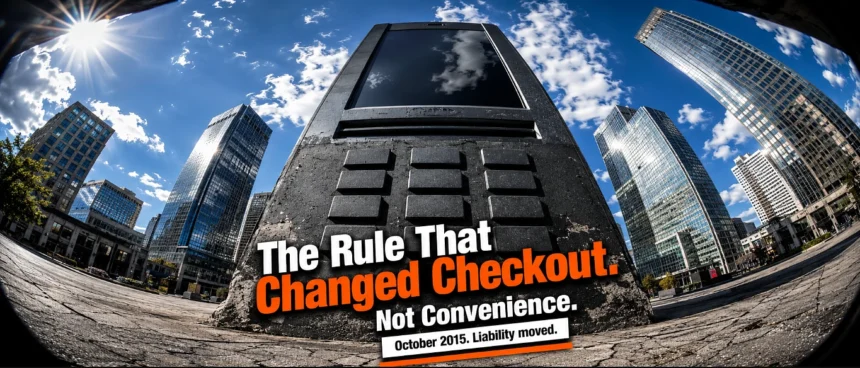
On 1 October 2015 the card networks moved the cost of counterfeit fraud onto whichever party in a transaction had not upgraded to chip technology. Before that date the issuing bank generally ate the loss. After it, a merchant still running a swipe-only terminal was the weakest link in the chain and paid for the privilege.
That single rule change did more to modernize the checkout counter than a decade of consumer demand for tapping phones. Terminals did not get smarter because shoppers asked for convenience. They got smarter because standing still became expensive.
The fraud numbers are better than advertised, and worse
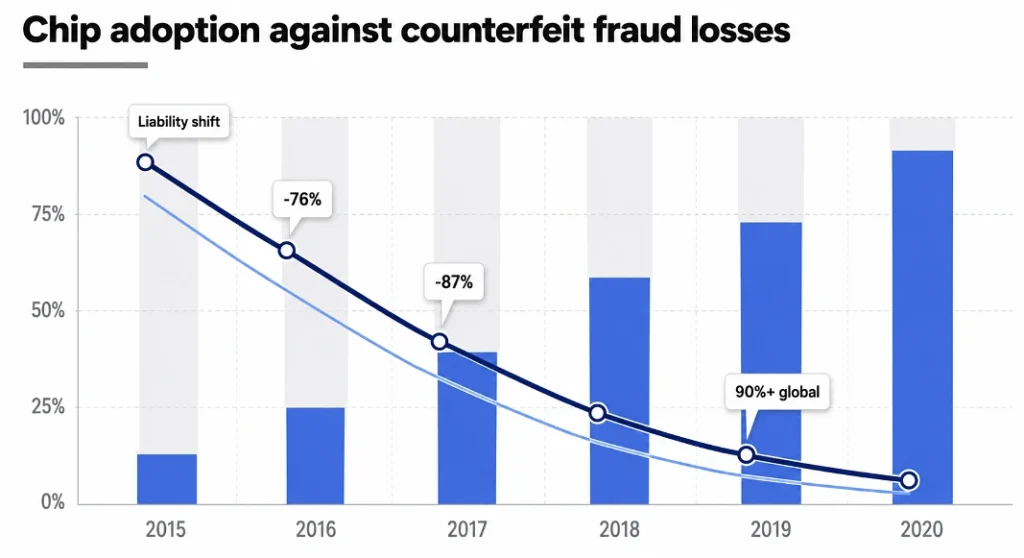
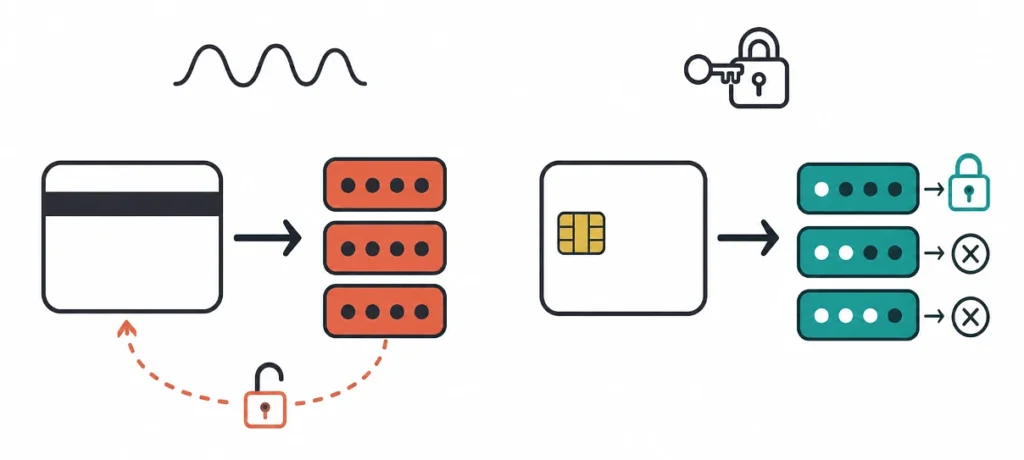
Visa’s own reporting is emphatic. Merchants who completed the chip upgrade saw counterfeit fraud losses fall 76 percent within four years of the liability shift, and by one measure, comparing March 2019 against September 2015, the decline at fully chip-enabled merchants reached 87 percent. EMVCo now puts chip technology at over 90 percent of card-present transactions globally. The mechanism is simple enough to explain at a counter: a magnetic stripe sends the same string of digits every time it is swiped, so anyone who captures that string once can reproduce it forever, while a chip generates a fresh cryptographic code for every transaction that is useless the moment it has been used.
So far, so triumphant. Then you read the Federal Reserve Bank of Kansas City, which went looking at what happened to fraud rates rather than fraud losses, and found something the industry marketing does not mention.
For non-prepaid debit transactions processed through dual-message networks, the counterfeit fraud rate did not decline at all. The lost-or-stolen fraud rate went up. The overall card-present fraud rate went up. And the distribution of who pays for it shifted in a direction that ought to interest anyone buying a terminal: card-present fraud losses fell for issuers and rose for merchants and cardholders.
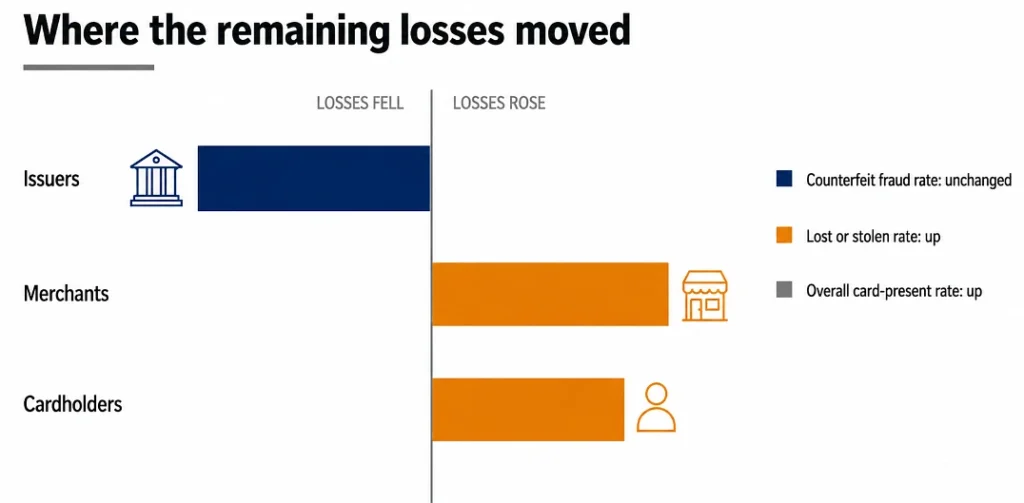
Both things are true at once, which is awkward but worth sitting with. Chip technology genuinely broke card cloning as a business model. It also relocated a chunk of the remaining risk onto the people standing behind the counter, which is exactly what the liability shift was designed to do. A merchant reading a vendor page about how EMV “reduced fraud by 76 percent” is being told a real number that describes somebody else’s improvement as much as their own.
This matters when choosing equipment because the security features on a spec sheet are not decoration. They are the difference between a dispute you win and a dispute you fund.
Everything the machine has to do now
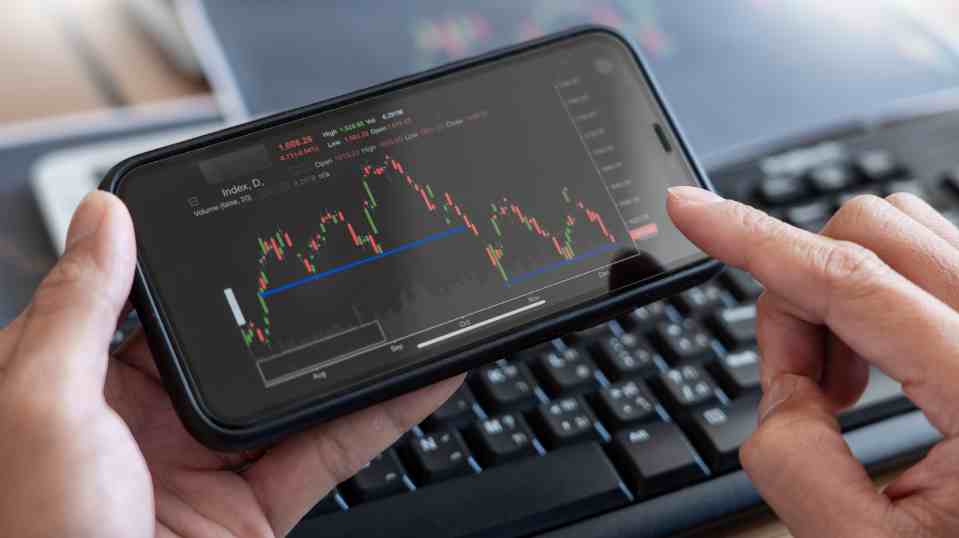
A terminal bought today is a small computer with a card slot attached, and the list of things it has to recognize keeps growing. Contactless payments through Apple Pay, Google Pay and Samsung Pay ride on NFC and complete in about a second. QR codes, dominant across much of Asia and creeping westward, work in both directions, either scanned from the customer’s banking app or displayed on the terminal screen. Mobile readers that clip onto a phone or tablet have turned market stalls, food trucks and home visits into card-accepting businesses without a phone line in sight.
Speed is the underrated part. Visa’s Quick Chip specification lets a customer insert and remove a chip card in two seconds or less without waiting for the transaction to finish authorizing, and contactless is quicker still. In a coffee shop at eight in the morning that difference compounds across a queue in a way that nothing on the marketing page quite conveys.
What the terminal does behind that speed is layered. Point-to-point encryption scrambles card data at the moment of entry, so a compromised device yields nothing readable. Tokenization swaps the actual card number for a substitute that means nothing outside its own transaction, which is why a phone tap never hands the merchant anything worth stealing. PCI DSS compliance sits over all of it as a requirement rather than a feature, and physical tamper detection watches for anyone trying to open the case.
Buying one without overbuying
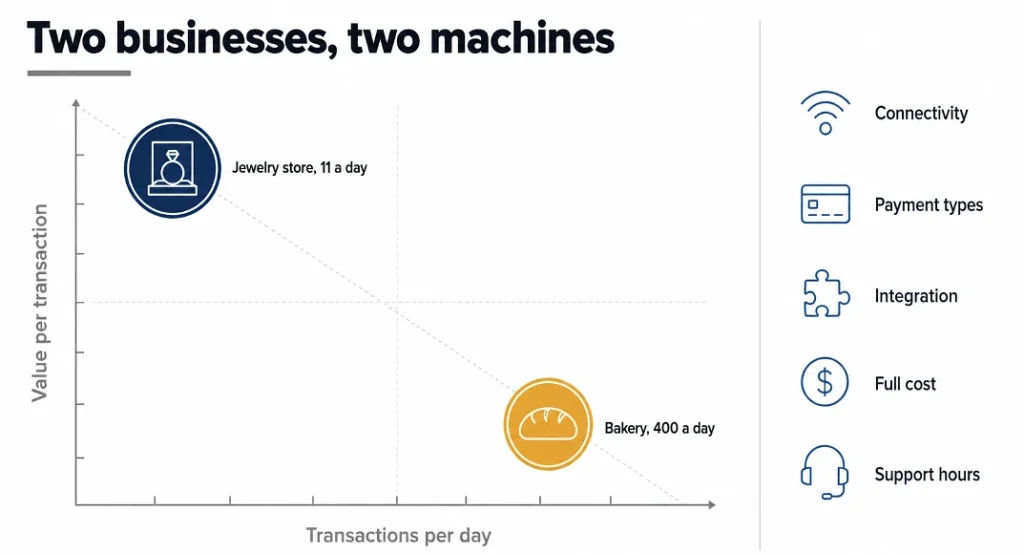
A jewelry store doing eleven transactions a day at high values and a bakery doing four hundred at low ones need genuinely different machines, and most buying guides flatten that distinction into a feature checklist.
The questions that actually separate models:
- Connectivity. Ethernet is the most reliable, WiFi the most flexible, and cellular backup is the one that keeps you trading when the building’s internet drops. Businesses discover which of the three they needed on the day it fails.
- Payment types. Chip, contactless and mobile wallets are table stakes. Whether you need QR or buy-now-pay-later integration depends on who walks through your door, not on what the brochure lists.
- Integration. The terminal has to talk to the point-of-sale system, the accounting software and the inventory tool you already run. Retrofitting that later costs more than specifying it now.
- The full cost. Hardware price is the smallest number in the equation. Processing rates, monthly service charges, and whether software updates and support are included will dwarf it inside a year.
- Support hours. A terminal that dies at seven on a Friday evening is only as good as the phone number attached to it.
Suppliers such as Discount Credit Card Supply stock across the range, and resellers tend to compare them against wholesalers like All-Star Terminals and POS Portal mainly on warranty terms and shipping speed rather than on the hardware itself, since the hardware is largely the same three or four manufacturers wearing different labels.
The near future, with the hype removed
Do you know: mobile payment transaction values are projected to exceed $12 trillion globally by 2027. For businesses, this isn’t just about accepting new payment methods—it’s about maintaining relevance in a market where checkout friction directly impacts conversion rates
Biometric cards are real and EMVCo is actively developing specifications for them. Cryptocurrency acceptance at the terminal remains a solution looking for a queue. Invisible checkout of the Amazon Go variety works impressively and costs more than most retailers will ever recover.
The prediction worth making is duller. Terminals will keep absorbing functions that used to live elsewhere, the point-of-sale software, the inventory count, the fraud scoring, until the box on the counter is the business system and the card reading is incidental to it. Which is roughly what happened to the telephone.
Merchants still running swipe-only equipment are not merely behind on convenience. They are the party the liability shift was written about, and that has been true for a decade now.