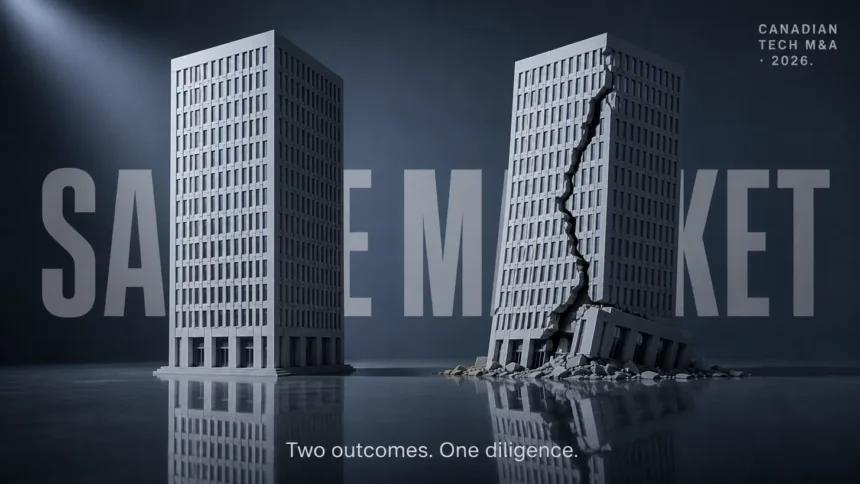
Canadian tech spent 2025 getting bought, sold and merged at a pace it had not seen in years, and the easiest way to understand what actually happened is to look at two Toronto-area companies that went into the same market and came out at completely opposite ends of it.
Cohere is the generative AI firm that ended up on the winning side, and through 2025 it was still the one doing the buying and the hiring rather than the one being shopped around.
- Closed a US$500 million Series D on August 7, 2025, about $690 million CAD, all-equity and all-primary, pushing its valuation to US$6.8 billion, up from US$5 billion a year earlier.
- Hired Joëlle Pineau, who ran Meta’s FAIR lab for years before leaving in May, as its first chief AI officer, and put her in a new Montréal office.
- Signed enterprise agreements with RBC, Bell, Dell, Thales, SAP, LG, Oracle and Fujitsu.
- Crossed US$100 million in annualized revenue and told investors it is aiming at US$200 million by year-end.
The round was co-led by Radical Ventures and Inovia Capital, with Nvidia, AMD Ventures, Salesforce Ventures and Canada’s public sector pension board all putting money in. Inovia’s Patrick Pichette took a board seat, and the line he used to describe why is the whole thesis of this article in one sentence, the company is “selling to enterprise” and “making money on every contract,” which he set against the “big-bet companies that are burning gazillions of dollars.”
The online car seller Clutch spent part of this same stretch living the other outcome and has only recently clambered back up from it.
- Cut staff and retreated from Western Canada.
- Marked down its own value by 97 out of every 100 dollars it once carried.
- Recovery took around two years.
Same country, same industry, same time frame. One company compounds, the other near-fails. The distance between those two data points is basically the whole story of what Canadian mergers and acquisitions turned into last year, and where it is going for the rest of 2026.
The Market Got Steadier, Not Wilder
There were 642 deals in the three-month span from July to September 2025 in Canada, for a total of $138.8 billion, and that deal count is the number to start with because it tells you this is not a repeat of the 2021 mania. The activity through the back half of the year and into 2026 has been fairly steady rather than spiky. No dramatic swings, just consistent activity settling into a rhythm.
Information technology has been either the most or second most active sector to date in 2026, along with materials and industrials. So the money is moving in tech, and it keeps moving, but a buyer in this market is nothing like a buyer in 2021. It is not chasing anything that breathes. It wants recurring revenue, a defensible position, real cash flow, and some capability it cannot quickly build for itself, and it is prepared to let everything that does not fit that description sit and wait.
Cohere and Clutch both walked into that market, and it sorted them for a reason.
Why Everyone Is Buying AI Instead of Building It
At the heart of most of these deals, pulling in two directions at once, is the AI. A company that does own real AI capability, its own models, its own specialized people, a dataset nobody else can put together, is exactly the kind of thing that everybody else suddenly wants to own. And a traditional company that slept through the shift is now buying its way in, because building an AI team from scratch would take years that the market won’t give you, while buying one that works takes months.
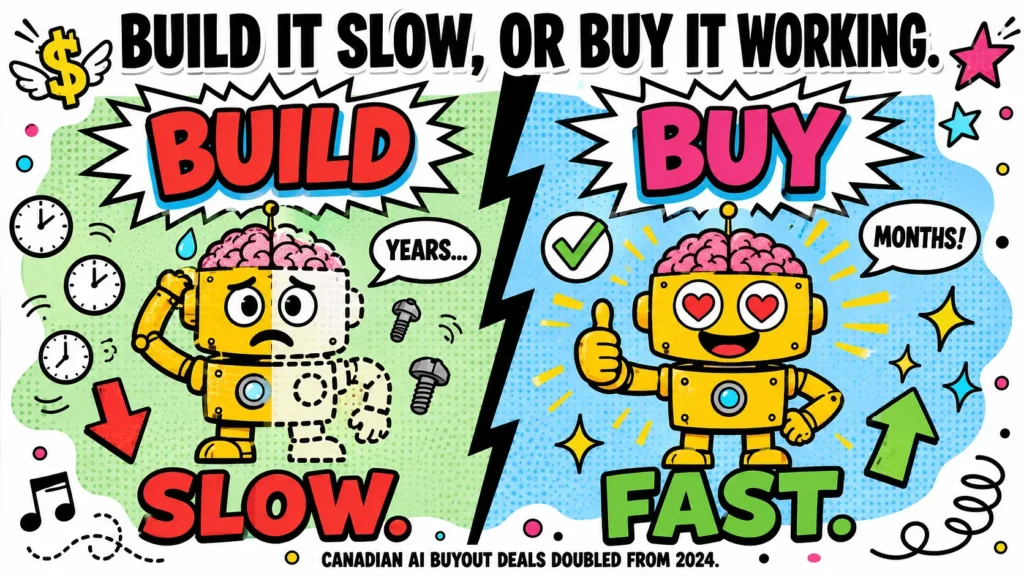
Osler reported unprecedented Canadian AI buyout volume in 2025, with the number of buyout and add-on deals doubling from 2024, and indicated a preference for vertical software companies using AI to raise margins as a popular buyout target in Canada.
Cohere shows why that’s the case. The classic Canadian story is a plucky startup doing something smart and then being absorbed by an American behemoth. Except Cohere raised half a billion dollars in funding, remains independent, and has signed contracts with Canada’s biggest bank and its biggest telecom, and that makes it the asset everyone circles rather than the acquisition somebody quietly folds in. Pichette, the Inovia partner who joined the board, called the mix of models, applications and the tools to run them a “strategic asset” for selling to big firms with heavy security and compliance needs, and that is the part a buyer cannot get anywhere else. In Clutch’s case they were selling something a buyer could get in a dozen other places, and when capital gets fussy about where it goes, that is exactly the spot that leaves a company exposed.
The Deal Is Won or Lost in the Diligence, Not the Price
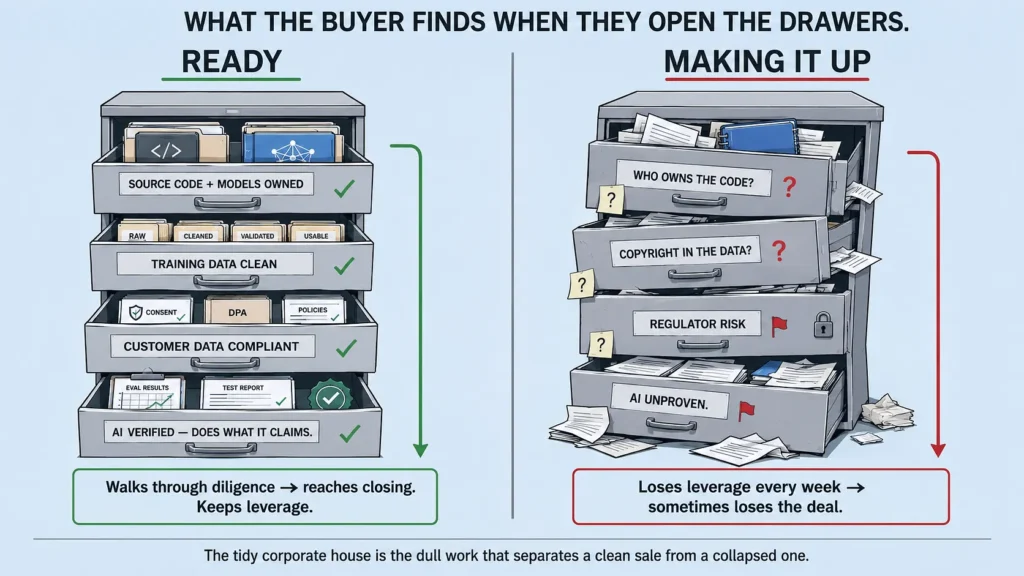
What makes the difference between whether a business is on the Cohere side or the Clutch side of the line is not the number that’s on the front of the offer, but what a buyer finds when they start opening drawers.
When a tech company is bought in 2026, it goes through diligence that is far heavier than the quick once-over buyers were used to a few years prior. The buyer is no longer only checking whether a legal problem exists, it is working out how the business can actually be folded into, scaled, financed and operated profitably after the deal closes, and for an AI or software company that means a set of questions a lot of founders never rehearsed.
- Who is the true owner of the source code and the models, the company itself or some former contractor who wrote a big chunk of it and left.
- Whether the data it learned from is clean, or whether there is copyright trouble baked into what the thing learned from.
- Whether the way customer data is handled survives a slow and close reading by regulators.
- Whether that impressive AI in the pitch deck is actually the company’s own, and whether it does what the pitch deck says it does.
A company that has those answers sorted walks through diligence and gets to closing. A company that is making it up as it goes loses leverage with every week the process drags, and sometimes loses the deal outright when a buyer hits a crack it does not want to inherit. Getting the corporate house tidy before going to market, the minute books, the material contracts, the intellectual property assignments all in order, is the dull, unglamorous work that quietly separates a clean sale from a collapsed one. This is also where a founder tends to get some early support. The ones that close without a scramble had a mergers and acquisitions lawyer in the room well before a buyer’s counsel started pulling on threads, rather than after.
The Price Tag Is Rarely the Whole Payment Now
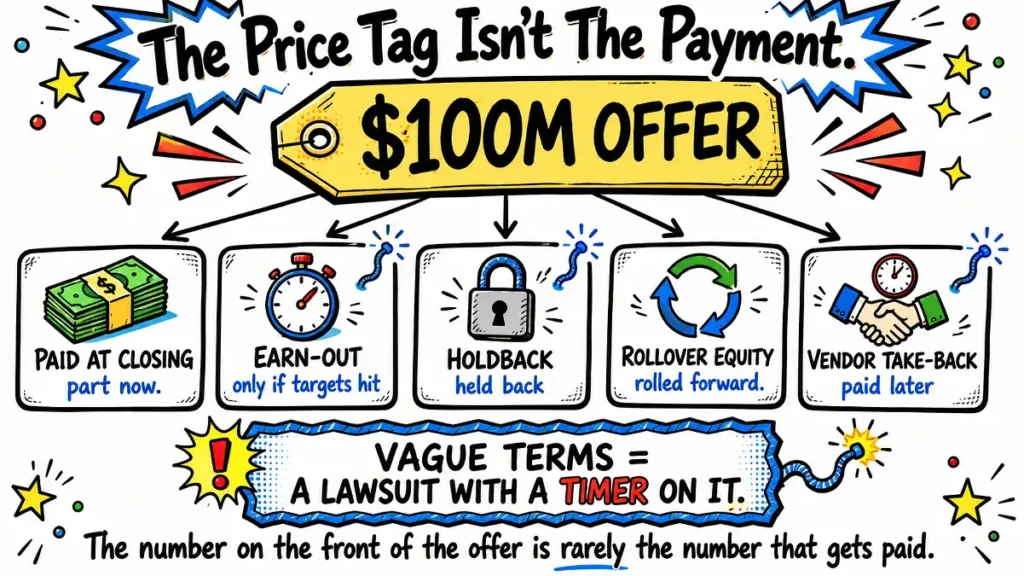
There is a quieter reason deals in this market stall or die, and it lives in how the money is put together. Buyers and sellers keep showing up with different numbers in their heads. The founder is pricing on last year’s growth and next year’s forecast, and the buyer is pricing on the risk that the growth does not hold, that a big customer walks, that the economy turns. To bridge that gap without either side leaving the table, the deal is built out of pieces, an earn-out here, a holdback there, some rollover equity, a vendor take-back, part of the price paid only if the business actually hits agreed targets after closing.
Those are tools that allow deals to get done, but they also load the gun for the fight that comes after. An earn-out that does not specify exactly which performance metric will be used, which company’s accounting rules apply, who is running the business in the earn-out period, and what happens if the company gets re-sold before the earn-out is paid, is a lawsuit with a timer on it. With that kind of vagueness, happily-signed deals can still turn into years of litigation.
What the Rest of 2026 Actually Rewards
The Canadian tech deals getting done, and getting done well, tend to share a profile, reliable revenue, intellectual property the buyer can confirm actually belongs to the seller, real depth in the management team rather than one irreplaceable founder, organized records, clean regulatory standing, and customer relationships that survive a change of owner. That is the Cohere end of things, the company that has leverage because it has its act together before anyone asks.
The companies that have a hard time are the ones that show up with a good story and a messy back office, hoping the story carries them through a process now specifically built to find whatever the story is covering up. That was closer to the hole Clutch had to dig out of, and digging out costs far more than never falling in.
The back half of 2026 is going to stay busy and stay picky at the same time, which only sounds like a contradiction. Buyers will move fast for the company that is genuinely ready and walk without much hesitation from the one that is not. So a Canadian tech company taking a serious look at a sale, merger or planned investor in the next 12 months is really making a decision now, long before any buyer opens the books, which of those two companies it wants to look like when someone finally does.