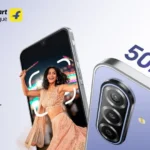
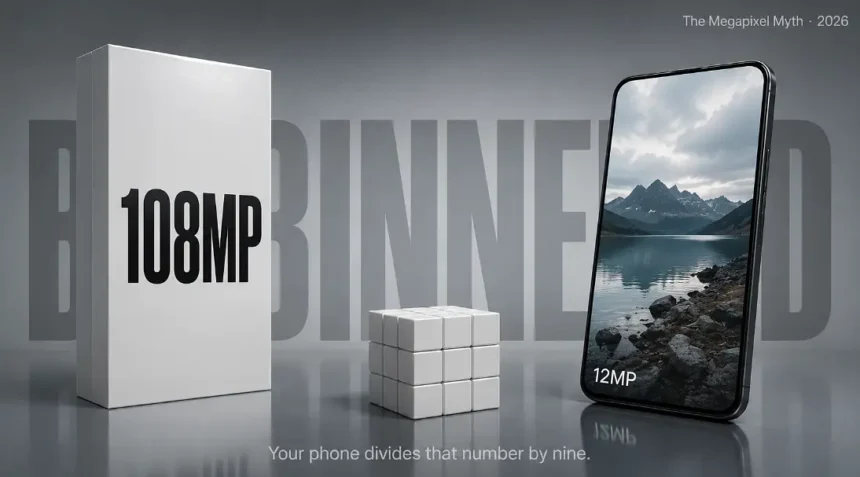
Your 108MP phone is taking 12MP photos right now. Not sometimes. Not in a special mode. By default, every single time you press the shutter.
That one fact breaks the entire megapixel sales pitch apart, and yet it’s sitting right there in the technical specs that nobody reads past the headline number on the box.
What a Megapixel Actually Measures
Short version — one megapixel equals one million tiny dots in your photo. A 48MP sensor records 48 million dots. A 108MP sensor records 108 million.
But what do those extra dots give you?
Resolution. That’s it. More megapixels means you can print a bigger photo or crop further into it before things go blurry. For anything you’re actually doing with your phone photos — sending on WhatsApp, posting stories, scrolling through your gallery — the difference between 12MP and 108MP is invisible. WhatsApp compresses the image anyway. Instagram downsizes it. Your screen can’t even display a 108MP photo at full resolution.
So why is every budget phone box screaming 108MP like it’s the only number that matters?
Because it works. It gets you to pick up that box instead of the one next to it.
Your 108MP Camera Is Lying to You By Default
Here’s where it gets uncomfortable for anyone who bought a phone based on that number.
Most high-megapixel phones use something called pixel binning. The camera takes those 108 million tiny pixels and groups them together — nine at a time, in Samsung’s case — to create fewer but larger “super pixels” that can actually capture enough light to produce a decent photo.
The math is dead simple.
108 million pixels ÷ 9 = 12MP output.
That’s your photo. That’s what you’re getting by default on a Galaxy S22 Ultra, and Samsung knows most people will never dig into the camera settings to find out. Their 200MP ISOCELL HP2 sensor? Same trick. Sixteen pixels merged into one. Output: 12.5MP.
But wait — can’t you just switch to full 108MP mode and get the real thing?
You can. And here’s what happens when you do:
- The file sizes balloon — we’re talking 30-40MB per photo
- Processing slows to a crawl
- Unless you’re standing in direct sunlight with perfectly steady hands, the images come out worse than the binned version
Why worse? Because those individual pixels on a 108MP sensor are tiny. The Galaxy S22 Ultra’s 108MP sensor has pixels measuring 0.8µm each. The iPhone 13’s 12MP sensor? 1.9µm per pixel. More than double the size.
Bigger pixel = more light per pixel = cleaner photo.
That budget phone with 108MP printed on the back has pixels so small they’re basically starving for light the moment you step indoors or the sun dips. And the phone knows it — which is why it bins them down to 12MP automatically and hopes you never notice.
Four Companies That Got Caught Faking Camera Results
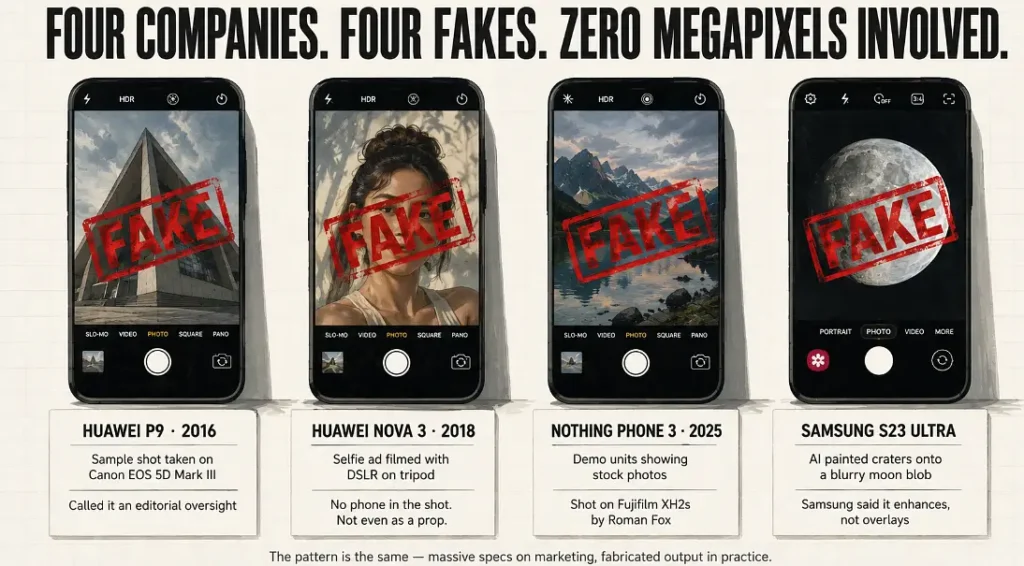
This part isn’t about spec sheet tricks. This is documented, named, timestamped fakery from companies that sell phones on camera quality.
Huawei — four times.
The P9 in 2016 — Huawei posted a “sample photo” taken with the phone. Somebody pulled the EXIF data. Canon EOS 5D Mark III. A camera body and lens worth well over $4,000 combined. Huawei called it an editorial oversight.
The Nova 3 in 2018 — an ad showed a couple snapping selfies on the phone. The actress from the ad, Sarah Elshamy, posted a behind-the-scenes photo on Instagram. In it, the actor is holding up an empty hand while a photographer behind a DSLR on a tripod captures the “selfie.” There was no phone in the shot. Not even as a prop. Huawei apologised again. Same language. Same script.
The P30 and P40 Pro both had their own separate promotional incidents after that. Four times for one brand.
Nothing Phone 3 — 2025.
Demo units in stores were showing camera samples that turned out to be stock photos. One was a car headlight image shot on a Fujifilm XH2s by a photographer named Roman Fox. Nothing’s co-founder said the units were supposed to be updated before launch but some slipped through. The company had paid to license those images though — which raises the obvious question of why you’d pay for stock photos you planned to delete.
Samsung Galaxy S23 Ultra — the moon incident.
A Reddit user took a blurry, detail-free photo of the moon from the internet, stripped it of all surface texture, and displayed it on a monitor. Then pointed the S23 Ultra at the screen and let the AI Scene Optimizer do its thing.
The result? A crisp, detailed lunar surface. Craters. Texture. Detail that did not exist in the source image at all. The phone’s AI had effectively painted a moon onto a blob.
Samsung’s official line was that the feature “enhances” but doesn’t “overlay.” The internet wasn’t buying it.
The pattern across all of these is the same — massive camera specs on the marketing material, and then the actual camera output either can’t match it or gets fabricated entirely. It’s not unique to phones either. Any product that leads with flashy numbers over actual performance runs the same risk. You see it in gaming too — load up something like inout games chicken road 2 based on the preview screen and the graphics look sharp, but the real test is always what happens once you’re actually playing. Specs and previews set expectations. The product has to deliver on them. And too many phone brands just… don’t.
Sony Makes the Sensors That Actually Matter
So if megapixels aren’t the answer, what is?
Sensor quality. And one company dominates that space so thoroughly it’s almost absurd.
Sony’s actual revenue share between 45% and 56%, while Japan overall held roughly a 48% regional market share. Their IMX and LYTIA series sensors are inside the iPhones, the Galaxy S flagships, the Xiaomi Ultras, the Vivo X-series — basically every phone that reviewers praise for camera quality.
Does Apple make its own sensors?
No. Tim Cook has publicly said Apple has worked with Sony for over a decade on iPhone camera sensors. Apple’s advantage is the image signal processor and the computational photography software — not the sensor itself. But they chose Sony for a reason.
Does Samsung use its own sensors in its flagships?
Here’s the kicker — Samsung manufactures ISOCELL sensors. They sell them to other companies. And then reportedly put Sony sensors inside the Galaxy S25 series for their own flagship line. That tells you everything you need to know about where the quality bar actually sits.
Sony’s top-end mobile sensors — the IMX989 and LYT-900 — are 1-inch type sensors running at 50MP. Not 108. Not 200. Fifty. And they produce results that make triple-digit megapixel phones look embarrassing in side-by-side comparisons.
What to Actually Check Before Buying
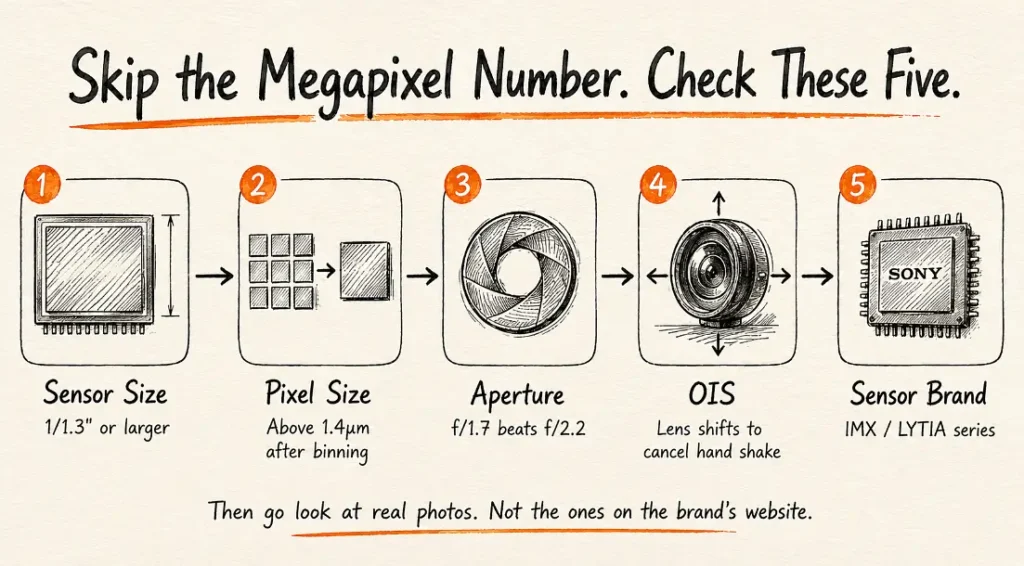
Skip the megapixel number entirely. Here’s what separates a good phone camera from a marketing exercise:
- Sensor size — physically larger sensor means more light captured. Look for 1/1.3″ or larger on any phone you’re spending serious money on
- Pixel size after binning — measured in µm. Anything above 1.4µm is solid. Below 1.0µm and you’re going to see it in every indoor and evening photo
- Aperture — the f/number on the lens. Lower means wider opening, more light. f/1.7 beats f/2.2 by a visible margin
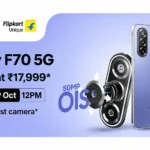
- OIS — optical image stabilisation. The lens physically shifts to cancel out hand movement. If a phone doesn’t have this, its low-light and video performance will suffer no matter what else the spec sheet says
- Who made the sensor — Sony IMX or LYTIA series sensors have a track record. Samsung ISOCELL sensors are solid in the mid-range. OmniVision shows up in budget phones. Knowing the sensor tells you more than knowing the megapixel count ever will
And then — go look at real photos. Not the ones on the brand’s website. Not studio-lit product shots. Actual side-by-side comparison photos from reviewers who test in kitchens, on streets, at night, in rain. That’s your camera review.
The megapixel number on the box exists to sell the phone. It does not exist to take better pictures. The sooner that clicks, the sooner you stop paying extra for a number that the phone’s own software immediately divides by nine.