


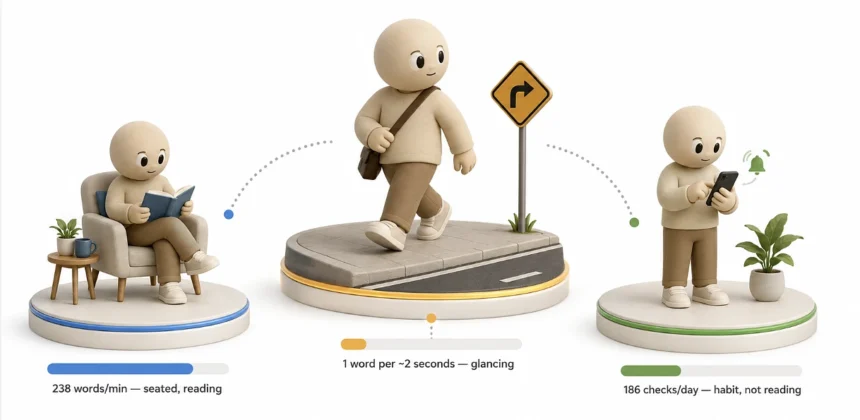
There is an assumption sitting underneath nearly every screen you walk past in a day, and hardly anybody who puts words on those screens has gone and checked whether it actually holds. The assumption is that reading is reading. That a person moves through words at roughly the same rate whether they are sat down with a book, or glancing at a menu board while the queue shuffles forward, or looking up at a departures screen with a bag in each hand and a gate number they are trying to hold in their head.
It does not hold, and it does not hold by a margin that is big enough to change how you would write for any of those screens.
The Average Adult Reads 238 Words a Minute, Not 300
For years the number people quoted was 300 words per minute. It turned up in design guides, in training decks, in those little estimated reading time labels that sit at the top of articles. And it was wrong, or at least it was built on the wrong people.
In 2019 Marc Brysbaert published a meta-analysis in the Journal of Memory and Language that pulled together 190 separate studies covering 18,573 participants, which is about as solid a base as this field has, and the number that came out was 238 words per minute for adult silent reading of English non-fiction. Fiction runs a little quicker at 260 because the words in it are shorter. Reading out loud drops to 183, because at that point your mouth is the thing slowing you down rather than your eyes.
Two hundred and thirty eight words a minute is just under four words a second. Worth holding onto, because what happens to that figure when the conditions change is the whole point of this.
Where the Old 300 Figure Came From
Mostly from small studies done on university students, who read faster than the general adult population and were never a fair sample of anybody. Brysbaert goes through the reasons for the overestimate in the paper itself. The short version is that if you keep measuring undergraduates you will keep getting undergraduate numbers.
A Driver Needs Half a Second to Two Seconds for One Word on a Sign
Traffic people have been working on this for decades and the reason is obvious enough once you think about it, because a driver who is reading a sign is a driver who is not looking at the road, and every word you put on that sign is costing somebody road they never saw.
The USSC Foundation studied roadside signs and they call the task glance legibility rather than reading, which tells you something on its own before you get to any of the numbers. What they found is that a driver needs somewhere between half a second and two full seconds to take in one single word, or one unit of information, on a sign. And then their own report says, without making very much of it, that this works out two to eight times slower than the speed the same person reads at when they are sat still with a page.
Sit with the size of that for a second. At a desk you are doing four words a second. At a sign you might be doing one word every two seconds. Same person, same eyes, same language, and the gap between those two states is eight times.
What That Does to the Arithmetic Everyone Uses
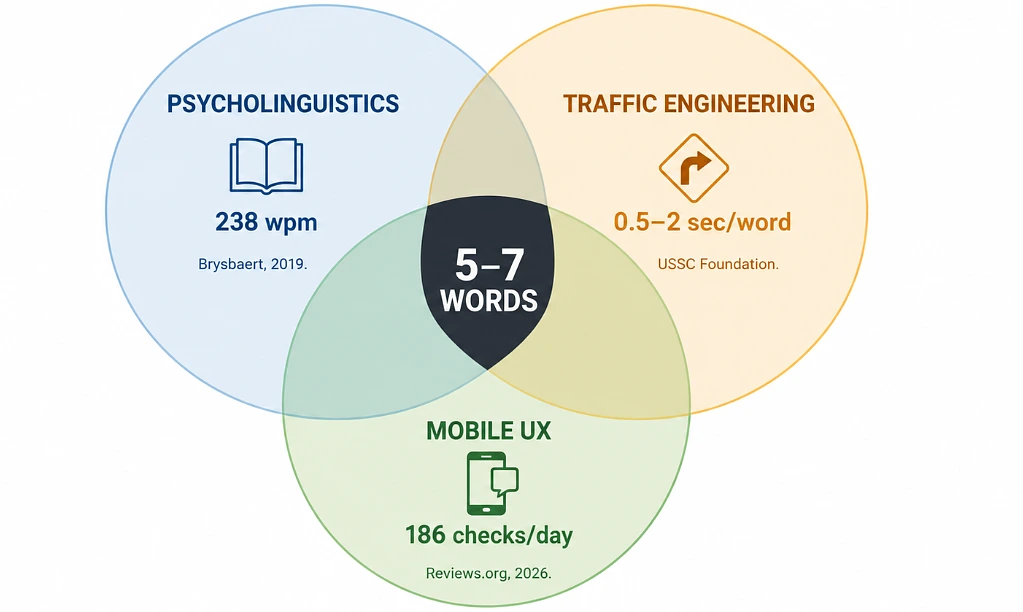
The instinct is to reason it out like this. A viewer looks for about three seconds, reading runs at about four words a second, so you have got yourself roughly twelve words to work with.
What the sign research says is that three seconds buys you somewhere between one and six words, and which end of that you land on depends on the conditions and on how old the person looking at it happens to be.
That is not a small correction. That is the difference between a headline and a sentence, and most of the copy that goes onto screens is written closer to the twelve than to the six.
Four Words Can Still Take Eight Seconds to Land
There is a figure in the signage guidance that pushes this further and it surprised me when I first read it. For a message that is only three or four words long, the full read then comprehend then react cycle comes in closer to eight seconds than two, and longer again for older viewers.
Not eight seconds of staring at it. Eight seconds before the thing has actually arrived and produced whatever response it was asking for. Four words is quick to see. Working out what those four words want from you is the slow part, and that part keeps running long after the eyes have gone.
Why the Same Eyes Slow Down So Badly
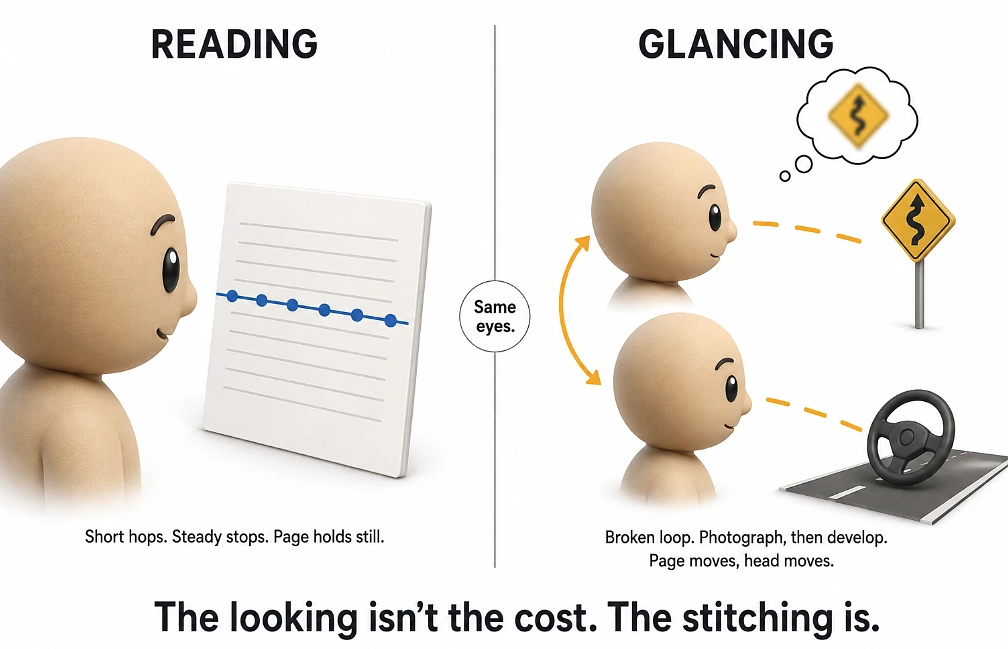
It is not that glancing makes anybody stupid and it is not really an attention problem either, at least not in the way people usually mean when they say that.
When you read a page you are in a stable loop. Your eyes make short hops along the line, roughly seven to nine characters at a time, and in between those hops they stop for a fraction of a second and that stop is where the words actually get taken in. The page is not moving. Your head is not moving. The loop runs continuously for as long as you want it to run.
A glance breaks that loop into pieces. The eye takes something closer to a photograph and then the brain develops it afterwards, quite often once you have already looked away. That is why the sign researchers describe reading in short spurts, with the driver going from the sign back to the road and then to the sign again. Every spurt is a separate exposure that then has to be stitched to the one before it, and the stitching is where the cost sits, not the looking.
Which is also why one extra word does not cost you a quarter more time. It can cost you a whole extra spurt, and an extra spurt at motorway speed is another sixty metres of road that nobody in the car looked at.
Phones Are Where Most People Learned to Read This Way
Reviews.org put out their 2026 survey and it has Americans checking their phones around 186 times a day, which comes out at roughly once every five waking minutes. That number drifted down a bit from the year before but the shape of it did not change.
Most of those checks are not sessions. They are glances at a lock screen, at a notification, at a name or a number or the time. Somebody doing that a hundred and eighty odd times a day is not practising reading, they are practising the glance, over and over, until it turns into the default way they come at every other screen in front of them.
So a person walking past a display in a lobby or a shop is not sitting down to read it. They are applying a habit they built somewhere else on a device in their pocket, and that habit has a very small ceiling on it.
Past Five Pieces of Information, Attention Falls Off a Cliff
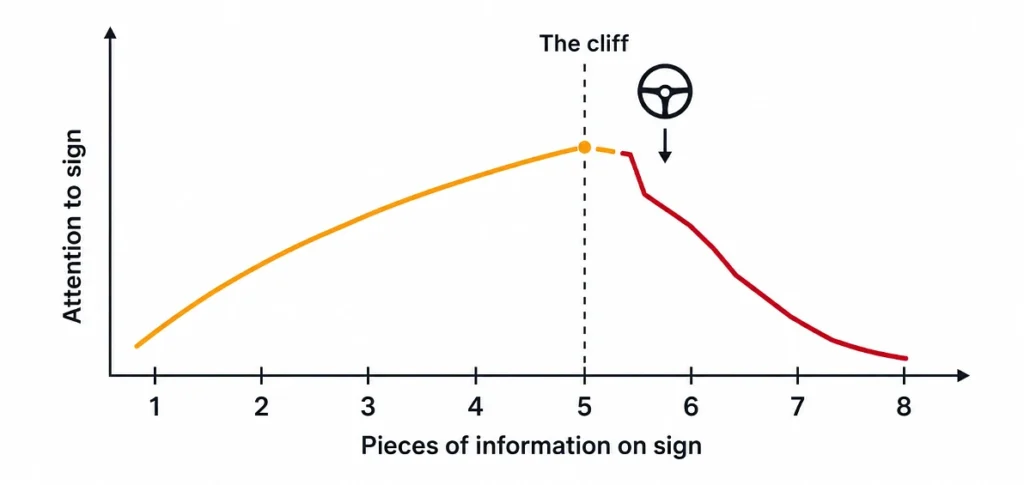
The eye tracking work on drivers turned up something worth knowing for anybody laying out a screen. As the amount of information on a sign went up, fixations on that sign got longer and more frequent, which is what you would expect and is not interesting on its own.
But once signs carried more than about five separate pieces of information, there was a sharp drop in visual attention to the road. Not a gradual trade where the driver gives a bit more to the sign and a bit less to the road. It went off a cliff.
That is the clearest evidence I have come across that there is a real ceiling on how much a person will process in a glance, and that going past it does not earn you partial credit. The viewer does not read seven of your nine items and skip two. Something in the process gives out.
What to Do With Anything Meant to Be Read Fast
None of this advice is new and every signage guide already tells people to keep it short. The difference is in knowing why and knowing by how much, because keep it short is exactly the sort of instruction that gets quietly negotiated away in a meeting when somebody wants one more line about the opening hours.
A message somebody is going to glance at wants to be built at around five to seven words, not twelve.
Split It Instead of Cramming It
If the message genuinely needs to be longer than that then it needs to arrive across separate exposures instead of being crammed into one. Road engineers sorted this out a long time ago and it is why you get an advance sign, then a primary sign, then a confirmation sign, rather than one enormous board carrying everything at once.
The other thing worth taking from the transport research is that the read is only part of what you are paying for. There is comprehension after the read and a reaction after that, and if the message is asking somebody to do something then the clock keeps running well after their eyes have moved off it.
None of this makes reading in a glance a lesser act. It is genuinely a remarkable thing that a person can pick up a phone, take in a name and a time and half a message, and put it back down inside two seconds. The mistake is in assuming that because it feels effortless it must also be fast, and then writing for a speed that nobody in that situation has ever actually hit.
















Very descriptive article, I liked that bit.
Will there be a part 2?