Apple is going to raise prices, and Tim Cook has now said so on the record. In a Wall Street Journal interview published Wednesday, the chief executive called the increases “unavoidable” and the memory chip situation “unsustainable,” comparing the shortage to a hundred-year flood and saying he’d never seen anything like it in over forty years.
He didn’t name a price. Apple rarely does so before a launch. But a TechInsights breakdown cited by the Journal shows why he sounded resigned, and it centers on the memory itself. The 12GB of DRAM in last year’s iPhone 17 Pro cost Apple about $39; on the iPhone 18 Pro it could run roughly $145. Storage moves the same way, with 256GB of flash climbing from around $13 to an estimated $51.
Stack it all up and the component bill for a base iPhone 18 Pro lands near $726, against about $582 for the 17 Pro – close to a 25% jump before marketing or shipping.
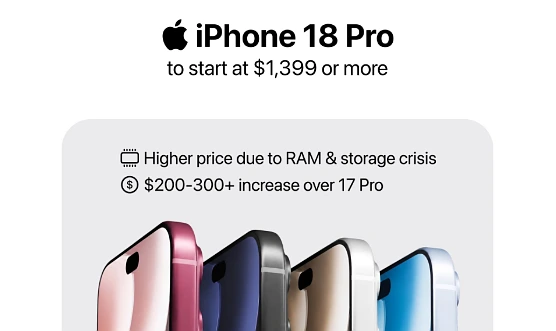
From there the pricing math is straightforward. Apple ran roughly a 47% margin on the base iPhone 17 Pro at $1,099. Hold that exact margin and the 18 Pro would need to sell for $1,371. More realistically, TechInsights pegs the increase near $270, pointing to a $1,299 starting price and a slightly thinner 44% margin. The Pro Max, which starts at $1,199 today, would climb from there. And none of that counts the rumored variable-aperture camera, which could cost Apple at least 50% more than the current setup and push the figure toward $1,399.
The cause isn’t really phones. It’s AI. Data-center operators are estimated to consume around 70% of global DRAM supply, and the three firms that make almost all of it – Samsung, SK Hynix, Micron – have shifted production toward the high-margin memory those servers need. The research firm IDC calls this a permanent reallocation rather than a passing shortage, which is a polite way of saying prices aren’t drifting back down. DRAM and NAND have both risen more than 300% since 2023. Cook ruled out the obvious fix, too: Apple isn’t going to build its own chip plants. “We know what we’re good at,” he said.
Worth a caveat before anyone treats $1,299 as settled. A higher build cost doesn’t force a higher sticker. Analyst Ming-Chi Kuo argued earlier this year that Apple will try to keep the entry price flat and eat the margin hit, mostly because a steady starting number is easier to sell. Another route is quieter still – raise the base storage tier and the price goes up on its own, dressed as an upgrade. Cook gave no timing, scale, or list of which products move first. The iPhone 18 lineup is expected in September, so that’s when guesswork turns into a real number.