There is something that just doesn’t fit in the digital out-of-home advertising market right now. More than 18 million active DOOH screens are running in transit stations, retail aisles, elevators, restaurants and city streets, and DOOH spending is expected to reach $39.12 billion by 2030, according to Grand View Research. Screens get larger, brighter, traded as programs, and are becoming 4K as a standard. The treatment being received is going the wrong way.
Data from audience measurement company Quividi, which uses computer vision technology to monitor tens of thousands of DOOH screens, showed the average viewing time in 2020 was 3.5 seconds, compared to 4.6 seconds in their 2014 reading. According to a peer-reviewed field study performed in a retail environment by Ravnik and Solina (Multimedia Tools and Applications), it’s even lower (1.2 seconds for male passersby, 0.4 seconds for female passersby). The next generation of brighter panels appears to steal a millisecond of human attention each time.
It’s not because screens are less visible. What it is is that the brain just stops working on them.
The number of animals that have been habituated drops less and less rapidly rather than steadily as a function of time, as it does in a straight line.
Habituation isn’t a marketing term. It is a quantified neurological phenomenon, first described in a review by Thompson and Spencer in 1966 in Psychology Bulletin and again by a 15 member working group in 2009 (Rankin et al., Neurobiology of Learning and Memory). The defining shape: response to repeated stimulus is a negatively accelerated curve, steep drop at first and a long flattening towards an asymptote where the stimulus has been memorized as background.
That mechanism isn’t picky. It can be used for startle responses in earthworms, with dripping taps, the face of a commuter that you see every day, and — for this discussion — with advertising on a screen that you see more than once.
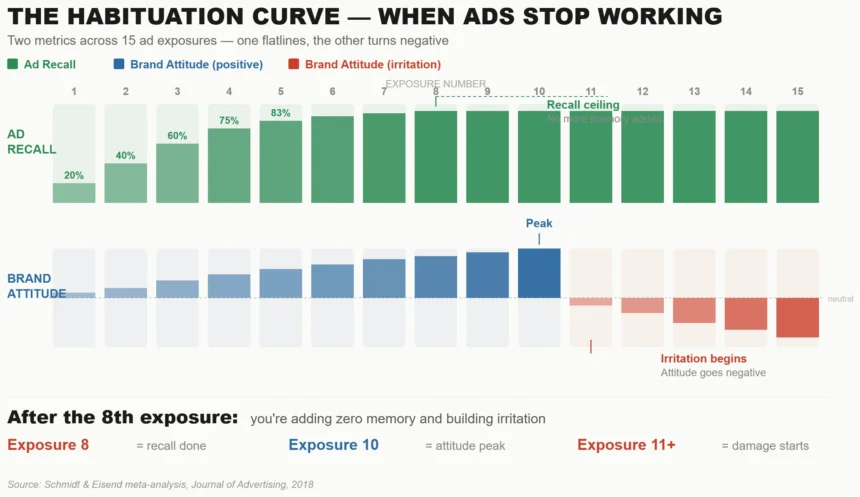
Decades of research on frequency have been compiled in a 2018 meta-analysis by Schmidt and Eisend in the Journal of Advertising and are found to show a specific shape: ad recall increases about linearly up to the 8th time of exposure, then levels off, while attitude towards the brand peaks around the 10th exposure before dropping into negative territory, the literature known as “wearout. After 8th play, no more memory is added. They add irritation.
This is the number in the headline. Eight is not an estimated number. The turning point of the data is.
One cup of coffee can equal all 8 exposures!
This is where the length of the loop — the one element of which no media buyer keeps track — is the issue.
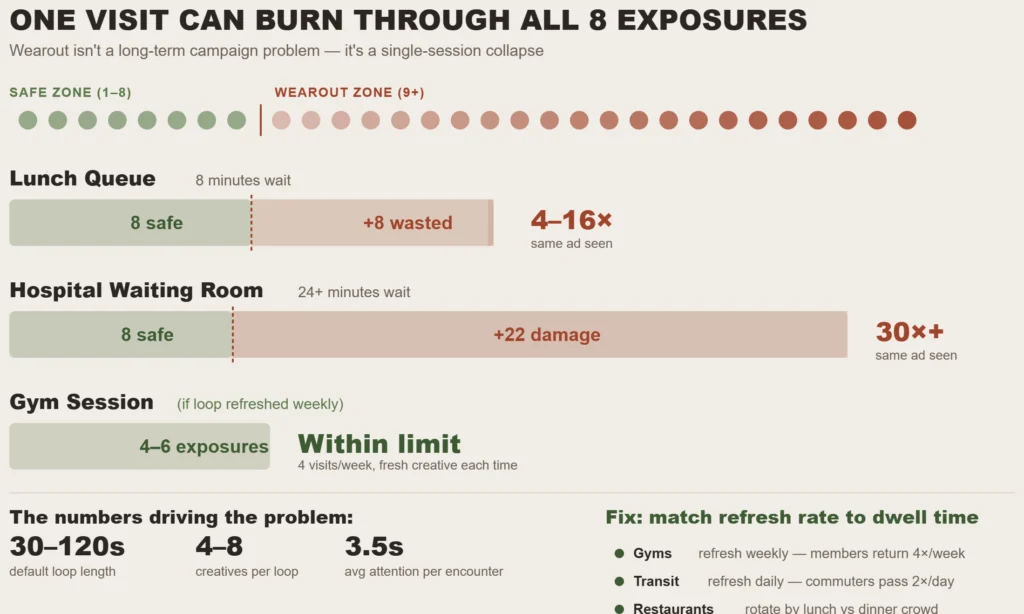
The default duration of a digital signage loop is 30 to 120 seconds, and the typical number of spots is 4 to 8. In a lunch line, if a customer waits 8 minutes, they’ll view the same ad 4 to 16 times before they get to the counter. The same place can be played 30 or more times in a hospital waiting room before it is called in, in which the average wait time is more than 24 minutes.
It’s not 8 exposures over the course of a 1/4 length campaign. This is 8 exposures in one visit! The wearout curve is not a long term issue, it is a collapse during the same session of wearout as in high dwell time environments.
The Nielsen Norman Group’s eye-tracking research adds a second layer. Across studies in 1997, 2007, and a 2018 update led by Kara Pernice, the group confirmed what they call banner blindness: viewers learn the geometry of where ads tend to appear, and eye fixations on those regions drop close to zero — not because the person consciously chooses to ignore the area, but because peripheral vision flags it as “ad-shaped” and the gaze never lands there in the first place. The 2018 study found this learned avoidance had extended to search-result advertising and was generalizing across contexts.
The same filtering happens in physical spaces. Once the brain tags a wall position, a screen bezel, or a loop sequence as “ad,” it stops being processed. The screen is still there. The light is still hitting the retina. The visual cortex has stopped passing the signal up the chain.
A Phone Serves One New Clip Every 21 Seconds — A Mounted Screen Loops Six Creatives Per Quarter
A mounted screen plays the same content on a 30-second loop. A phone serves something new every scroll.
| Channel | Content novelty | Daily attention (average) |
|---|---|---|
| Mounted DOOH screen | Same loop, 2–6 unique creatives, often for the full quarter | 3.5 seconds per encounter |
| Smartphone (global average) | Algorithmic feed, effectively infinite novelty | 4h 37m |
| Smartphone (US adult) | Algorithmic feed | 4h 2m |
| Smartphone (Gen Z) | Algorithmic feed | 9h+ |
Sources: Quividi iQ Index 2020; DataReportal 2024; eMarketer 2025; Statista 2025.
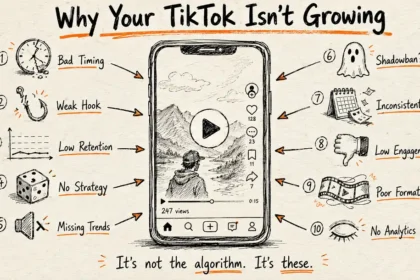
The asymmetry is structural, not stylistic. TikTok serves a new short-form video roughly every 21 seconds on average. Instagram Reels and YouTube Shorts run on similar pacing. In any minute spent on a phone, the user encounters fresh stimuli that an algorithm has selected based on their viewing history. Habituation doesn’t set in because the brain registers new input constantly.
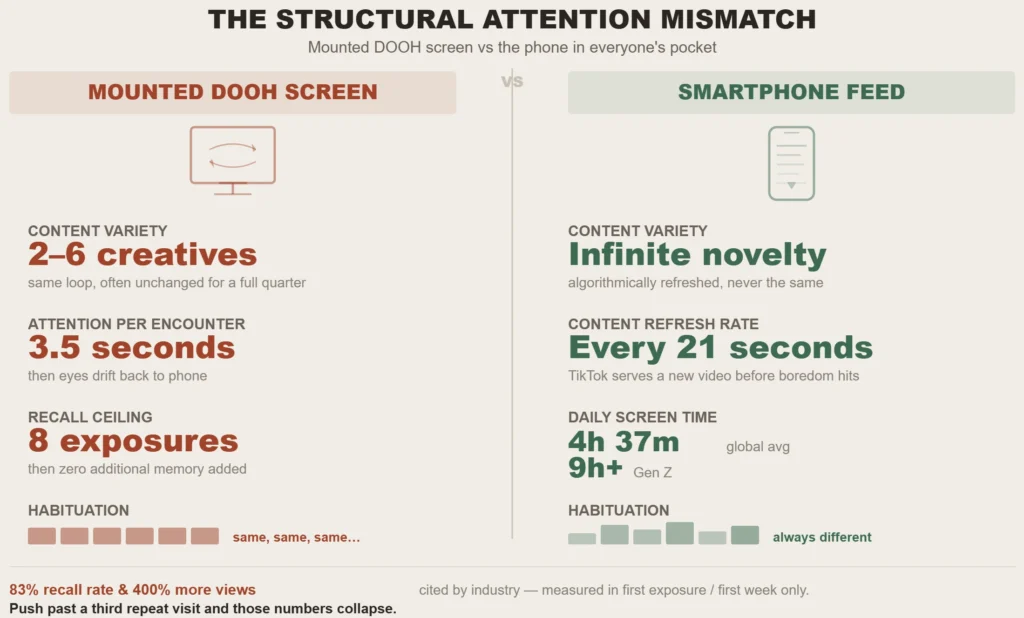
Even when a phone serves an ad, the next swipe replaces it within seconds. Compare that to a wall-mounted screen where the same six creatives loop until the next quarterly refresh.
This is also where a contradiction in DOOH industry research becomes easier to read. Industry-backed studies regularly cite an 83% recall rate for digital signage and 400% more views than static displays. Both figures come from first-exposure or first-week measurements. Push the window past a third repeat visit to the same venue and the numbers collapse. Kronrod and Huber’s 2018 study in the International Journal of Research in Marketing found that high-frequency advertising produced higher recall in the short term but generated measurable irritation that suppressed brand preference — irritation that only dissipated weeks after the campaign ended.
For screens placed in venues where the same audience returns regularly — gyms, transit corridors, corporate lobbies, regular lunch spots — the wearout cycle restarts every visit while the recall ceiling stays flat.
Where the Loop-Length Math Breaks Down
A few of the numbers, lined up next to each other:
- 3.5 seconds — average attention per encounter with a DOOH screen (Quividi, 2020)
- 8 exposures — point at which ad recall stops increasing meaningfully (Schmidt & Eisend, 2018)
- 10 exposures — point at which brand attitude peaks before turning negative
- 18 million — active DOOH screens deployed globally (2024)
- $20.74 billion — global DOOH ad spend in 2024 (Grand View Research)
- 4h 37m — global daily smartphone screen time
- 96 — average daily phone checks per US adult
Stack those against each other and the structural mismatch becomes hard to argue with. A medium that gets 3.5 seconds of attention per encounter and hits its recall ceiling at the 8th exposure is competing for attention against a medium that holds the same viewer for hours per day with algorithmically refreshed content that resets the novelty signal every few seconds.
So what’s the variable operators can actually touch?
Loop refresh rate relative to venue dwell time. Networks that rotate creative based on the venue’s actual repeat-visit pattern — gyms refreshing weekly because members return four times a week, transit stations refreshing daily because commuters pass twice, restaurants timing rotations to lunch versus dinner crowds — pull recall numbers closer to their first-exposure peaks. Networks running quarterly creative on screens that audiences see four times a week are buying the flat end of the habituation curve and reporting it as reach.
The DOOH industry’s growth math assumes screens add value with each impression. The habituation literature has been saying since 1966 that they stop adding value somewhere between the 8th and 10th exposure. Whether the curve gets respected at the planning stage, or absorbed as a write-off at the measurement stage, is increasingly what separates the networks pulling repeat advertisers from the ones cycling through them.